Quasi-Central Bank: Nvidia Has Become the Leading Financier in the AI Sector. Why Is This Dangerous?

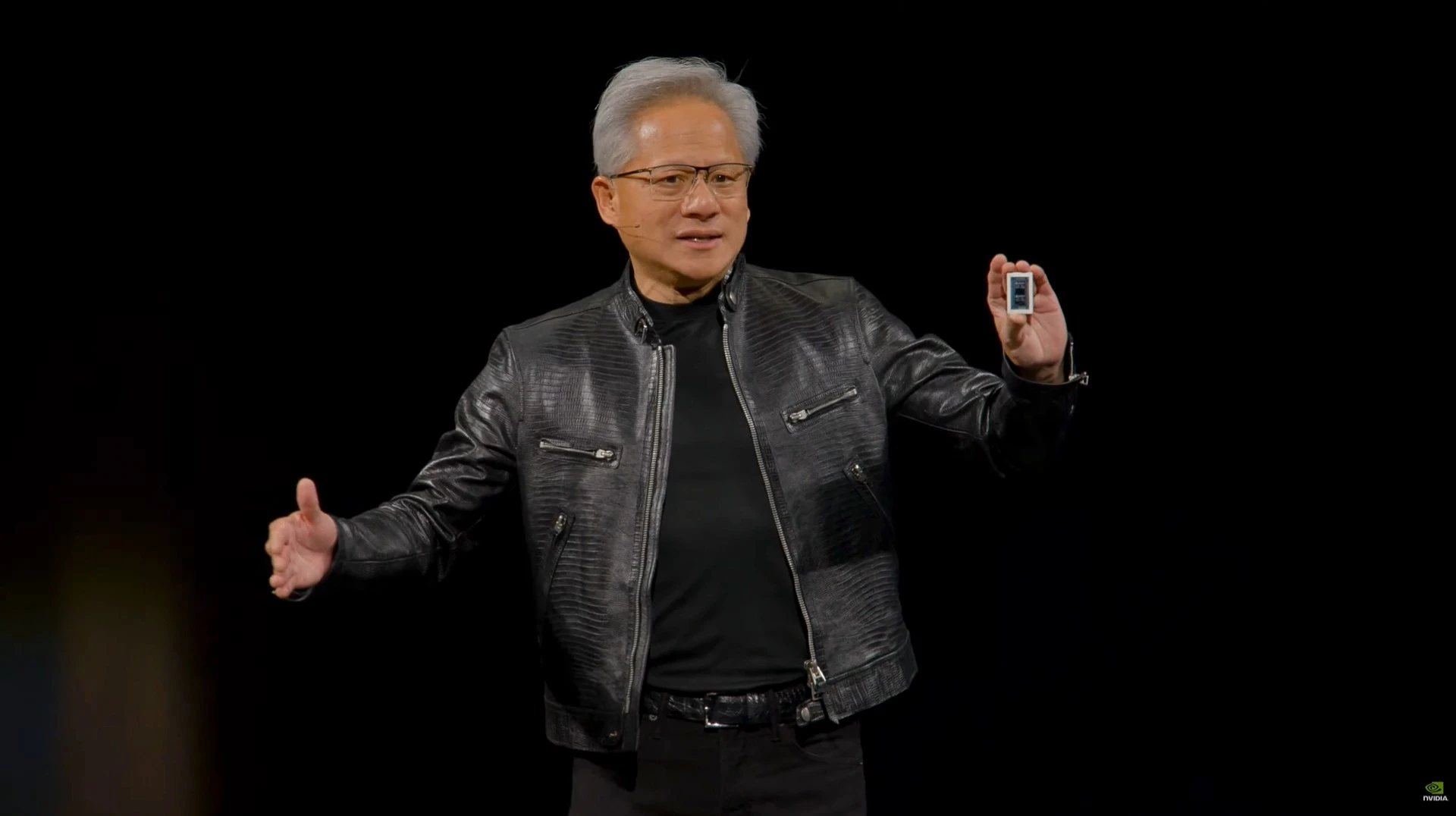
Nvidia CEO Jensen Huang is actively trying to convince Wall Street that Nvidia processors are a new investment-grade asset. Photo: Nvidia / X
Over the past two years, Nvidia has made a giant leap forward. It’s not just the developer of the most popular graphics processors, with an 80–90% market share. Nvidia acts as a lender of last resort for its customers and influences the cost of their borrowed capital. It is now being called the “central bank for AI.” How risky is this role for the company?
Nvidia Finance Executive
Total capital expenditures on AI from 2024 to 2029 will reach approximately $11.1 trillion, according to forecasts by the research firm SemiAnalysis. Already, companies—including tech giants—are financing this expansion through debt. The industry’s outstanding debt will reach $7 trillion by 2029. In the U.S., this will be the second-largest market for debt financing after mortgages, which are currently estimated at $13 trillion.
These funds will be available to market participants at varying prices. For hyperscalers with investment-grade credit ratings, they will be much cheaper than for large neo-clouds. For example, Alphabet, Google’s parent company, issued $2.75 billion in 50-year bonds with a 5.7% coupon at the end of 2025. A comparable $2.6 billion credit line in August 2026 cost the non-cloud company CoreWeave more than one and a half times as much.
Small and medium-sized cloud providers can often secure a large loan if they already have a take-or-pay contract with a major tenant covering several years in advance. Without such a contract, it is very difficult to secure a loan to purchase new chips, just as it is difficult to find customers without a guarantee of computing capacity.
But Nvidia has figured out how to cut this Gordian knot to its own advantage.
In the fall of 2025, it entered into a $6.3 billion agreement with CoreWeave (Nvidia is an 11% shareholder ). Under the agreement, Nvidia committed to purchasing the company’s unused cloud computing capacity through spring 2032 at a fixed price below market value. Nvidia provided CoreWeave with revenue and protected it from a drop in demand, but on one condition: if the cloud service generated more revenue on the market than the guaranteed price, the partners would split the “excess profit.”
Nvidia used a similar arrangement with the Australian companies Sharon AI and Firmus. Over the next six years, Sharon AI will install 40,000 Nvidia chips worth $4.9 billion. The purchase will be financed through loans backed by Nvidia. Firmus has also committed to purchasing 170,000 chips backed by Nvidia’s guarantees.
In this scenario, Nvidia doesn't need an additional cash flow, but rather support for demand for its products, according to analysts at SemiAnalysis. The more of these commitments Nvidia makes to second-tier players, the more those players will borrow from banks to purchase its new chips.
Nvidia has now begun offering its AI capabilities to gamers as a service, Morgan Stanley analysts wrote in August 2026.
Here’s an example. OpenAI has agreed with SB Energy, a subsidiary of SoftBank, to lease capacity for 20 years at the PORTS-Pike data center campus currently under construction in the U.S. state of Ohio. Nvidia has invested $1.5 billion in SB Energy and has also guaranteed the residual value of the first phase of the 4.25 GW campus—up to $105 billion—in the event of an OpenAI default. If OpenAI stops paying, Nvidia will cover the difference between the minimum asset value specified in the contract and the amount that SB Energy can obtain from another client.
SB Energy CEO Rich Hossfeld openly acknowledged during an appearance on CNBC's "Squawk Box" that Nvidia is needed for this project to help them secure funding.
A single lease agreement from OpenAI may not be enough for lenders, explains Yegor Tolmachev, a senior analyst at Freedom Broker. OpenAI does not have an investment-grade credit rating, so its status won’t make loans cheaper for SB Energy; however, Nvidia’s involvement will allow SB Energy to borrow at a lower interest rate.
Nvidia has essentially taken on the role of lender of last resort for AI startups, infrastructure projects, and neo-clouds, and has become a liquidity provider capable of mobilizing third-party capital. Furthermore, through its guarantees, it directly influences the cost of credit. This has led the media (example 1, example 2) to refer to the company as the “central bank for AI.”
That’s a striking comparison, says Yegor Tolmachev. But is it accurate? Nvidia cannot “print” either money or chips in the desired quantities; it bears the credit risk of its own customers and cannot act as a guarantor of financial stability. It would be more accurate to describe the company’s actions as “vendor financing”: the practice itself has been around for a long time, but it has reached this scale for the first time.
Its previous surge coincided with the dot-com bubble—Cisco and Lucent were big fans of this tool in the late 1990s, says Tolmachev. And it ended badly.
In addition, Nvidia has reached an agreement with six investment giants—Apollo Global Management, Blackstone, BlackRock, Brookfield Asset Management, Goldman Sachs, and KKR—to utilize more than $500 billion in private capital. These funds will be drawn down as specific transactions are approved. In these transactions, the borrowed funds will also be backed by a form of guarantee from Nvidia. Nvidia promises that if a borrower defaults, it will cover up to 25% of the difference between the initial contract price of the equipment and its actual market sale price.
What does this move by Nvidia achieve? The company’s Wall Street partners will attract sovereign wealth funds, insurance companies, and pension funds to invest in AI development. And this will ultimately drive demand for its chips and services.
Nvidia Titan
Despite Nvidia’s dominant position (Mordor Intelligence and Axis Intelligence estimate that it controls 80–90% of the AI accelerator market in terms of revenue and shipments), it has reason to be concerned about demand for its chips.
Analysts at Silicon Analysts, an AI research firm, believe that Nvidia's market share could drop to 75% by the end of 2026 amid competition from AMD and chips developed by hyperscalers seeking to reduce their dependence on Nvidia.
So it’s important for Nvidia to build loyalty among its customers. Since 2024, it has become a major investor in the AI sector and a shareholder in many of its clients—developers of neural networks and neo-clouds. Among those that have received funding from it are CoreWeave, Databricks, Cohere, Runway, and others.
In 2023, Nvidia's stake in startups was valued at $300 million. According to disclosures for the second quarter of 2026, the value of Nvidia’s stakes in private startups had already reached $51.2 billion, while its stakes in public companies were valued at $42.8 billion.
In 2023–2024, Nvidia created the ideal sales funnel and effectively closed the loop from neural network development to its commercial deployment on its technology stack. It launched DGX Cloud, a service for renting AI computing power via a web browser. Instead of operating its own data centers, Nvidia partnered with the largest cloud providers—Oracle, AWS, Microsoft Azure, and Google Cloud—to host its service on their infrastructure. In this way, Nvidia becomes a computing layer integrated into the major cloud platforms.
In addition, Nvidia introduced AI Foundry—a platform where developers can create and customize their own neural networks—and launched the new generation of AI Enterprise. This is a software and licensing package for deploying models in real-world business processes.
In a sense, even Anthropic—which purchases chips from Amazon and Google—has fallen into Nvidia’s web. Through a complex chain of agreements, it signed a $35 billion deal to lease cloud computing power from Lambda. Lambda is a cloud service in which Nvidia holds a stake, according to The Economist. During a conference call following the release of SpaceX’s first earnings report after its IPO, Elon Musk stated that going forward, his company would build its infrastructure “exclusively on Nvidia solutions”; Musk considers Nvidia’s new AI platform, Vera Rubin, to be the best on the market.
In the West, Nvidia competes with AMD and hyperscalers, which are trying to develop their own GPUs, and in the East, with Huawei, which dreams of transitioning China and the countries of the “Global South” to its own chips, according to Mikael Gorsky, an AI researcher and lecturer at the Holon Institute of Technology.
"It can't fully control the technology stack either," adds Stepan Gershuni, an investor at the Cyber Fund venture capital fund. Nvidia has a large market share in chips, computing, and interconnects, yet it doesn’t build physical infrastructure, isn’t involved in the energy sector, and doesn’t have its own chip manufacturing plants.
"Is Nvidia trying to secure a large share in every market it can? Of course it is. Just like any other company," adds Gershuni.
Red Flags and Lines
Nvidia’s debt currently stands at just over $33 billion, but its potential liabilities to customers amount to about $300 billion, according to The Economist. The magazine includes, among other things, guarantees related to the lease of a data center for OpenAI and up to $125 billion in obligations under its partnership with Wall Street.
Analysts at Morgan Stanley have a slightly different estimate: in their view, Nvidia's total financial obligations will reach $200 billion by 2028, of which $170 billion will be attributable to the support mechanisms described above.
Nvidia’s total debt-to-EBITDA ratio currently stands at just 0.4x, and its free cash flow after shareholder distributions exceeds its debt—the company could theoretically pay off its debt in a year, according to Morgan Stanley analysts. However, as early as 2027, the total debt burden could rise to 0.7x EBITDA. And after all shareholder distributions, free cash flow will be sufficient to repay only 15% of the debt, analysts warn.
As long as the market is on the rise and demand remains steady, Nvidia may not incur any warranty-related costs at all, according to Vivek Arya, a senior analyst at BofA Securities.
But if the AI market bubble bursts and demand for AI chips and computing power plummets, Nvidia will have to cover lease payments and the difference in value as assets depreciate, and borrowers may stop servicing their debt. Nvidia’s own revenue will also decline, according to Egor Tolmachev. The growing volume of on- and off-balance-sheet liabilities has already become one of the red flags in Nvidia’s stellar financial results for the second quarter of 2026, he adds.
Wall Street may have another unpleasant surprise in store. According to Goldman Sachs CEO David Solomon, it’s time for Wall Street to decide whether computing power is a quality asset.
Opinions on this matter vary. On the one hand, Nvidia CEO Jensen Huang is “selling”the market on a new financing model: AI chips are transforming from rapidly depreciating electronics into a full-fledged asset class, such as commercial real estate or airplanes. On the other hand, skeptics and short sellers, including the legendary Michael Burry, are warning of the risks: Big Tech companies are artificially inflating the useful life of accelerators on paper, while in reality they lose their economic value very quickly.
Will Jensen Huang be able to convince Wall Street that he's right? Jensen is highly respected as a visionary whose technical intuition, combined with his energy and hard work, has built one of the largest companies on the planet. Furthermore, cloud infrastructure providers continue to lease out 5-year-old chips on long-term contracts for 3–5 years in advance at high rental rates; no one is sending them to the scrap heap.

Nvidia's large-scale investment activities, however, are teetering on the line between regulatory immunity and the first serious antitrust risks.
On the one hand, the company funds all these initiatives with its own capital, often as part of a consortium of investors rather than individually, argues Yegor Tolmachev. But if the volume of off-balance-sheet liabilities continues to grow and disclosure remains insufficient, the SEC and credit rating agencies will step in.
The U.S. Department of Justice has been investigating Nvidia's practices since September 2024, and the European Commission has also held consultations regarding the possible exclusion of competitors from the market. However, no charges have been filed against the company so far.
Regulators are unlikely to take a stance that would seriously weaken the U.S. leader in the AI sector, according to Kirill Goncharov, Director of Product and Digital Transformation at BusinessPad. However, providing financing to clients on the condition that they prioritize the use of Nvidia chips in their projects is a slippery issue, according to Natalia Strelkova, a senior consultant at the law firm Kamenskaya & Partners.
Nvidia appears to have picked up on this sentiment. The company recently froze credit support for some cloud service providers in exchange for a share of their revenue, the WSJ reported, citing sources. This comes amid growing criticism of the company for circular deals: it uses its own funds to support projects that then generate demand for its chips.
This article was AI-translated and verified by a human editor