Reuters: Tesla Exaggerated Safety Data on Its Autopilot System to Secure EU Approval

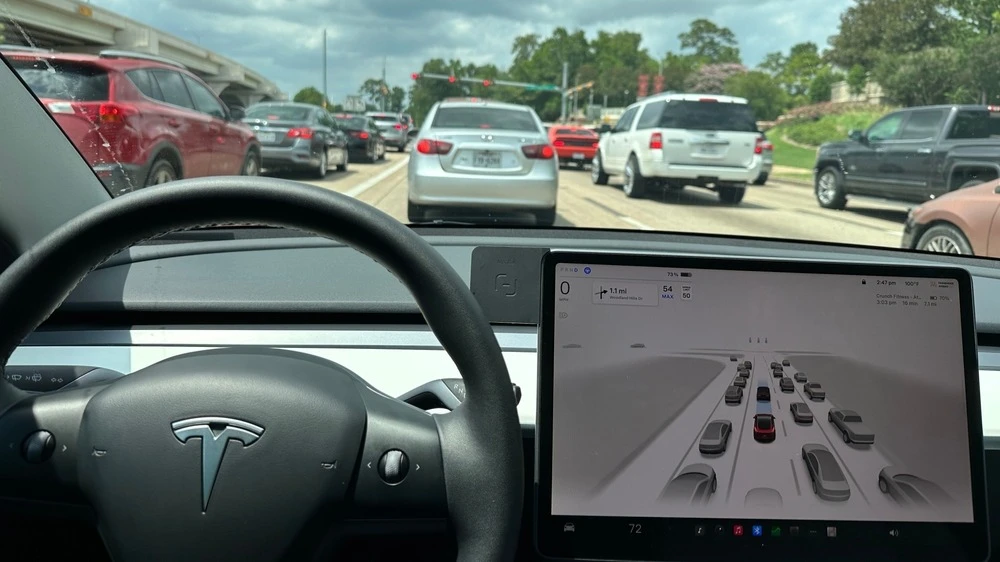
In an effort to gain approval for its driver-assistance systems, Tesla presented statistics to European regulators that independent experts have called “misleading marketing” / Photo: Brian Gallegos / Shutterstock
To secure approval in Europe for its Full Self-Driving (FSD) system in Europe, electric car manufacturer Tesla provided safety data on the system to regulators in Sweden and the Netherlands, which independent researchers say contained “misleading marketing,” Reuters has learned.
Details
An analysis by Reuters published in late May showed that Tesla CEO Elon Musk and other company executives have increasingly cited statistics over the past year that purportedly prove that Tesla’s Full Self-Driving (FSD) system — is up to 10 times safer than driving by ordinary human drivers.
However, an investigation by the news agency uncovered several inaccuracies that artificially exaggerated the reliability of Tesla’s Autopilot. According to correspondence obtained by Reuters through Freedom of Information Act requests, Tesla provided “inflated” FSD safety data to certain European regulatory agencies.
Specifically, according to documents obtained by Reuters, the electric vehicle manufacturer approached the Dutch Road Transport Agency (Rijksdienst voor Wegverkeer; RDW) in late 2024 to begin the FSD approval process. In a letter to the RDW dated November 2024, Tesla provided a link to its safety report and stated that “active use” of FSD makes roads safer. The agency notes that while the automaker charges a monthly subscription fee for access to this feature, the system still requires constant attention from the driver.
After more than a year of testing and discussions with Tesla, the RDW approved the use of FSD in the Netherlands in April 2026. The Dutch regulator is now seeking EU-wide approval of the system on behalf of Tesla.
Shortly after the Dutch authorities announced their decision on April 10, Tesla’s regulatory policy manager, Ivan Comusanac, sent an email to Swedish regulators requesting similar approval for the FSD system in Sweden. He attached a slide presentation to the email claiming that Tesla vehicles using FSD can travel more than seven times the distance between accidents compared to the average American driver, Reuters reports. The presentation also claimed that FSD could potentially save 32,000 lives and prevent 1.9 million injuries.
What independent experts are saying
Road safety researchers interviewed by Reuters stated that the figures Tesla provided to European regulators are deeply misleading, as they are based on the unrealistic assumption that every vehicle in the U.S., including trucks and accident-prone motorcycles, will be replaced by a Tesla passenger car equipped with FSD, and that every Tesla vehicle is actually at least seven times safer than the one it replaces.
A Reuters analysis also found that Tesla overstates the safety performance of its technology, by comparing the frequency of accidents involving FSD-driven electric vehicles that triggered airbags with the overall accident rate for all vehicles in the U.S., which includes far less serious incidents. The company also compares its vehicles to the average American car, which is much older than the average Tesla. This skews the results, as automakers have gradually introduced new safety features that reduce the number of accidents.
The RDW declined to comment on the issues identified by Reuters, but the agency noted in a statement that it “does not rely on marketing claims or external statistics” when making decisions, and instead conducts its own “tests, analyses, and inspections” of the system on public roads and test tracks.
Anders Eriksson, an investigator with the Swedish Transport Agency, declined to comment on the data provided by Tesla, but added that Swedish regulators “look beyond the headline figures” and that any assessment of such a system would be based “not solely on aggregated safety claims, but on the totality of the evidence presented.”
Tesla did not respond to the agency's requests for comment. The company's stock rose about 1% in trading on June 15.
Context
Tesla stated that approval of the FSD system in Europe is crucial for growing car sales in the region. The electric vehicle manufacturer is still trying to regain market share after its sales plummeted last year, partly amid protests against Elon Musk’s political activities, including his support for right-wing European political parties, Reuters notes.
According to the European Automobile Manufacturers' Association (ACEA), Tesla vehicle registrations rose by 59.6% in the first quarter compared to the same period last year. A total of 57,792 electric vehicles were sold in the EU (compared to 36,203 in the first quarter of 2025). Tesla’s quarterly market share in the EU rose from 1.3% to 2%.
In recent weeks, analysts and investors have been increasingly discussing the possibility of a merger between Tesla and SpaceX, Business Insider (BI) noted. In May, Dan Ives, managing director at investment firm Wedbush Securities, predicted that aerospace company SpaceX and electric vehicle manufacturer Tesla would merge into a single company in 2027.
This article was AI-translated and verified by a human editor