Small-Cap Companies vs. Tech Giants: How Backblaze Is Battling for the Cloud Market

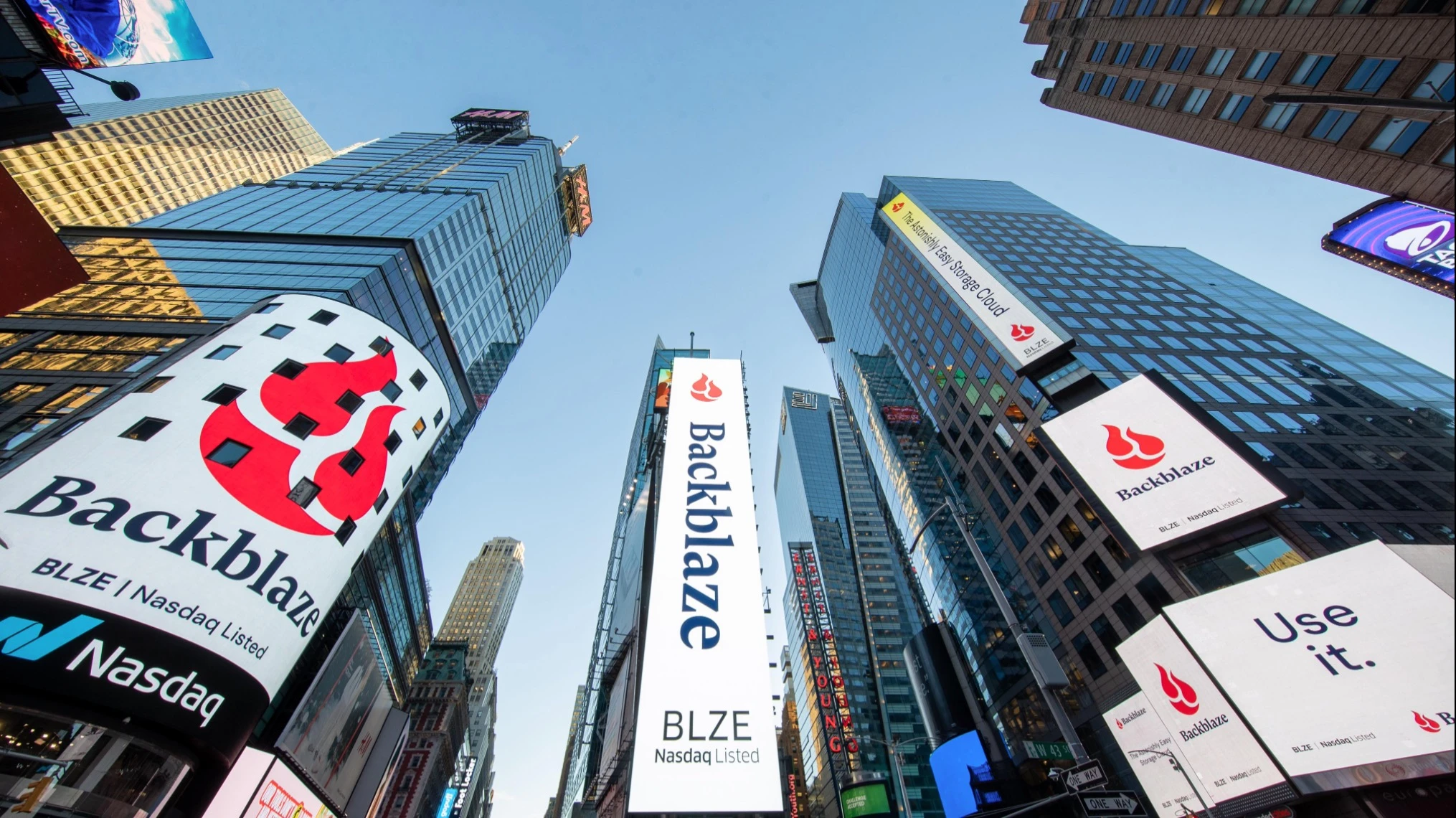
Backblaze positions itself as an infrastructure provider for the AI market / Photo: Nasdaq Exchange / X
The high cost of cloud services is a headache for nearly all data-driven projects. Backblaze, a Palo Alto-based backup service, faced this problem several years ago. As a result, it built its own cloud using inexpensive hard drives and declared a price war on the market leaders—AWS (Amazon’s service), Google, and Microsoft—and then radically changed its business model. Now Backblaze is itself a provider of cloud storage for AI, with a contract with CoreWeave. The company’s stock has risen 300% since the start of the year. Is it worth buying?
Hyperscaler Pricing Plan
In 2007, in Palo Alto, the unofficial capital of Silicon Valley, the founders of the startup Backblaze were manually assembling and testing Storage Pods—the first server enclosures designed for high-density hard drive storage—in a small apartment.
“The world has rapidly gone digital; everyone has laptops now, but few people were making backups,” — recalls Gleb Budman, co-founder and CEO of Backblaze, a native of the Soviet Union who emigrated to the U.S., on the CEO Speaks podcast on the GigaOm channel.
The business idea behind the project was to create the most affordable service possible that automatically backs up users’ files to the cloud. But it wouldn’t have been possible to keep costs low using Amazon or Dell servers—their service fees were too high, and Backblaze would have had to pass those costs on to its own customers, says Budman.
In the end, the project developers decided to use hard drives instead of the more expensive flash memory for the project.
The idea proved so popular that in 2015, Storage Pod evolved into a new business segment for the company—the Backblaze B2 cloud storage service.
IT professionals started reaching out to us. They said, “Listen, I appreciate your service for backing up all my laptops and desktops, but I have other data storage needs as well. Help me with all of this—archiving, application storage. I have media content. I need a way to manage it...”

Service B2 offered its services“at one-fifth the price of hyperscalers,” as well as free data export. This became the project’s hallmark.
Users often calculated their budgets based on the cost per gigabyte of storage and forgot that hyperscalers charge separately for any data downloads from the cloud.
It is precisely this hidden “download tax” (Egress Fee)—the foundation of the cloud platform economy—that Backblaze has decided to challenge.
It undercut the competition not only through its infrastructure but also through its own software. In addition, the company focused on object storage without spending resources on computing power, as Nebius and CoreWeave do, for example. Backblaze also did not invest in additional services, such as file synchronization and collaborative editing, as offered by Google Drive or Dropbox.
The dichotomy between hyperscalers’ expensive flash memory and niche players’ cheap hard drives is somewhat contrived, according to Mikael Gorsky, an AI researcher and lecturer at the Holon Institute of Technology: In any cloud environment, data archives are stored on hard drives, while flash memory ensures maximum data processing speed and instant response times for databases and virtual machines. Therefore, machine learning simultaneously utilizes different types of memory. They open the door to a wider range of possibilities.
A Leap into the Ocean of AI
In 2021, Backblaze went public. It offered 6.5 million shares on the Nasdaq at $16 per share— in the middle of its stated price range—and raised $100 million. Such a modest offering size was atypical for tech companies in the early 2020s. CNBC called this IPO a throwback to a time when startups with less than $1 billion in revenue went public to raise capital and increase brand awareness.
On its first day of trading, Backblaze’s stock rose 24%; on the second day, it rose another 12%, bringing the share price to $22.31 and giving the company a market capitalization of about $650 million. “Our IPO day was a special occasion for us and the culmination of 14 years of hard work by our entire team,” Gleb Budman wrote in his blog on the company’s website.
But in 2022, inflation surging to its highest level in several decades forced the U.S. Federal Reserve to aggressively raise interest rates, and the era of cheap “COVID” money came to an end. The world’s return to normal life undermined the business models of the “pandemic beneficiaries,” many of which were IT companies. The IPO boom that had occurred over the previous two years also came to an end in 2022. The stocks of stock market newcomers and unprofitable companies were hit the hardest. Backlbaze met both criteria.
In a post marking the anniversary of the IPO, Budman wrote that the company’s stock had plummeted by 70% since going public, and that this had posed a challenge for shareholders and employees.
“Of course, I wish the last 10 months on the markets had turned out differently. Who wouldn’t?” Budman noted, but added that he has no regrets about going public.
Before going public, Backblaze had raised only $3 million and issued $10 million in convertible bonds. This, too, stood in contrast to the actions of many tech companies, which were actively driving up their valuations during funding rounds. Budman attributed these modest figures to the founders’ desire to retain control of the company.
On the other hand, Backblaze aggressively granted stock options to key engineers to retain them long-term, German Kaplun, co-founder and Chief Strategy Officer of TMT Investments, told Oninvest. The company was one of Backblaze’s early investors. This led to a constant dilution of existing shareholders’ stakes, but since the startup seemed promising, TMT Investments accepted this risk.
Backblaze used the proceeds from its IPO to radically upgrade its business model. By the time it went public, the B2 segment accounted for only one-third of its revenue, but it was growing rapidly (+60% year-over-year in the first half of 2021). Backup services, on the other hand, saw their growth slow (+12% over the same period). Customer loyalty in the B2 segment was higher than in the backup segment, as was the average annual revenue per user.
In 2025, it launched B2 Overdrive, a high-speed storage solution designed for heavy workloads. And in 2026, it launched B2 Neo—a cloud data storage solution for neoclouds that provide computing power for AI. Neoclouds can integrate these resources under their own brand and offer them to users at their own prices (this is called “white label”). Since then, while maintaining its other business segments, Backblaze has positioned itself as an infrastructure provider for AI needs.
A truly major client
In the summer of 2026, Backblaze signed a 5-year contract with the cloud provider CoreWeave for just $335 million and an undisclosed number of exabytes (1 exabyte equals 1 million TB) of storage. Actual payments will be tied to the actual capacity leased. If CoreWeave takes on all the capacity specified in the contract in equal installments, Backblaze will receive $67 million annually from the neo-cloud provider. To date, Backblaze’s total revenue from its B2 cloud segment has been slightly higher—$79.9 million in 2025.
To retain this key client, Backblaze is also relying on an incentive component—the contract provides CoreWeave with warrants for 4.2 million Backblaze shares, expiring in 2032 and 2035. Their exercise will be tied to contracted capacity. If Neocloud meets the conditions, it will receive the shares at $7.60 each—more than half the current price. However, the stakes of existing shareholders will once again be diluted.
“Backblaze was in the right place several years before that place became obvious,” Kaplun says: Until recently, it was seen as a data storage and backup company, but now it’s becoming part of the AI infrastructure, he notes.
The AI race has presented companies like Backblaze with a window of opportunity for revenue growth, according to Gorsky. “Open protocols and low rates will easily win over AI developers, and white-label offerings may be of interest to neo-clouds,” he explains.
However, he acknowledges that Backblaze does not sell its know-how, and even without hyperscalers, competition in the cloud market is fierce, with many small and medium-sized players offering similar solutions and pricing plans. In addition, in the fall of 2023, Backblaze tightened its pricing policy and introduced a limit on free data downloads for B2 customers (three times the average monthly storage volume).
Currently, B2’s monthly price for 1 TB of storage starts at $6.50, iDrive e2’s starts at $6, and Wasabi’s starts at $7.99. Cloudflare R2, a larger player in the market, has made data downloads completely free.
"Fantastic" Financial Statements and Real Risks
Gleb Budman called the company's latest quarterly results "fantastic" due to its successes in the field of AI, despite a 2% decline in revenue from backup services.
Backblaze's revenue in the second quarter of 2026 was $42.7 million (+18% year-over-year). B2 cloud storage accounted for more than half of that—$26.6 million—and the AI-focused segment grew 34% year-over-year.
Incidentally, the situation was similar in the first quarter of 2026: the AI segment saw 24% year-over-year growth, while the company reported stagnation in the backup segment.
The company raised its 2026 revenue forecast to $172–174 million (from $161.5–163.5 million) and its adjusted EBITDA growth forecast to 27–29% (from 23–25%). Next year, according to Backblaze’s own forecast, revenue in the B2 segment will grow by 40%, while revenue in the backup sector will decline by 3%.
Despite strong financial results, Backblaze remains unprofitable, although its loss is narrowing—in the second quarter, it amounted to $5.1 million (or $0.08 per share). One reason for this is that nearly all of the company’s cash is being consumed by capital expenditures and debt service ($6.6 million and $5.8 million in the first half of the year). At the same time, its operating cash flow for the same period was $13.8 million.
The situation will not change in the near future: During a conference call, CFO Mark Suden said that the company will increase CAPEX to 55–65% of revenue in the second half of 2026, explaining that this is due to upfront investments in capacity that must be delivered under signed contracts. Its gross margin will temporarily decline “by several hundred basis points.”
Backblaze has two vulnerabilities that individual investors should be aware of.
First, there is the current reliance on a single key client—Coreweave.
Backblaze has secured a contract with CoreWeave, but Citizens analyst Rustam Kanga doubts whether the company will be able to close new deals of this scale without issuing warrants or diluting shareholders' stakes.
It is clear that the company is trying to mitigate this risk. During a conference call with investors following the second quarter of 2026, Gleb Budman mentioned that Backblaze is in talks with other cloud infrastructure providers. The company reported a 57% increase in the number of large customers (contracts of $50,000 or more) and a 67% increase in annual revenue from this group. Backblaze has four additional major deals with unnamed clients—each worth over $500,000—and its B2 Overdrive division signed a “seven-figure” contract with a leading AI model developer (whose name is also undisclosed).
Second, Backblaze is not profitable and plans to continue investing in sales and marketing, infrastructure, and development to remain competitive in the market, notes Mike Tsikos, a financial analyst at Needham & Company. If its growth rate slows, additional investment may be required. He fears this could delay plans to achieve profitability and negatively impact the stock price.
Backblaze did not respond to Oninvest's inquiry.
Despite concerns, 8 out of 10 analysts covering Backblaze have assigned it a “Buy” rating. Following the release of its earnings report, Oppenheimer raised its price target from $15 to $25, B. Riley Financial raised its target price from $16 to $24, and Needham & Company raised its target price from $14 to $23. The consensus target price for the company’s stock is $19.71.
At the close on August 12, Backblaze shares were trading at $19.34.