The First Bubble in U.S. History: How Investors Went Wild—and What Does Elon Musk Have to Do With It?

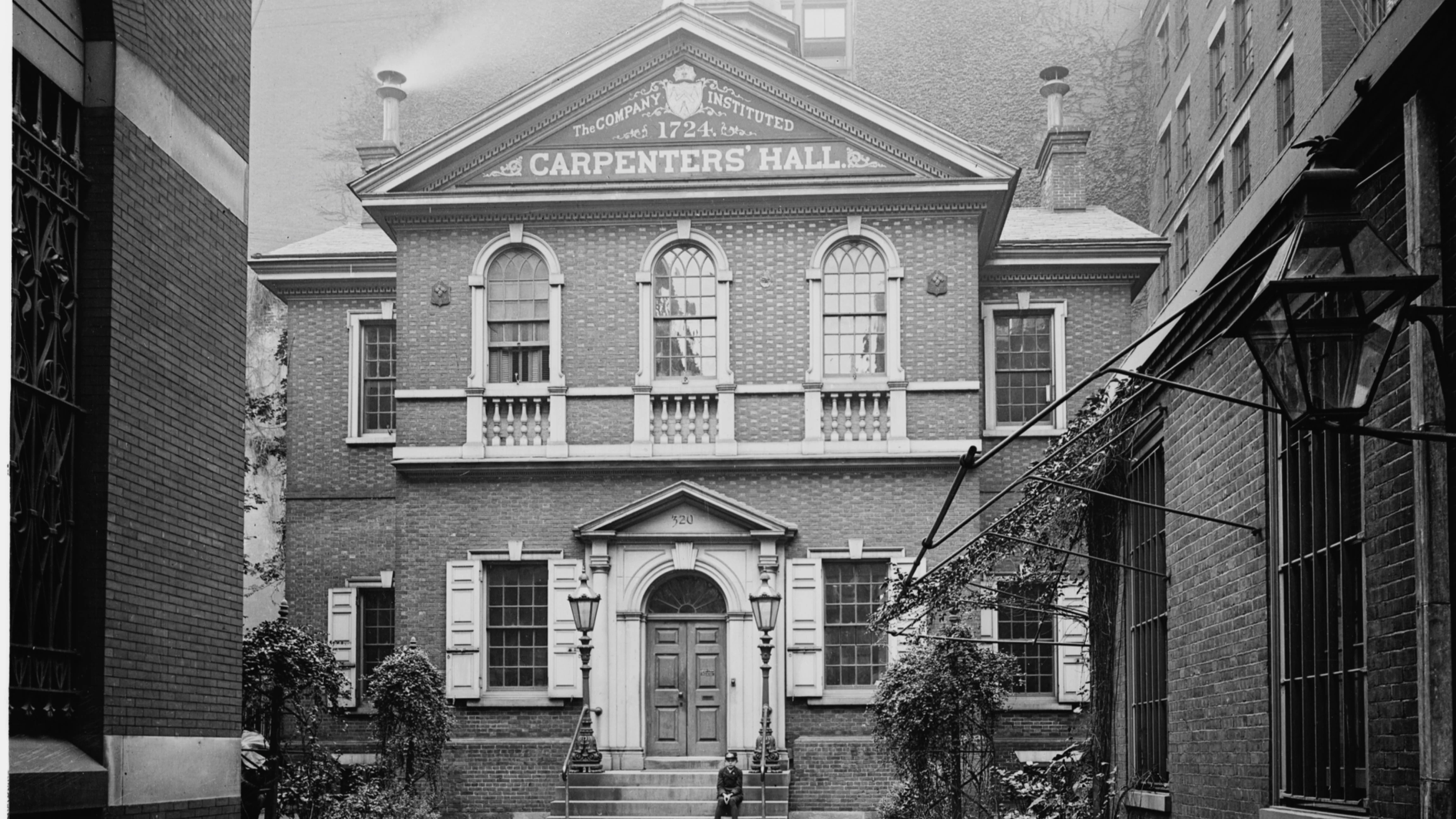
Originally, the First Bank of the United States was located in Carpenters' Hall—the site of the First Continental Congress. 1900. Source: Library of Congress
Alexander Hamilton’s financial system triggered the first major crisis in U.S. history. What if this pattern were to repeat itself in 2026?
Early in the morning on July 4, 1791, a crowd gathered outside the Bank of North America in Philadelphia. Brokers, merchants, and other investors from across the country surrounded the building on the north side of Chestnut Street. Everyone wanted to get a spot in line closer to the doors, although calling this crowd a line would be a stretch.
In a new country and a new financial market, people were presented with new opportunities—to profit from the initial public offering of the First Bank of North America. Philadelphia, which was then the capital of the United States, and other cities that followed were swept up in a sort of IPO frenzy. Just two months later, newspapers were already reporting on a bubble—and the Secretary of the Treasury had to intervene to prevent the collapse from dragging down the entire financial system of the young republic. The nation’s central bank itself survived, but the bubble ruined people, altered the country’s political landscape, and reshaped the American financial system.
How does the panic of 1791 resemble the frenzy surrounding the most high-profile IPO of 2026? Could history repeat itself 235 years later—and do the scale of Elon Musk’s ambitions and SpaceX’s dominant position make any share price seem justified?
The First Bank of the United States: From Chaos to a Unified System
After the War of Independence, the United States remained a financially fragmented country: there was no single currency, each state had its own debts, and the central government had neither a stable source of tax revenue nor the institutions needed to manage public finances.
Alexander Hamilton, the first U.S. Secretary of the Treasury, set out to reform this system. He proposed consolidating state debts at the federal level, creating a unified market for government bonds, and establishing a national bank.
“The purpose of the national bank is to increase public and private credit. The former gives the government the authority to protect its rights and interests, while the latter facilitates and expands trade between individuals,” Alexander Hamilton wrote to Robert Morris, one of the Founding Fathers of the United States.
The first bank in the United States was established in February 1791—as a national corporation with a 20-year term. However, it did not become a central bank in the modern sense: it did not set monetary policy or regulate other banks.
“No venture of comparable scale, built on such a solid foundation, has ever before been offered to investors as the Bank of the United States,” reported the New-York Packet. Journalists wrote that the bank “would facilitate the conduct of any business […] and enable the government to reduce the national debt and lessen the public burden.”
The $25 Offering: How First Bank's Public Offering Was Structured
The authorized capital of the First Bank of the United States was $10 million, which amounted to nearly 5% of America’s GDP in 1791. The federal government was to purchase $2 million worth of shares and receive a 20% stake in the bank. The remaining $8 million was raised from private investors through the issuance of 20,000 shares with a par value of $400 each.
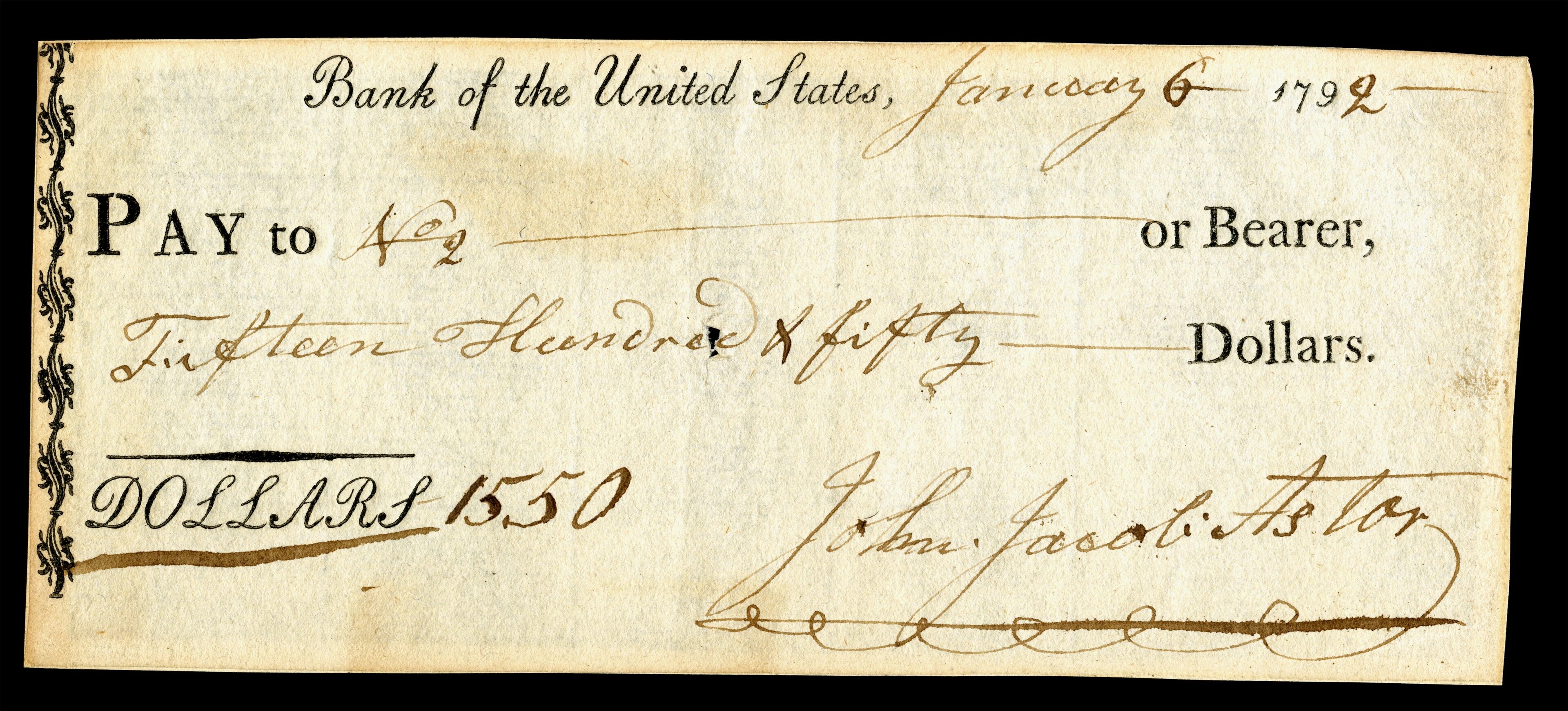
A check from the First Bank of the United States, issued by financier John J. Astor in 1792. Source: National Numismatic Collection, National Museum of American History
The full $400 per share did not have to be paid immediately—instead, only an initial payment of $25 was required, for which a scrip—a certificate—was issued. Once the full amount was paid, one share could be obtained for each such certificate. The remaining amount had to be paid within two years, with $300 to be paid in federal bonds. This was part of Hamilton’s plan: the bank’s issuance simultaneously supported demand for government debt.
The certificate holder could resell it along with the obligation to pay the remaining amount. When purchasing the security, the investor paid only 6.25% of the share’s value, so any price movement of the certificate multiplied both the profits and losses relative to the initial investment—in effect, leverage was built into the certificate.
From Patriotism to Madness: How America's First Financial Bubble Inflated
Alexander Hamilton timed the offering of shares in the First Bank of the United States to coincide with July 4, 1791, so that the purchase of the securities would be seen as support for the young republic. Newspapers fostered a patriotic spirit: “Every friend of the Federal Government, everyone who wishes for the Union’s prosperity, must feel the deepest satisfaction in seeing how citizens […] compete with one another” in purchasing certificates, thereby demonstrating “the most unequivocal proof of their confidence in the public credit.”
The entire allocation was snapped up in about two hours—demand far exceeded supply. In the commotion, the organizers issued 4,600 more certificates than had been planned.
“This circumstance was gratifying not only because it demonstrated trust in the government,” wrote U.S. President George Washington, “but also because it provided unexpected proof of the sound judgment of our citizens.”
Many interested buyers did not receive their certificates during the initial offering and turned to the secondary market to purchase them. As early as July 6, a certificate purchased for $25 was selling for about $35; a week later, it was selling for $45.
The quick profits made by early buyers fueled new demand: participants who had never dealt in securities before joined the trading, and often borrowed money to buy certificates only after the price had already surged.
The market was gripped by what, more than 200 years later, would come to be known as FOMO—the fear of missing out.
In early August, the rally turned into a frenzy. On August 2, the certificates were selling for $100 at the New York auction; by August 5, the price had already risen to $146. On August 11, prices reached $280 in New York and $300 in Philadelphia. In less than six weeks, the certificates had risen in price more than 12-fold.
Newspaper articles fueled demand for certificates: they published price quotes and reported on stories of people striking it rich. But as early as August, editorials began appearing in newspapers comparing “certificate mania” to the South Sea and Mississippi Company bubbles, which a century earlier had nearly destroyed the financial systems of Great Britain and France. “Madness is sweeping the entire nation; but sooner or later, as truth dictates, all things will inevitably assume their true proportions—and just as surely as death claims every mortal, thousands of people will yet curse their blind faith in bank certificates,” — wrote the Gazette of the United States.
The Domino Effect: How a Night Courier Crashed the Market
The reversal began in New York: the price had reached $280 the day before, but trading opened at around $250 that morning, and prices continued to fall. By the end of the day, the certificates were trading at $197—nearly 30% below the previous high.
The news of the market crash in New York was delivered to Philadelphia by an overnight courier. Those who received it first rushed to sell their securities on the morning of August 12. While the certificates had been trading above $300 the previous evening, by noon buyers had virtually disappeared: offers at $140–160 found no takers. Reports emerged of fictitious trades: participants, acting in concert, were making purchases at inflated prices in an attempt to create the appearance of demand and prop up prices.
On August 13, 1971, the New York Journal reported: “The bubble has burst.”
The market dynamics that had driven the market up subsequently exacerbated its decline. Over the course of six weeks, the certificates rose in price more than 12-fold, even though the bank had not yet begun full-scale operations and had not yet demonstrated future profitability. The rise was fueled by a shortage of certificates and cheap credit: a mere $25 was required to get started, and many borrowed the remaining amount.
How Hamilton Averted the First U.S. Financial Crisis
The collapse of the certificates quickly spread to the federal debt market. Government bonds were used to pay for a large portion of the cost of stocks, and they were also used as collateral for loans. Therefore, market participants who needed cash to settle their accounts sold both certificates and government securities.
Trade in Philadelphia slowed, trust between merchants and creditors was undermined, and thousands of participants faced losses, debts, and bankruptcies.
American Enlightenment thinker Benjamin Rush wrote: “A young broker, Mr. Siber, from New York, who had made $10,000, lost his mind. I visited him along with Dr. Barton at the City Tavern. [...] Major speculators have become either talkative and loquacious or gloomy, sullen, silent, and irritable. General Stewart, who had only just begun trading in certificates, admitted that he could not sleep at night. [...] I have never seen such widespread madness. Nothing else was discussed in any social circle, not even among those who had no personal interest in the matter.”
Hamilton saw the collapse of the speculative market as a threat to government credit, upon which his financial system was built. He was convinced that this was a liquidity crisis: investors were selling off assets at any price in order to meet their obligations.
Hamilton drew up a plan to stabilize the market over the weekend: he allocated $300,000 from the depreciation fund to purchase federal bonds in New York and Philadelphia. In a letter to New York businessman William Seton, Hamilton wrote: “If there are gentlemen who support government funds and others who oppose them, I would be glad if your purchases would help the former. This is to be kept in the strictest confidence.”
Purchases of federal bonds began on August 17. The emergence of a major buyer halted the sell-off of government securities, brought cash back into the market, and supported the value of collateral. The Treasury did not purchase certificates, but the easing of pressure on borrowers also helped this market: the very next day, prices rose by more than 20%.
But the crash of 1791 did not put an end to speculation. Leveraged trading, cheap credit, and hopes for government intervention soon reignited the market—this time in New York, where an even more widespread financial panic occurred in the spring of 1792.
To restore confidence in the market and regulate securities trading, on May 17, 1792, brokers signed an agreement under a sycamore tree on Wall Street. This document marked the first step toward the creation of the New York Stock Exchange.
Alexander Hamilton resigned as Secretary of the Treasury in 1795 and returned to his law practice. In 1798, he entered military service and effectively took command of the army that had been raised in preparation for war with France.
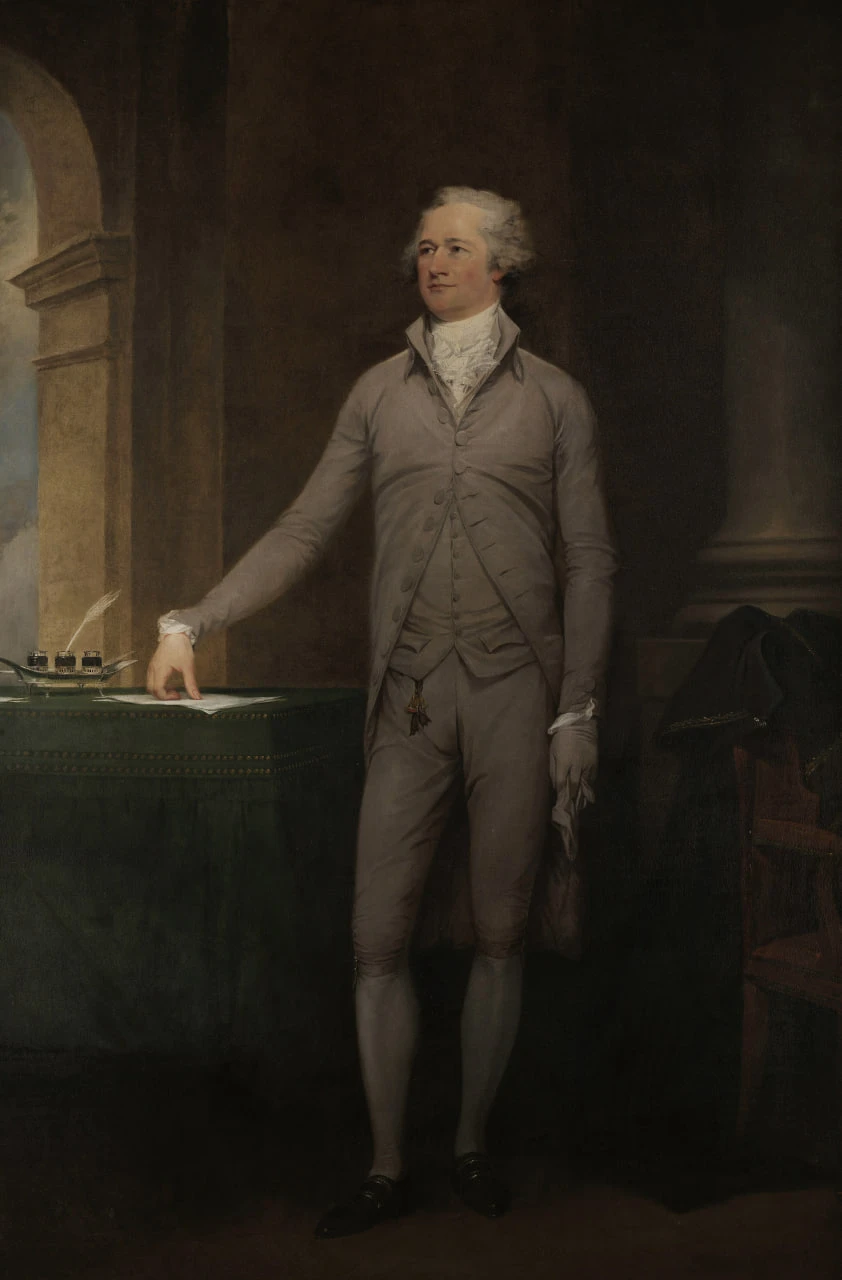
U.S. Treasury Secretary Alexander Hamilton drafted the market stabilization plan over the weekend. Portrait by John Trumbull, 1792. Source: Metropolitan Museum of Art
Hamilton did not become the Elon Musk of his time: despite creating the country’s new financial system, he did not amass a vast fortune. He wrote that his assets might not be sufficient to pay off all his debts. In July 1804, Hamilton was mortally wounded in a duel with Vice President Aaron Burr, his longtime political rival; he was not yet 50.
Criticism of the financial system Hamilton had created continued even after his death. His opponents argued that the national bank and the federal debt market allowed a small circle of financiers to profit from speculation, while the consequences of crises affected the entire economy. This later became one of the arguments against extending the First Bank’s charter; it ceased to exist in 1811.
Rhymes with Modernity
Ray Dalio, the founder of Bridgewater Associates, often says that history doesn't repeat itself, but it does rhyme.
The IPO frenzy of 1791 bears many similarities to the largest offering of 2026. The First Bank of the United States and SpaceX have little in common, but in both cases, the exceptional nature of the project may have prevented investors from assessing its securities objectively. In 1791, this “moral certainty of success” was bolstered by the bank’s ties to the federal government; in 2026, it will be driven by SpaceX’s leadership in the commercial launch market.

The First Bank did indeed become the foundation of the new financial system, but before long, scrip was being bought as a scarce ticket to the country’s prosperous financial future. SpaceX also possesses technologies and a market position that are extremely difficult to replicate. The problem arises when a company’s strengths begin to be perceived as proof that it’s nearly impossible to overpay for its stock. Renowned short seller Jim Chanos called SpaceX’s offering “an IPO of hopes and dreams” and believed that investor interest was more closely tied to Elon Musk and the hype surrounding artificial intelligence than to the company’s financial performance.
There is also a certain similarity in the way the market increasingly bet on growth. In 1791, purchasing scrip required a down payment of only $25 for a share with a full value of $400; moreover, as mentioned above, many investors even borrowed the initial amount. In the first weeks following the IPO, a series of leveraged funds and funds betting on a decline in SpaceX’s stock price appeared on the market. Retail investors gained the ability to increase their bets on both rising and falling prices. In a rising market, such instruments accelerate the inflow of speculative capital, while during a market reversal, they amplify losses and selling pressure.
Finally, the company’s exceptional position does not guarantee investors protection against a decline in its stock price. After the collapse of the certificates, Hamilton supported the federal debt and the financial system, but did not restore the scrip’s price to its peak levels. SpaceX’s strategic role and government contracts strengthen its business, but they do not, by themselves, set a floor for its market valuation.
This article was AI-translated and verified by a human editor