The Strong Tenge vs. Kaspi: How the Company Reported Its Results and Why It Decided to Go Offline

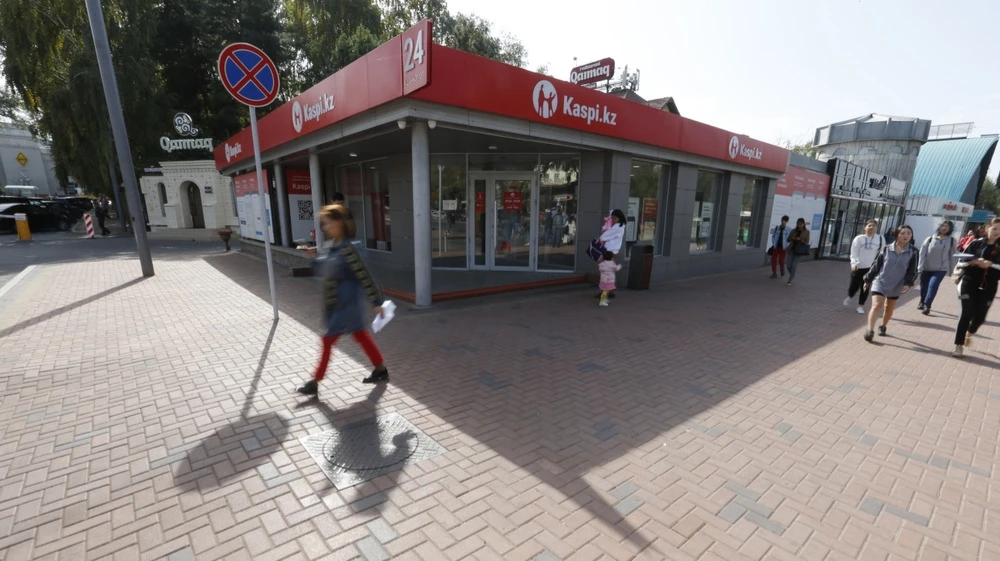
Kaspi plans to open 3,000 neighborhood mini-markets. Photo: Pavel Mikheyev/Shutterstock.com
The Kazakhstani fintech company Kaspi.kz has released its financial results for the third quarter of 2026. Due to the strengthening of the tenge, year-over-year revenue growth slowed to nearly zero; however, the company expects to meet its previous annual profit forecast and significantly improve its performance in 2027.
What about the results?
Kaspi.kz’s consolidated revenue in the third quarter of 2026 totaled 1.12 trillion tenge ($2.5 billion, hereinafter based on the exchange rates used by the company: 440.86 tenge per dollar and 8.99 tenge per Turkish lira), up 0.6% year-over-year and 0.5% quarter-over-quarter. Adjusted EBITDA rose 1.4% year-over-year and 2.6% quarter-over-quarter, to 407.6 billion tenge ($925 million). Net income reached 281 billion tenge ($637 million)—1.1% higher than last year and 8.5% higher than the previous quarter.
Fintech remains the main source of revenue growth: its revenue reached 489 billion tenge ($1.1 billion), up 19.4% year-over-year and 7.5% compared to the second quarter. However, the segment’s adjusted EBITDA declined by 1.1% year-over-year to 178.8 billion tenge ($406 million); the company attributes this to high funding costs.
Revenue for the electronic payments segment totaled 181.9 billion tenge ($406.8 million), up 5.7% year-over-year and 7.7% quarter-over-quarter. The segment’s adjusted EBITDA decreased by 1.2% year-over-year to 104.8 billion tenge ($238 million).
Strengthening of the tenge
Marketplace revenue grew by 20% year-over-year in constant currency, while gross sales volume increased by 8%, Kaspi.kz CEO Mikhail Lomtadze said in a press release. The division’s adjusted EBITDA rose 7.8% year-over-year to 124 billion tenge ($281 million). However, the division’s actual revenue declined by 15.1% year-over-year and by 8.2% compared to the second quarter, to 466.3 billion tenge ($1.1 billion).
The main reason for the actual decline was the strengthening of the tenge. According to the company, in the second quarter, the dollar depreciated against the tenge by 7.6% year-over-year, while the Turkish lira depreciated by 21% over the same period. During this period, the company’s overall revenue grew by 15% year-over-year, while the marketplace’s revenue grew by 10.7%. However, in the third quarter, the tenge strengthened even further: the dollar depreciated by 19.7%, and the lira by 32%.
This led to a decline in the tenge equivalent of the Turkish division’s revenue. In the third quarter, revenue in Turkey fell to 214.1 billion tenge ($485.6 million) — down 18.8% from the previous quarter and 34.7% year-over-year, whereas in the second quarter, year-over-year growth had still held steady at 6.2%.
According to Kaspi.kz, imported goods have become cheaper overall in Kazakhstan due to the strengthening of the tenge. Although the volume of goods sold through e-commerce channels rose by 24%, the average unit price fell by 8%, so gross merchandise value (GMV) growth amounted to only 14%, said David Ferguson, managing director and head of investor relations at Kaspi.kz, during a conference call dedicated to the quarterly results.
"Most of the products on the marketplace are imported into Kazakhstan. Now sellers can buy more for less money [...] And more and more often, they’re passing this price advantage on to buyers—or at least sharing the savings with them,” Ferguson said.
Profit Support
Kaspi.kz has lowered its forecast for the growth in total merchandise sales through its marketplace for 2026 from approximately 20% to 12% in constant currency. However, the forecast for adjusted EBITDA growth of approximately 5% remains unchanged, as do the growth targets for payment volume and the average loan portfolio of the fintech segment—both at approximately 15%.
Lomtadze stated that “the divisions focused on payments and fintech continue to provide a solid foundation for future profit growth”: in August and October, the company cut the interest rate on three-month deposits by one percentage point on two separate occasions. The main impact of these decisions is expected in 2027.
Mikhail Lomtadze also noted that a significant reduction in investments in Turkey would “support the consolidated profit forecast” for 2027. Ferguson reported that funds previously allocated to the development of Hepsi Bank and the network of Turkish ATMs will now be redirected.
Kaspi is going offline
Mikhail Lomtadze discussed the successful launch of a pilot network of 42 brick-and-mortar stores under the Magnum Daily brand in Almaty. Store-level EBITDA margin stood at approximately 15%, with an estimated payback period of 18 months. Kaspi finances the retrofitting of existing independent stores, provides the product assortment, and manages inventory and pricing, while leaving partners in control of day-to-day store operations—for which they receive 7% of sales.
By the end of 2027, Kaspi.kz plans to expand its network to 300 stores in nine cities across Kazakhstan. The “medium-term goal” is 3,000 stores, but no specific timeline has been provided for achieving this goal. According to the company’s estimates, such a network could generate annual revenue of 1.44 trillion tenge ($3.27 billion) and EBITDA of 216 billion tenge ($490 million) while maintaining current profitability.
The Magnum Daily network is also expected to serve as the infrastructure for delivering e-commerce orders within 30 minutes. According to Lomtadze, testing of this feature will begin as early as November. “This is a huge opportunity for us. [...] Probably one of the most promising opportunities we’ve ever had,” he said, sharing his expectations.
Kaspi.kz has proposed a dividend for the quarter at the same level as before—1,000 tenge per share.
“In our view, Kaspi.kz reported neutral results for the third quarter of 2026. As expected, interest expense continues to grow faster than interest income, but the growth rate has slowed slightly compared to the second quarter,” said Freedom Broker analyst Daniyar Orazbaev, commenting on the company’s financial results and noting that the slight 1.1% increase in profit “was in line with expectations.”
On the Nasdaq, as of 12:30 a.m. Almaty time on November 10, 2026, the price of Kaspi.kz depositary receipts fell 2.23% to $89.71.
This article was AI-translated and verified by a human editor