Where Can You Drive the Tesla Roadster? This and Other Questions About Musk's "Rocket on Wheels"
This flying machine is a visual argument in favor of a merger between SpaceX and Tesla

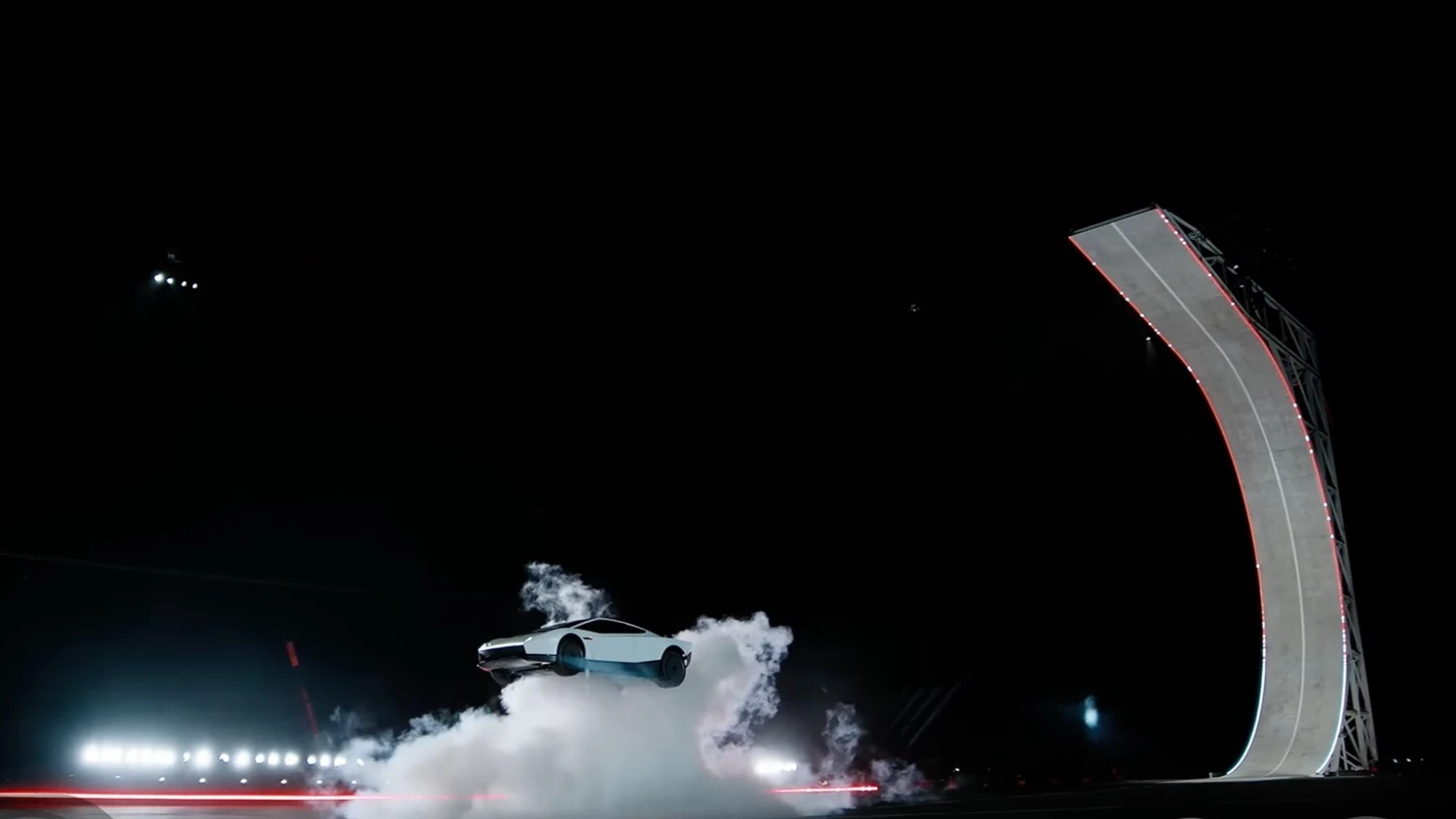
On October 15, Tesla held a presentation of the Roadster flying hypercar. Screenshot from the livestream on the company's official YouTube channel
On Thursday evening, October 15, at the SpaceX launch site in McGregor, Texas, Elon Musk unveiled a car that can fly. And not just figuratively: a second-generation Tesla Roadster drove up a curved ramp, hovered upside down 21 meters in the air, plummeted, flipped in midair, and landed gently. Then, doing a somersault, it leaped over the entire lineup of Tesla cars parked nearby—from the Model 3 to the Cybertruck. “Well, it worked,” Musk said. “Flying cars are a reality.”
It sounds like a triumph of engineering, but it raises some practical questions: Who would need a car like this, and why?
Is that even a car or a rocket?
The second-generation Roadster is the result of “a collaboration between the world’s best car company and the world’s best rocket company,” as Musk described it, referring to Tesla and SpaceX.
The car is equipped with a system of fans that create low pressure under the underbody—this not only allows it to hover with its wheels pointing upward, like a fly on the ceiling (for which it’s hard to think of a practical use), but also presses it more firmly against the road, which improves traction, handling, and acceleration.
Behind the driver's seat in the flying Roadster is a metal and carbon-fiber tank that contains gas under extremely high pressure—according to comments by Tesla's Vice President of Engineering, Lars Moravi, it’s ordinary air, meaning the system can be recharged simply by pumping in fresh air. Pipes run from the tank to 10 nozzles located around the vehicle, allowing it to accelerate, take off, and maneuver in the air. This is called a cold gas engine—it uses only compressed gas; nothing burns inside it. A similar principle is used in some of SpaceX’s space systems for maneuvering.
Musk promised to begin mass production in 2028—that is, 10 years after the entrepreneur first mentioned that Tesla might be able to fly.
Where could you fly to with this?
Most likely, nowhere. Right now, the Tesla website is offering pre-orders for three versions of the Roadster.
The base Performance model is a two-seater with a “suction cup” system but without gas engines. It is fully road-ready. The suction system provides excellent traction and better handling in turns, but not acceleration or flight.
The reservation fee is $50,000; the final price, as with other models, has not been announced. To be honest, it doesn't quite qualify as a "killer feature."
The Thrust version is a two-seater, featuring a “suction cup” plus four gas jets at the rear for acceleration. At the presentation, the car demonstrated acceleration from 0 to 100 km/h in just 1 second—a record that the manufacturers promise to improve to 0.81 seconds in the production version. The reservation fee is $250,000; again, flights are not included.
And finally, the Rocket version—10 nozzles around the perimeter, single-seater, capable of flight, available by invitation only; even the booking price is a secret.
The U.S. National Highway Traffic Safety Administration oversees compliance with vehicle requirements but places the responsibility for certifying their safety on the automakers themselves. However, Tesla’s website explicitly states that the Rocket flying car “is not approved for use on public roads.”
Meanwhile, the U.S. Federal Aviation Administration (FAA) told CBS that the Roadster does not meet their definition of an “aircraft.”
All in all, it's not even remotely clear who would certify such a vehicle for use on public roads, how that would be done, or whether it will ever receive such approval at all.
It's possible that it will remain nothing more than an expensive toy for millionaires, and driving (or flying?) the Roadster will only be allowed at special test tracks or on private property.
How much might a flying Roadster cost? Well, for example, the British electric hypercar McMurtry Spéirling PURE costs 995,000 pounds sterling (that is, about $1.3 million) and accelerates to 100 km/h in 1.55 seconds. It has a “suction cup” and can hover upside down, but it can’t fly.
Will the flying car really change Tesla's business?
Probably not. And this is perhaps the only issue on which analysts are virtually unanimous.
Dan Ives of Yorkville Ives puts it bluntly: “The Roadster won’t boost either sales volume or revenue. What it does is restore the brand’s prestige at the top of the market and draw attention to the company’s engineering capabilities.”
Gene Munster, managing partner at Deepwater Asset Management, called the presentation “a demonstration of engineering capabilities with no commercial value other than the desire to embarrass traditional automakers.”
“It’s inevitable that something that’s a hybrid between a car and an airplane will be a bad car and a bad airplane—and quite expensive, too,” — remarked Roger Connor, curator of vertical flight at the Smithsonian National Air and Space Museum.
The Flying Roadster isn’t a product. It’s what’s known as a “halo car”—an image-building model, a concept designed to make the video go viral on social media, make the Tesla brand shine again, and draw investors’ attention to the company. The first part definitely worked—Musk’s post about the Flying Roadster presentation has garnered nearly 80 million views.
Why did Musk show this right now?
The formal reason is obvious—Tesla’s quarterly earnings report on October 21. But there may be far more fundamental scenarios behind the flying Roadster.
The WSJ claims that Musk is effectively ceding the mass-market auto sector to China, which is capable of building cars for thousands of dollars less than Western countries. And Tesla, in his view, should focus on the Cybercab robotaxi, the Optimus robots, and expensive, exotic vehicles, such as the flying Roadster.
Musk himself called the Roadster “the last car designed to be driven by a human.”
The second possibility is that this is in preparation for a mega-merger between Tesla and SpaceX. Incidentally, Musk officially confirmed on October 20 that both companies are currently discussing this.
Slate, CNBC, and Barclays analysts believe that the flying Roadster is a visual argument in favor of such a merger. On the Kalshi prediction platform, the odds of a Tesla-SpaceX merger by March 2027 jumped from 29% to 56% in one week. Barclays expects an announcement before the annual shareholders’ meeting, which is scheduled to take place no later than December 6, 2026. JPMorgan called the potential merger “strategically sound.”
Who is actually building flying machines?
They're completely different companies. And everything they do is much closer to reality.
The eVTOL sector—electric vertical takeoff and landing aircraft— is estimated to be worth $87.6 billion.
These aren't sports cars with jet engines—they're actual electric air taxis that will transport passengers between airports and city centers.
In March 2026, the FAA approved eight pilot programs in 26 states—for Joby Aviation, Archer Aviation, Beta Technologies, and Wisk. This means that test flights will begin even before full certification is granted.
Joby Aviation is leading the race. In April 2026, the company conducted the first point-to-point flights in New York City’s history: from John F. Kennedy International Airport to helipads in Manhattan. TIME magazine included the company’s aircraft on its list of the best inventions of 2026.
Joby is in the final, fifth stage of FAA certification. Archer Aviation is in the fourth. The difference between the Tesla Roadster and an eVTOL is fundamental. The flying Roadster is just a one-car show at a test site, while Joby promises real consumer value: getting to the airport in 7 minutes, instead of spending an hour or two stuck in traffic—even if you’re lucky enough to be whisked through it by a Cybercab driverless taxi.
This article was AI-translated and verified by a human editor