Where to Invest $10,000 to Profit from a Decline in AI: Put Options and Hedge Stocks

You can bet on a decline in the AI sector using put options, but this would be a bet on a “black swan.” Photo: Igor Omilaev / Unsplash
Every new drop in the stock prices of companies related to artificial intelligence prompts market participants to wonder whether the market bubble is beginning to burst. For investors looking to profit from a potential downturn in the AI sector, Freedom Holding co-founder Igor Klyushnev has compiled a list of ideas for a $10,000 portfolio.
Situation: No signs of a correction in the stock market yet
In terms of fundamental metrics, AI companies are doing well: revenue and profits continue to grow.
However, financial conditions for them deteriorated in September: The U.S. Federal Reserve raised interest rates by 0.25 percentage points for the first time since July 2023, bringing the rate to 3.75–4%, and signaled another hike before the end of the year. High interest rates are hitting companies that finance their AI development through debt.

The cost of credit default swaps (CDS) on a basket of Amazon, Google, Microsoft, and Oracle stocks is at an eight-year high, according to Apollo’s data. The main causes for concern are the debt burdens of Oracle and CoreWeave.
In BofA’s September survey of portfolio managers, long positions in semiconductors were cited as the most “concentrated” trade (53% of responses), while 42% view AI investments as the primary source of a potential credit event. However, 79% do not expect any of the AI giants to cut back on investments by the end of the year.
Another factor is causing market concern: a decline in return on invested capital. Companies are investing more and more in AI infrastructure, and the return on every new dollar invested is gradually falling. However, the scale of this decline remains moderate for now. This is a typical phase of the investment cycle, not a sign of a “bursting bubble”: the more capital is invested, the lower the return on each new dollar.
If you want to bet on a decline, you should do so using put options on specific assets rather than the broader market. But it’s important to understand that this is a bet on a “black swan”—an event that I personally do not consider the base case scenario.
The advantage of buying put options in the AI sector is that this form of protection is relatively inexpensive right now. The main disadvantage is that if prices don’t fall, the premium paid for the option will be lost.
You should allocate slightly more than half of your investment amount (about 55%) to options. The remaining funds can be invested in defensive stocks that held their value or rose during past AI-driven market corrections.
I believe that if a correction does occur, it will likely be triggered by the situation with interest rates and rising borrowing costs, rather than AI itself, and the broader market will decline.
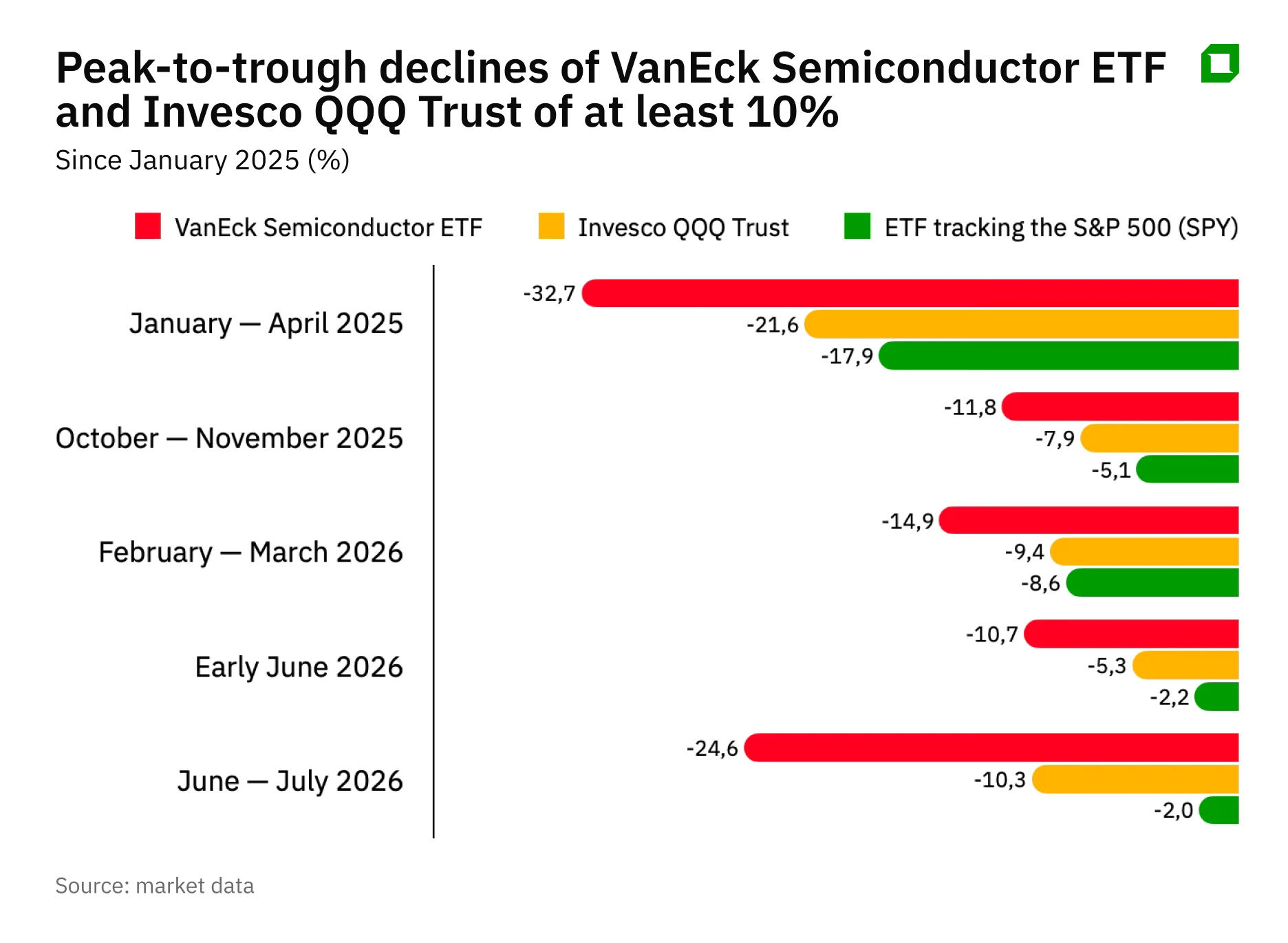
However, the past year and a half has shown that AI stocks can decline even when the broader market is not. An example is the performance of the VanEck Semiconductor ETF (SMH) and the Invesco QQQ Trust (QQQ), which tracks the Nasdaq-100.
Which call options should I buy?
Most companies in the S&P 500 are not involved in AI, so it’s not worth buying put options on an ETF that tracks a broad index (SPY). That would be betting on the entire market. During corrections in the AI sector, this ETF’s price fell by an average of just 7%, and in July 2026, it fell by only 2% while the chip sector dropped by 25%.
Which one should I choose?
— Nvidia
The leading AI stock and the symbol of the entire sector. The implied volatility of its options is around 36%, the lowest it has been in three years: insurance against a drop in the company’s stock price is currently cheaper than usual. In the five AI-driven corrections since 2025, NVDA has fallen by an average of 15%. The options are highly liquid.
— VanEck Semiconductor ETF
Investing in the entire semiconductor sector with a single stock mitigates the risk associated with any individual company. If a market correction begins due to AI, chip manufacturers will be the first to suffer. In four out of five market corrections since 2025, the SMH has fallen more sharply than the software sector (when compared to the iShares Expanded Tech-Software Sector ETF). In July 2026, the IGV rose 6%, while the SMH fell 25%.
— Invesco QQQ Trust
This is a bet on a potential decline in the Nasdaq-100, which consists largely of companies in the AI and big tech sectors. It works during both broad-market corrections and corrections in the AI sector. In this case, the put options have the lowest price in percentage terms and the narrowest spreads.
I prefer the January options series with an expiration date of January 15, 2027. It covers Nvidia’s earnings report on November 18 and the Fed’s December meeting, and the premium on these options declines more slowly than that of the December options. The February series is more expensive, and there are still few open positions in it for the Invesco QQQ Trust and the VanEck Semiconductor ETF.
For Nvidia, I chose a put option with a strike price of $200 and a contract price of $860; for QQQ, one with a strike price of $680 and a contract price of $1,735; and for SMH, one with a strike price of $510 and a contract price of $2,103. One contract represents 100 shares.
A parallel bet on defensive stocks
If we consider a correction scenario, it makes sense to simultaneously invest in securities that tend to be more resilient during such periods. The remaining portion of the investment (45%) can be allocated to these securities. Freedom analysts examined approximately 75 defensive stocks and ETFs during five AI-driven market corrections since 2025. It was not sector-specific ETFs that performed best (utilities and gold ETFs, on average, did not rise during these episodes), but rather individual companies.
These are Consolidated Edison, Chubb, AT&T, and Duke Energy.
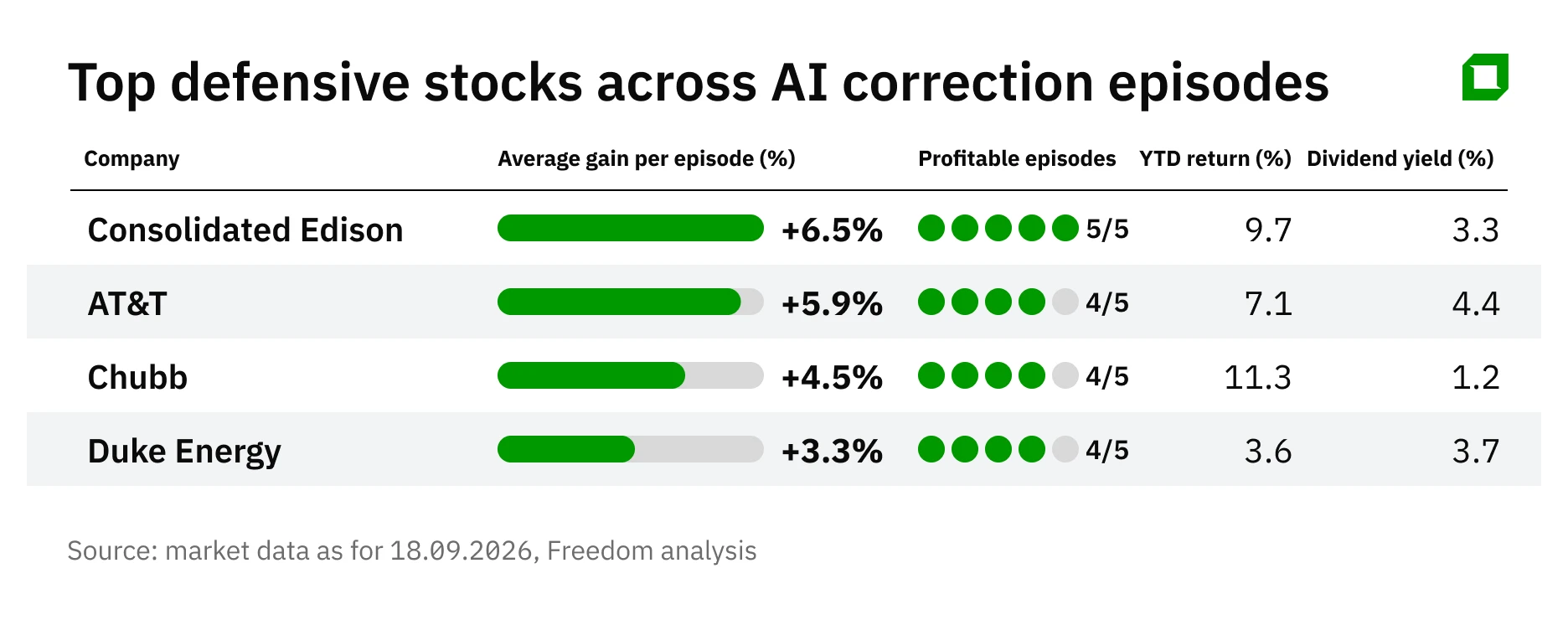
All four stocks moved in the opposite direction, on average, during the sharp sell-off in chipmaker stocks. Unlike Coca-Cola or Johnson & Johnson, for example, which have risen sharply in price, these stocks have not yet seen significant price increases.
For this part of the portfolio, we recommend buying the actual stocks rather than options: they pay dividends and don’t expire.
AT&T is a better fit for a call option strategy: a January call with a strike price of $26 costs about $125 per contract, and the spread (the difference between the option's bid and ask prices) is about 4%.
What will happen by January 15, 2027?
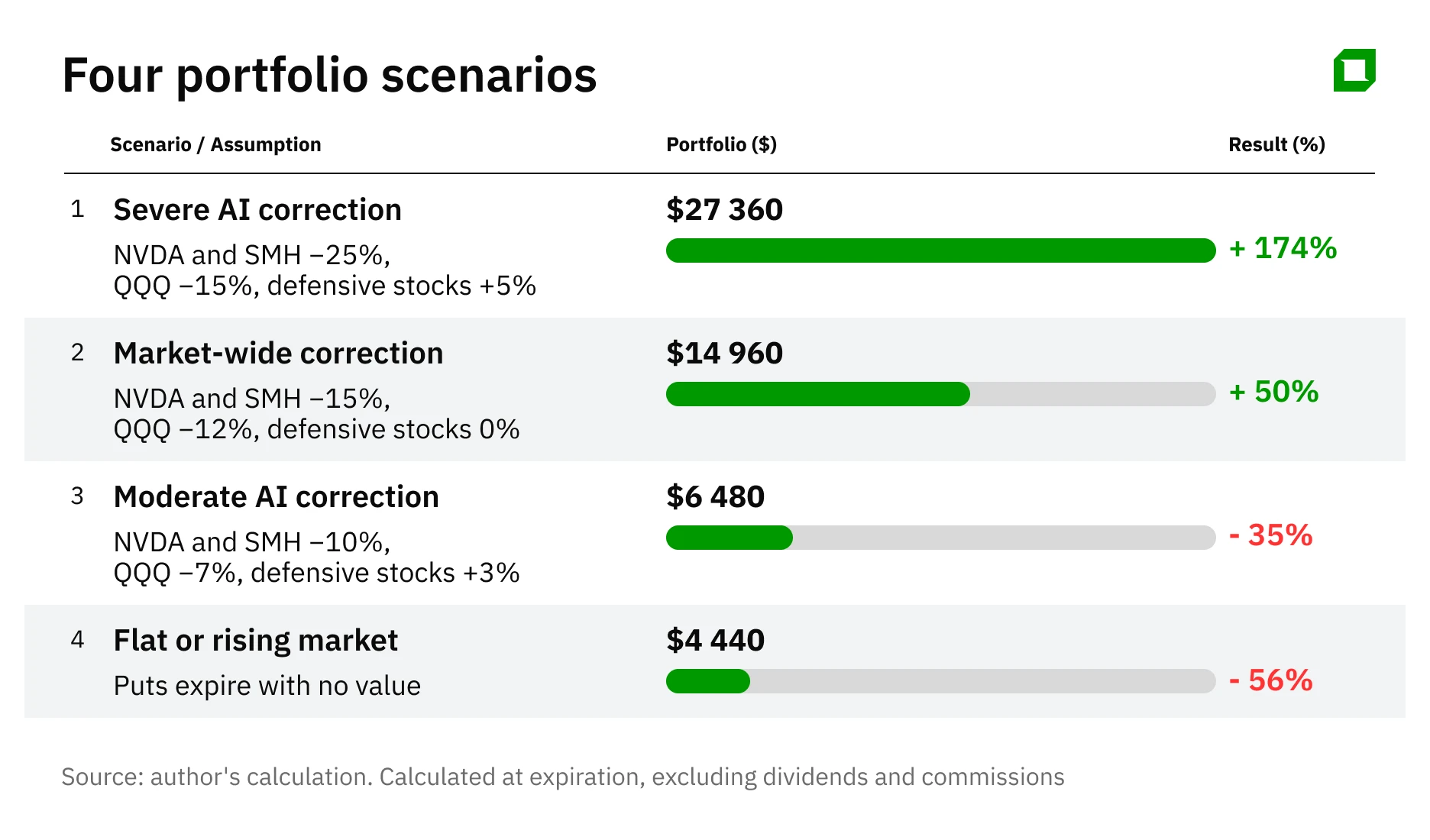
Key takeaway: This strategy only pays off if there is a significant correction. If the decline is minor or doesn’t happen at all, the portion involving put options will be lost, and the portfolio will lose about half its value. That is precisely why you should not allocate more than 50–60% of your investment amount to them. And even with this approach, the risk of such a strategy remains high.
Risks and Disclaimers
— A purchased put option requires predicting both the direction of the market and the timing. If a correction begins after expiration, the investor will lose the option premium.
— Historically, buying put options has been unprofitable on average: insurance costs money. It’s a deliberate bet on a specific scenario, not a way to make money “on average.”
— Defensive stocks do not guarantee growth: in February–March 2026, some of them fell in price along with the market. In addition, the Fed’s rate hikes will put pressure on utilities companies, including those on the proposed list of ideas.
This is not intended as individual investment advice.
This article was AI-translated and verified by a human editor