A Unicorn with Kazakhstani Roots: What Investors Are Paying for at Higgsfield

Higgsfield is competing for a client who has already been offered several options for organizing advertising production / Photo: Oninvest
In August, Higgsfield, a developer of tools for creating images and videos using AI, announced that it had raised $400 million. In this funding round, led by the investment firm DST Global, investors valued Higgsfield at $5.4 billion. One of the company’s co-founders and its chief technology officer is Yerzat Dulat, a native of Kazakhstan. The company’s headquarters are in California, and its engineering team is based in Almaty.
Today’s Higgsfield is no longer quite the same business that entered the market two years ago. The company is now building its business around advertising production: it combines its own and third-party models so that clients can move from concept to production-ready material. It’s not just about content creation—it’s about delivering a finished product.
Not every tool is right for the job
In 2024, Higgsfield’s initial focus was on its proprietary video-generation technology and the Diffuse mobile app. Users could create short videos featuring themselves and their friends. The company started out by providing entertainment for the general public and viewed an advertising platform as the next step.
Alex Mashrabov, co-founder and CEO of Higgsfield, explained that the mobile app quickly gained an audience, but users weren’t returning often enough. Visual effects specialists and professional marketers turned out to be the most interested. For them, the mobile version wasn’t enough, so in the spring of 2025, the company launched a desktop version of the product.
A marketer has a different set of tasks: there’s a product, a brief, and a deadline for the ad’s release. They need to maintain the product’s visual identity, choose the right presentation, and secure the materials for a specific placement. Higgsfield began expanding its offerings around these tasks.
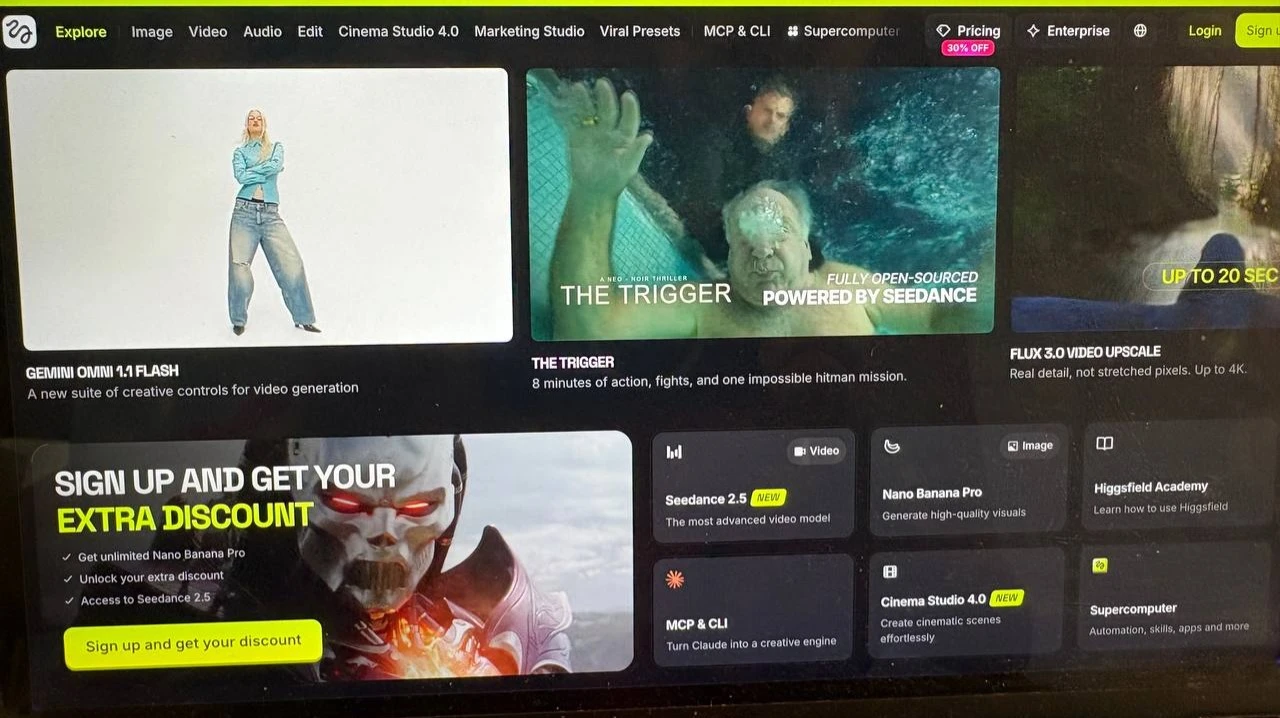
Let’s take a look at one of the scenarios in Marketing Studio—the Higgsfield section for advertising— which was updated in August. The user selects a template, such as a video featuring a speaking character, and uploads a photo of the product. The service creates a video up to 15 seconds long. In this scenario, there’s no need to write a detailed text prompt for the model: some of the solutions are already built into the template. Before publishing, the user reviews the result, including the voiceover and pacing. If another attempt is needed, the video is regenerated.
Another example is the Higgsfield tool, which turns a product page into an ad. In a breakdown of Higgsfield published by OpenAI in January 2026, the company describes how the service uses OpenAI models: GPT-4.1 and GPT-5 analyze product information and plan the video, the platform selects a predefined structure, and Sora 2 (an OpenAI model that generates videos and synchronized audio based on text descriptions or images) creates the video. The Click-to-Ad tool has been using OpenAI models at least since its launch in early November 2025. The client starts by providing a link to their product; the program translates it into tasks for various tools.
A general engineering principle is not to leave a model to tackle a long task on its own. The program passes data to the appropriate tools, saves intermediate results, and organizes checks and iterative steps. This type of execution organization is called a “harness.” If we were to summarize the shifting priorities with three slogans, they would be: 2023— “write a good prompt, ” 2025— “provide the necessary context, ” and 2026— “build a harness.” From instructions to information for the model, then to the structure of the entire workflow. The new does not replace the old: instructions and context are part of this system. In services like Higgsfield, its purpose is to spare the client from having to manually control every step.
Comparing AI to electricity helps illustrate this point: a universal technology opens up a multitude of applications. Continuing the analogy, a business can be built not only on a power plant but also on a refrigerator—a device designed for a specific task. Higgsfield creates such a “device” for advertising production: it transforms a client’s request into tasks for the generators. At the same time, the company continues to develop its own models, particularly for image editing. Its product does not require that every tool within it be proprietary as well.
How Does Higgsfield Make Money?
The story of Dollar Shave Club—an American retailer of razors and shaving products—shows why this is important for an advertising team. Laura Higgins, recently appointed Director of Brand and Innovation at Dollar Shave Club, discovered that there was no campaign ready for the Fourth of July in 2026, even though the U.S. would be celebrating the 250th anniversary of its independence. She decided to quickly capitalize on the theme of revolution: linking the uprising against the old order with the company’s promise to free customers from expensive shaving.
That’s how the ad featuring reimagined historical scenes came to be: George Washington, the future first president of the United States, fords the Delaware River, and the brand’s razors and gels appear among the period details. The deliberately artificial images helped drive the joke home, rather than making the scene look like documentary footage.
People came up with the concept. With the help of Higgsfield, a copywriter turned it into a storyboard—a sequence of future scenes—in just a few days. Then, a small in-house team used Higgsfield and the text-based AI assistant Claude to create different versions. In this case, the AI generation supported the advertising concept that had already been selected, rather than replacing it.
Higgins set the goals herself and reviewed the work before release. The first draft was ready in two or three days, and the final 30-second video took about a week. The entire campaign, from concept to launch, took about three weeks and went live on July 1, shortly before the holiday. The team received not just a collection of entertaining images, but an ad ready for the target date.
Dollar Shave Club’s reported campaign costs totaled just $400. To put that in perspective: the American studio Demo Duck estimates that producing a short commercial costs $25,000–50,000, not including placement costs. This doesn’t mean that the entire effort by the Dollar Shave Club team cost $400: the breakdown of that amount has not been disclosed.
It’s not just the generator that matters here, but also the selection process. In generative adversarial networks (GANs), the generator learns to create data, while the discriminator learns to distinguish between generated and real data. Let’s extend this idea beyond neural network training: the generator proposes, and the discriminator weeds out. It’s not necessary to aim for a flawless first attempt. You can create many options at low cost and choose carefully.
Coming up with a good solution and recognizing it are two different skills. In a 2021 OpenAI experiment, a small model with a trained evaluator that selected from 100 solutions to a math problem slightly outperformed a much larger model that lacked such an evaluator.
In advertising, such a “discriminator” is—for example—a team that knows its product and the brand’s style. If the options are inexpensive, suitable ones are regularly found among them, and since the selection process is fast and reliable, even a multitude of failures won’t prevent you from getting the right commercial. In the case of Dollar Shave Club, the team came up with a joke and decided what to produce: their judgment complemented Higgsfield’s creativity. The commercial success of the ad is then validated by the audience.
For the advertising team, this process repeats itself: the next product, a new occasion, a different platform. This makes Higgsfield’s business model clearer: selling ongoing access to tools and additional usage.
That’s exactly how the payment system works. According to information from a Higgsfield representative published on August 18, subscriptions accounted for about 70% of revenue, with the remainder coming from additional “credit” packages—virtual units used to pay for service usage. The revenue mix has also changed: while business users accounted for less than a quarter of revenue in January 2026, by August they were already generating more than half.
The company describes the scale of this change as follows: a year earlier, sales were approximately $20 million on an annualized basis; in August 2026, if sales from the previous four weeks were sustained throughout the year, they would total $700 million. This calculation is based on recent sales, not the amount already earned over the course of the year. The transition to professional operations coincided with a sharp increase in the stated commercial scale.
At the same time, Higgsfield reveals almost no internal business metrics: its profit margins, cost of generation, and customer retention rates are unknown.
In my view, this highlights the appeal of such a pricing model for investors. Higgsfield aims to become a regular part of the client’s operating expenses. New products and campaigns create recurring tasks—and a reason to pay for a working solution.
Runway and Adobe are competing with Higgsfield for the same job
“We benefit from the release of every new model,” says Mashрабов. A technological breakthrough by another company could improve Higgsfield’s product. But competitors could also take advantage of that same model.
Let's compare three scenarios for the same task: the team needs a short promotional video about a product. These can be described using three formulas.
“A template instead of a blank slate”—the Higgsfield scenario described above. Choose a template, insert a photo of the product, generate a short video, and review it. Most of the design decisions are already incorporated into the template: the client doesn’t have to come up with the video’s structure from scratch.
“Conversation Instead of a Remote”— Agent, an AI assistant from Runway, a developer of video production models and platforms. The user describes the product, target audience, and desired content; the assistant suggests a direction and creates the ad. The user can then ask to replace the voiceover or make the opening more energetic. In-house and third-party models work behind the scenes, while the client controls the outcome through dialogue.
"Generator in the Studio"is the approach taken by Adobe, the creator of Photoshop and other professional creative software. Firefly combines its own and third-party models with editing tools. The user creates content, refines it using another model or fine-tunes it in the editor, and continues editing in professional software. Content generation is seamlessly integrated into the familiar workflow of working on details.
The platforms' capabilities overlap; the formulas describe the selected scenarios. For the client, the difference is practical: how many decisions can be entrusted to the template, which tasks are best delegated to an assistant, and which ones the client prefers to control directly in the editor.
Its direct competitor is also seeing growth. On August 20, 2026, Runway reported that its subscription sales in Europe had increased by 50% over the previous twelve months. Higgsfield is competing for a client who has already been offered several options for organizing ad production.
The company has expanded its lineup of paid products, ranging from video generation capabilities to an advertising production tool. The ongoing competition with Runway and Adobe centers on whose tools teams will use on a daily basis.
Higgsfield’s story provides a useful benchmark for other AI companies as well. It’s important to look not only at the best model demonstration, but also at the costs involved in achieving the desired result: all the attempts, tests, corrections, and human time. The most impressive initial image and the most useful working product may come from different developers. Higgsfield’s goal is to be the product with which the client ultimately completes their work.
This article was AI-translated and verified by a human editor