AI Needs Energy and Power: 3 Stocks from Griffin's Portfolio with Growth Potential of Up to 400%

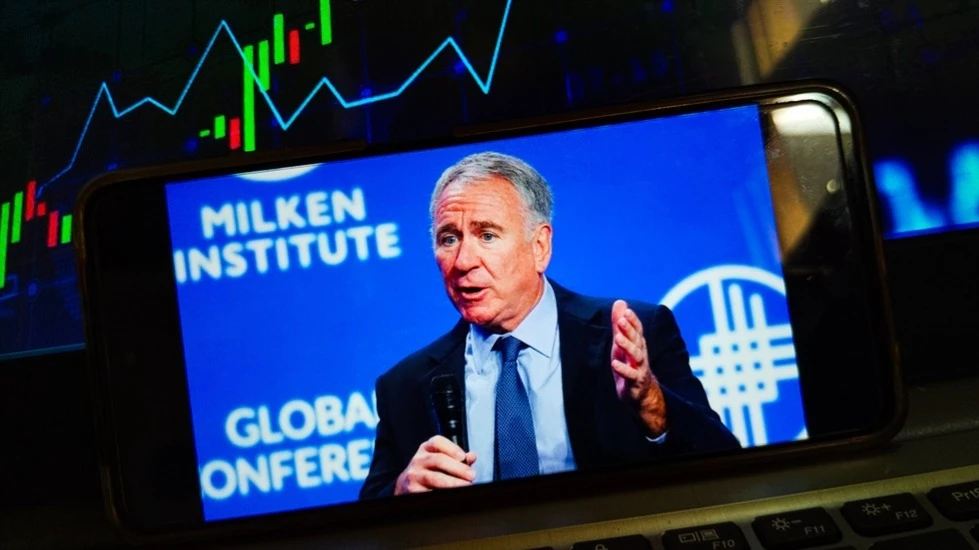
Founded by Ken Griffin, Citadel manages $77 billion in investment capital, according to the company as of October 1, 2026 / Photo: Erlin Diah / Shutterstock.com
In just a few years, artificial intelligence has evolved from an area of academic research into a trillion-dollar industry: it generates text and video, accelerates scientific discoveries, makes robots smarter, drives taxis, and detects cyber threats. The rapid development of this technology and its potential have made AI a central element of corporate strategies, economic policy, and geopolitics, according to a report by the International Energy Agency.
But artificial intelligence cannot exist without energy, notes the IEA. AI models are trained and deployed in energy-intensive data centers. A typical AI-focused data center consumes as much electricity as 100,000 households, but the largest ones currently under construction will require 20 times as much.
Sam Altman, CEO of OpenAI—the developer of ChatGPT—clearly illustrated AI's energy needs.
People are often curious about how much energy a ChatGPT request consumes. The average query consumes about 0.34 watt-hours (W·h), which is roughly equivalent to the power consumption of an oven for just over a second or a high-efficiency light bulb for a couple of minutes.
The largest market is the United States. By the end of the decade, data centers in that country will consume more electricity than the producers of aluminum, steel, cement, chemicals, and other energy-intensive goods combined, according to an IEA report.
Electricity is the primary—but not the only—resource that companies in the AI sector are competing for. The second is infrastructure. The largest companies tend to build their own data centers, while for smaller players, a model involving the use of a public cloud with shared infrastructure may be attractive, according to an S&P Global report. The latter approach has another advantage: it helps avoid numerous challenges, including potential supply disruptions and the need to comply with sustainability standards, the report notes.
Below are three small companies that generate revenue from the development of AI infrastructure and were part of the portfolio of Citadel Advisors, founded by Kenneth (Ken) Griffin, as of June 30, 2026, according to the Form 13F filing for the second quarter.
SharonAI
Australia-based SharonAI, with a market capitalization of $1 billion on the Nasdaq, provides computing infrastructure based on high-performance Nvidia graphics processing units (GPU-as-a-Service). Its existing data centers are located in Sydney and Melbourne. At the end of the second quarter, the company reported a 412% year-over-year increase in revenue, to $1.9 million. Its net loss for the same period soared 165-fold, to $430.4 million. Of this amount, $423.8 million was attributable to non-cash items, including a $400.4 million loss from the revaluation of convertible bonds amid rising stock prices, the company explained. As of August 6, it had $8.8 billion in contracts.
SharonAI went public as recently as February 2026, offering investors nearly 4.17 million shares at $30 apiece. Since then, its stock price has fallen by 6.7%. The stock has eight analyst recommendations, all of which are “buy.” The average price target of $112.44 implies growth potential of approximately 300% relative to the closing price on October 21.
Boost Run
Boost Run, with a market capitalization of $704 million, is a provider of scalable cloud infrastructure for enterprise artificial intelligence and high-performance computing (HPC). It provides customers with GPU and CPU computing power, data storage, and managed Kubernetes services on a subscription basis. The company lists Nvidia and Dell Technologies among its partners.
Boost Run operates six data centers in the U.S. and plans to launch three more in the near future, the company said in its second-quarter 2026 earnings report. At that time, Boost Run reported a 270% year-over-year increase in revenue, reaching $31.1 million.
This small-cap stock is also a newcomer to the stock market—it went public in May 2026 following a merger with the SPAC Willow Lane. On its first trading day, May 11, its stock closed at $21; since then, the price has fallen by nearly 60%. However, Wall Street believes in the company’s prospects. Its stock has five analyst ratings, all of which are “buy.” The average price target of $42.2 implies 402% upside potential relative to the last closing price.
ProPetro Holding
ProPetro, with a market capitalization of just over $939 million, provides services to oil and gas companies—ranging from hydraulic fracturing to power supply. In late 2024, it established ProPWR, a division that provides mobile natural gas-powered electricity generation for data centers, oil and gas companies, and industrial clients—without the need for connection to the power grid.
At the end of the second quarter, the holding company’s revenue fell 6.2% year-over-year to $305.8 million. The net loss for the same period rose by 13.4% to $8.1 million, while the loss per share remained unchanged at $0.07.
Over the past 12 months, ProPetro’s stock price has risen by nearly 21%, but it is down nearly 20% year-to-date. Seven Wall Street analysts recommend buying the company’s stock, while five others recommend holding it. The average price target is $15.3, which is twice the stock’s closing price on October 21.
This is not intended as individual investment advice.