Brent, Chevron, Occidental: how will the US operation in Venezuela affect the oil market?

Following the US military operation in Venezuela and the capture of President Nicolas Maduro, there are two possible scenarios for the country's oil industry, Jorge Leon, head of geopolitical analysis at consulting firm Rystad Energy, told Bloomberg.
The first option is a quick and peaceful transfer of power, which would allow sanctions to be lifted and exports to resume as normal. In the second scenario, the transfer of power would be more difficult, leading to internal conflicts and disrupting production in Venezuela.
"Much will depend on the military's next moves," Leon said. "Which of these scenarios is more likely will become clear in the coming days and hours."
Who will win and lose from the change of power in Venezuela?
The US military operation was preceded by months of escalating tensions between Washington and Caracas. In December, after the Americans seized oil tankers off the coast of Venezuela, analysts at Seeking Alpha attempted to assess how a potential US invasion of Venezuela would affect the energy sector. Here are the conclusions they reached:
— The most obvious immediate beneficiaries are American oil companies that do not operate in Venezuela. These include Occidental Petroleum and Diamondback Energy. They will be able to generate high free cash flow amid rising oil prices and moderate capital expenditures, explained analyst Louis Gerard.
Chevron's assets, on the other hand, will be at risk in the short term, he continued. Chevron is currently the only major US oil corporation drilling in Venezuela. On the other hand, in the long term, Chevron could be the biggest beneficiary of increased production in the country in the event of a successful regime change and privatization of the state-owned oil company Petróleos de Venezuela. After the air strikes on Venezuela, Chevron said it was giving top priority to the safety and well-being of its employees and the security of its assets.
— Oilfield service companies such as SLB and Baker Hughes will also benefit from the potential increase in production in Venezuela, the analyst noted.
— The losers in this scenario will be oil refining companies on the US Gulf Coast, such as Marathon Petroleum and Valero Energy, whose refineries are geared toward processing heavy oil. If supplies in the region are completely cut off, these companies will have to switch to Canada and pay a premium, which will lead to higher costs and lower refining margins.
— Analysts also anticipate a short-term spike in oil prices. However, in the longer term, everything will depend on how the transition of power proceeds, they note. An effective transfer of power could lead to a rapid increase in oil exports to the global market. However, historically, large oil-producing countries that have been under military pressure from the US (Iraq, Libya) have been unable to restore production to previous levels, Seeking Alpha notes.
What is known about Venezuelan oil
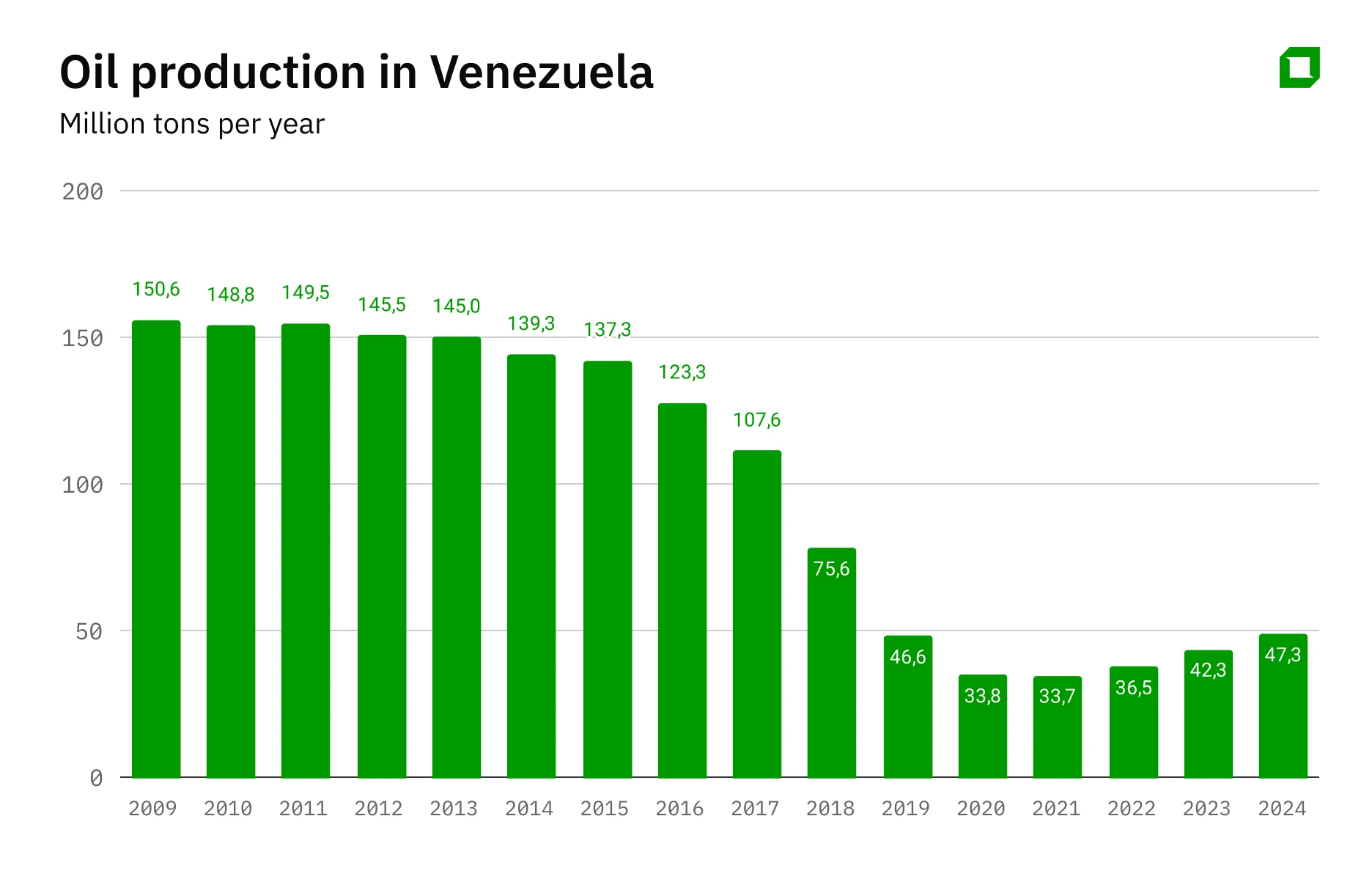
Venezuela is considered to have the world's largest oil reserves, but its production is hampered by Western sanctions. Before the partial blockade by the US, oil production in Venezuela was just under 1 million barrels per day. Ten years ago, this figure reached almost 2.5 million barrels per day. Returning to this level — and even higher — will take time and require a clear and feasible plan for the post-Maduro era, writes Bloomberg.
It is more difficult to estimate oil exports from Venezuela — many tankers loading there resort to "Iranian tactics": they hide their location in Venezuelan waters and resort to secret ship-to-ship transshipments. According to Bloomberg, Venezuelan oil shipments are estimated at between 500,000 and 800,000 barrels per day.
This article was AI-translated and verified by a human editor