Can Helly Hansen and the sale of Lee deliver 50% upside for Wrangler owner Kontoor?

Over the last 12 months, Kontoor Brands stock is down 20% / Photo: Kontoorbrands.com
Kontoor Brands, the owner of Wrangler, has always sought to sell more than just jeans – it offers a lifestyle rooted in casual American style. Over the last year, the stock has fallen 20%, and the company is now overhauling its denim business. It is promoting Wrangler’s Western image to women with the help of Barbie, has acquired outdoor apparel maker Helly Hansen, and has decided to sell Lee, whose sales have been declining. Can this strategy accelerate growth, what threat does super El Niño pose, and why do analysts see upside of 50% for Kontoor stock?
Marlon Brando and cowboys
Kontoor Brands is a relatively young company. It was spun off in 2019 from VF Corporation, a large U.S. fashion conglomerate whose brands include Vans and North Face. The new company inherited Lee and Wrangler, denim labels with long histories.
Lee traces its roots to 1889. Founder Henry David Lee was a wholesale grocer who launched his own line of overalls. Lee jeans became a fashion staple and a symbol of youth culture only in the 1950s, thanks to movie stars Marlon Brando and James Dean. Wrangler dates back to the 1940s, when its jeans were designed and “made by cowboys for cowboys,” wear-tested by rodeo stars.
Denim was the backbone of VF Corporation for years. In 2003, it accounted for more than half of sales. By the late 2010s, however, the denim business had become less attractive than the company’s other brands, such as Vans and North Face. In 2018, VF Jeanswear revenue fell around 2% to $2.76 billion, while other business segments grew by high single digits.
A new era
VF Corporation spun off its denim business in 2019, naming the new company Kontoor Brands and giving it the Wrangler, Lee, and Rock & Republic brands. VF distributed 100% of Kontoor's equity to existing shareholders and retained no stake in the company. Shareholders received one share in the new company for every seven VF shares they held.
At the same time, Kontoor took on around $1 billion of debt under a new credit facility and transferred most of the proceeds to VF. Kontoor subsequently warned that the debt could restrict its future business strategy and adversely affect its results, financial condition, and cash flows.
On the first day of trading, Kontoor CEO Scott Baxter wrote that “Kontoor Brands begins an exciting new journey as a global lifestyle apparel company.” The company planned to grow its denim brands independently by expanding beyond its successful men’s jeans business and wholesale sales. “This was set up for men’s denim bottoms—print, repeat, sell it to the wholesale channel,” Barclays Vice President for Equity Research Paul Kearney said in 2024, describing the denim business under VF. “Really the journey since then has been about creating this as a stand-alone entity that can explore other opportunities for growth.”
Barbie goes Western
The transformation proved difficult, however, as the company’s key brands moved in different directions. By 2023, Wrangler accounted for almost 70% of revenue. Its share of the company’s total revenue had risen steadily over three years, while Lee’s had fallen, Kontoor data showed.
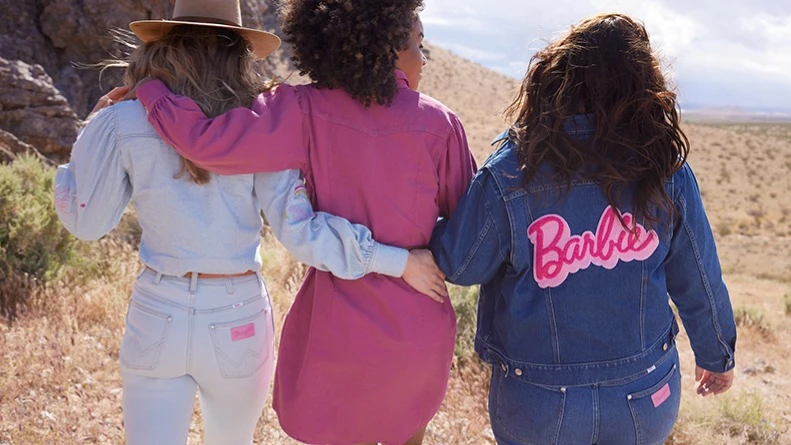
Wrangler’s decision to focus on women helped drive its momentum. The brand’s partnership with country music star Lainey Wilson, known for her role in the modern-day Western series “Yellowstone,” supported the strategy. Meanwhile, the Wrangler x Barbie collaboration in autumn 2023 became, in the company’s words, its “fastest-selling collaboration ever.”
The expansion of Western apparel became one of Wrangler’s key growth drivers. Kontoor called 2024 “Wrangler’s most successful year in decades,” as sales by its U.S. Western business rose 5%. Wrangler also began building out its outdoor apparel line. The category generated more than $200 million in revenue in 2024, up 15% versus the previous year and double the level five years earlier.
Lee also sought to shed its legacy image and court younger consumers. However, collaborations with Japanese anime franchise Dragon Ball Z and Chinese streetwear brand Roaringwild failed to reverse the downward trend. Lee’s revenue fell 4% to $843 million in 2023. The decline accelerated to 6% in 2024, with the top line at $791 million.
Helly Hansen comes into the picture
In search of new growth, Kontoor announced in early 2025 that it had agreed to acquire Helly Hansen, a Norwegian sailing and ski apparel brand, for around $900 million.
Founded in 1877, Helly Hansen is known for a series of technological breakthroughs, like the first fleece fabrics for sportswear in the 1960s, moisture-wicking base layers in the 1970s, and its patented H2Flow temperature-regulating system in 2012. Helly Hansen gear is popular with national teams and Olympic athletes.
Kontoor acquired the brand from Canadian retailer Canadian Tire, seeking access to a more affluent, active, and younger consumers, as well as greater geographic diversification. From June through December 2025, Helly Hansen generated $475 million in revenue, more than three quarters of it internationally.
Sale of Lee
In May this year, Kontoor announced that it had agreed to sell Lee to Authentic Brands Group, whose portfolio includes Reebok and Guess, for up to $1 billion. It planned to focus on its faster-growing brands, Wrangler and Helly Hansen.
Kontoor believed that Lee’s first major brand equity campaign in years had helped improve perceptions of the brand, but its sales still fell 5% in 2025. The agreement provided for an initial payment of $750 million and a potential earnout of up to $250 million based on Lee’s future performance under Authentic Brands Group’s ownership.
The deal is expected to close in the fourth quarter. Kontoor plans to use $400 million of the proceeds to accelerate share buybacks and pay down debt.
Where things stand
In the second quarter, Kontoor’s revenue from continuing operations rose 19% year over year to $584 million. Helly Hansen contributed $114 million, while Wrangler sales increased 2%. Adjusted operating income was up 19% at $94 million. The management raised its full-year adjusted earnings per share forecast to $5.25-5.35. Long-term debt remained significant at $1.1 billion at the end of the quarter.
In early September, Kontoor outlined Helly Hansen’s long-term strategy and financial targets through 2030 at the brand’s investor day. The company aims to increase Helly Hansen’s revenue to more than $1.1 billion from $675 million in 2025, bring its operating margin into the mid-teens, and generate more than $500 million in cumulative cash through 2030.
“We’re deepening our presence in the U.S., strengthening our position in the Alps, and growing across outdoor and workwear, where our opportunity is greatest,” Helly Hansen Global Head Børre Hegbom said, outlining plans to scale the European brand.
What analysts say
Analysts are divided on Kontoor’s prospects as an investment. JPMorgan North America Equity Research analyst Matthew R. Boss is optimistic (his September 3 note was seen by Oninvest), arguing that the portfolio transformation over the last five years, including the sale of Lee, has created the foundation for mid-single-digit-plus revenue growth and mid-teens total shareholder returns. Boss has maintained his “overweight” rating and target price of $105 per share, implying 63% upside from Thursday’s close. Barclays analyst Adrienne Yih and her colleagues likewise have maintained an “overweight” rating at a target price of $99 per share (their September 8 note was also seen by Oninvest).
BNP Paribas Securities analyst Laurent Vasilescu points to weather-related risks for Helly Hansen, much of whose business is tied to winter sports. During the previous super El Niño, a climate phenomenon in which sea surface temperatures in the equatorial Pacific become abnormally warm every few years, the brand’s revenue fell 5% in 2015 and another 7% in 2016, he noted in a note (seen by Oninvest). The risk is again high: the U.S. National Oceanic and Atmospheric Administration puts the probability of a very strong El Niño in autumn and winter 2026-27 at more than 90%. BNP Paribas has reiterated its “underperform” rating at a target price of $50 per share. It is the lowest valuation on Wall Street and implies 24% downside.
Overall, Wall Street remains upbeat on Kontoor. According to MarketWatch data, eight of the 11 analysts covering Kontoor rate it “buy” or “overweight,” versus two “hold” and one “sell.” The average target price of $97.50 per share implies 51.3% upside from Thursday’s close.