ChatGPT, Claude and DeepSeek invested my €500. None of them made any money

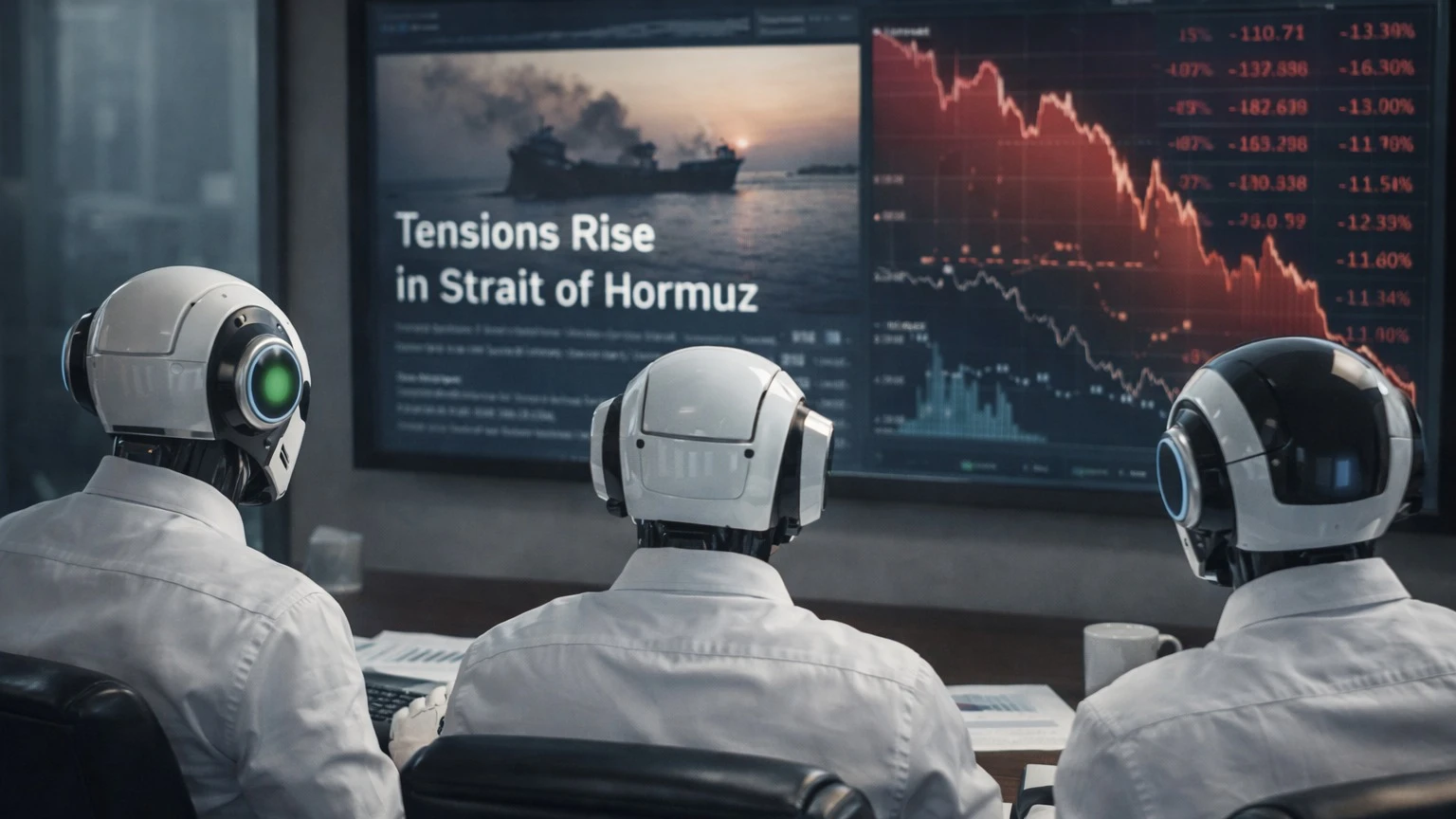
Only one stock out of those selected by chatbots turned out to be profitable: it was the securities of crypto exchange Coinbase. The illustration was created with the help of AI.
Five days before the war with Iran, I tasked three AI chatbots to invest €500 for a month at my maximum return. All three bots warned me that investing for that long was highly speculative. Besides, neither they nor I were prepared for the war in the Middle East. As a result, all portfolios went into negative territory.
Where it all began
Let me remind you that on February 24, I gave a task to three chatbots to invest €500 for one month. The experiment involved "Americans" - ChatGPT from OpenAI, Claude from Anthropic, and the Chinese DeepSeek. I asked them to ignore the moral aspects of investing (for example, investing in defense companies), to offer only stocks, without ETFs, currencies, gold and other protective assets. It was not about a diversified portfolio, but about maximizing aggressive growth. I was asked to offer several options, finding interesting bets in different regions or sectors, and to provide a final shortlist of three stocks. The experiment lasted until April 6 inclusive.
All three chatbots picked shares of European ASML - this company has a unique technology for manufacturing high-precision chips. The American AI got it in the selection by regional markets, the Chinese DeepSeek took it to the final shortlist.
In the end, all three chatbots got it wrong with this stock, with the European manufacturer's securities falling more than 12% to $1304 (closing data on April 6).
US AI bots recommended betting on its partner Nvidia. But its shares have fallen more than 7% since the day of the experiment, to $177.64.
In addition, both ChatGPT and Claude recommended investing in Coinbase stock. And the cryptocurrency exchange's shares rose just over 9% to $174.8 as of April 6.
What happened to each portfolio?
ChatGPT error: strategy not fit for purpose
ChatGPT, in addition to Coinbase and Nvidia, bet on Rheinmetall. But shares of the German defense giant fell 7.7% during the experiment period, to €1,570 at the close on April 2 (European exchanges were down on April 3 and 6).
Nvidia 🔻 7.3% Rheinmetall 🔻7.7% Coinbase ✅9.1%
ChatGPT offered to invest €200 in Nvidia, and €150 each in Coinbase and Rheinmetall. The portfolio loss was €12.45 and the total return was minus 2.49%. If the €500 had been equally distributed, the loss would have been less than 2%.
ChatGPT wrote in his defense what his strategic error was:
It was not a "stock selection failure", but a failure of investment logic for a given horizon. I gave long-term ideas for a short-term task. But the market was declining during this period and all securities were falling at the same time. The failure was not in the choice of companies - they are of high quality. It was in the inconsistency of the strategy with the task to get maximum profit for 1 month. I suggested betting on long-term trends. It was necessary to bet not on trends, but to look at events. And the main thing: you should have made at least one bet against the market.
Claude's mistake and hallucination: failed to take into account political risks in the US
Claude on Anthropic had a third bet on Super Micro Computer - and it was an utter failure: the stock fell more than a quarter, from $30.71 to $22.05.
Nvidia 🔻7.3% Super Micro Computer 🔻28.2% Coinbase ✅9.1%
The total for the Claude portfolio over the course of the experiment was a loss of €43.96 or -8.79% of the €500 invested.
Claude (probably out of guilt!) glossed over this by writing that the main reason for the failure was the "external black swan". If you thought he was referring to the war in the Middle East, he wasn't. According to Claude's version of the story, Trump declared so-called "Emancipation Day" on April 2, imposing sweeping tariffs that affected almost every sector of the U.S. economy. But the problem is that this was a year ago.
No model would have predicted the exact date and magnitude of that decision. But that doesn't absolve me of responsibility for picking the stocks that were most vulnerable: - All three are in the technology sector, which was hit the hardest. - All three are high multiples, so they fall the hardest on a sell-off. - No positions from other sectors to diversify (even though you asked for three stocks). - A one-month horizon is too short to recover from the shock.
Claude's conclusion was the same as ChatGPT's: the recommendations were based on fundamentals, but we should have taken into account the political risk in the U.S. and not concentrated everything in one sector.
"This is my mistake in choosing a strategy for a particular timeframe," Claude admitted.
DeepSeek error: blamed the person
DeepSeek, in addition to ASML, bet on less promoted players. And if the American chatbots had at least one share in the plus, the Chinese one was a loser in all positions. Celestica, which provides critical data center infrastructure for AI, posted a minus 1.5%, falling to $292.3. Shares of Latin American fintech Nu Holdings fell 11.9%, from $16.19 to $14.15.
ASML 🔻12.3% Celestica 🔻1.5% Nu Holdings 🔻11.9%
The DeepSeek portfolio had a loss of €42.74, or -8.55%
DeepSeek also admitted its failure, but reminded me several times that it had played by my terms. The Chinese chatbot noted that his Feb. 23 market was logical - all three stocks were in uptrends. He also glossed over the fact that ASML was probably down because of new export restrictions to China announced by the US and the Netherlands in March. That hasn't happened this year.
The main mistake is underestimating the fragility of "betting on everything that grows." When you demand maximum profit without regard to moral constraints, but with a ban on ETFs and protection, the only thing left is high-risk aggressive growth. In such a portfolio, failure in a month is not the exception, but a likely scenario. I didn't put in enough hedge and didn't offer short positions or options (you asked for equities only). The second mistake - three stocks from two different sectors (tech + fintech in EM), but all three correlate with global risk appetite. When it fell, everyone fell.
Now DeepSeek recommends not to sell anything on panic, if there are no new negative signals. A drop of 11-12% in a month is a normal movement for such stocks.
"Waiting for a recovery is prudent, especially for ASML and Celestica, whose fundamental drivers have gone nowhere," the Chinese chatbot added.
What people think
The experiment using AI chatbots to generate baskets of investment ideas looks interesting as an illustration that large language models are good at understanding and reflecting current market consensus trends and topics that are in the focus of investors' attention today. However, the results of such an experiment should be interpreted with caution, says George Timoshin of Freedom.
There is a noticeable mix of two different levels of recommendations in the text. First, LLM offer structural allocation by regions and sectors, which is closer to the classical portfolio approach. However, in the final version, a thematic basket (this cannot be called a portfolio) is formed from a few specific stocks that do not actually correspond to the stated geographic structure. As a result, strategic allocation is de facto transformed into a concentrated speculative basket, where increased idiosyncratic risks at the level of individual companies appear, and the diversification effect practically disappears

In his view, it is also interesting that all three models focus heavily on the same themes. Recommendations are dominated by AI and defense-related companies, as well as certain highly volatile stories. Crypto-infrastructure, for example. This is more a reflection of the current market consensus narrative than a search for so-called alpha, a metric that assesses investment performance relative to market returns, Timoshin says.
Thus, such an experiment is more of a demonstration of which ideas and sectors are now perceived by the market as potentially the most volatile and capable of sharp movements, which may be of interest to the short-term speculator. However, a full-fledged investment process usually requires a clearer understanding of strategic allocation and risk management approaches, he said.
Experimental outcome
The first place goes to ChatGPT, its investment brought the least losses.
DeepSeek is in second place. In absolute terms, he lost about the same amount of money as Claude. But I would take away a point from the Chinese chatbot for passive aggression and blaming the person for the wrong task.
Claude got the worst score. Not understanding what year he is living in is also alarming - minus a point for hallucinations.
This article was AI-translated and verified by a human editor