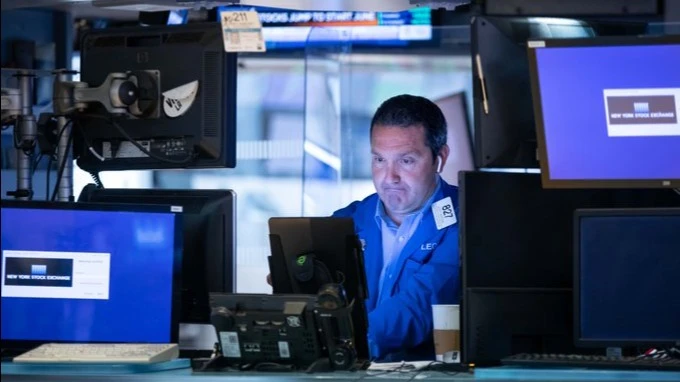
Google has acknowledged that AI is impacting its core business. What should investors keep an eye on?
Following the release of its earnings report, Alphabet risks losing more than $400 billion in market value in a single day—more than at any time in the company's history

Analysts have identified the factors that will determine whether Google's stock decline will continue after the earnings report / Photo: Alena Veasey / Shutterstock.com
Google acknowledged that AI has begun to erode revenue from web search, its core business. Growth in search advertising slowed more sharply than analysts expected in the third quarter due to the company’s own chatbot, AI Mode: advertising on it currently generates less revenue than in traditional search results with a list of links. Search accounts for about half of the revenue of Alphabet, the holding company that owns Google, and it is this revenue that funds the massive investments in AI, according to Bloomberg. Due to record capital expenditures on artificial intelligence, Alphabet’s free cash flow was negative for the second consecutive quarter, the Financial Times notes.
Following the quarterly earnings report, Alphabet’s stock fell by more than 10% in premarket trading on October 29. If the decline continues during the regular trading session, the holding company will lose more than $400 billion in market value in a single day, which would be a record low in its history, according to the FT.
Three questions are now important for shareholders: Will the search business be able to pick up speed again? How much will capital expenditures increase in 2027? And will the cloud business become a new pillar of Alphabet in time?
The cloud won't replace search growth. The market fears that AI will take revenue away from Google’s core business, and investors need to see that search revenue growth is accelerating, not slowing down, says Dave Wegner, portfolio manager at Aptus Capital Advisors. “Right now, the main argument in favor of the stock is the cloud business, but until search proves that AI is driving growth, the stock will likely continue to fall,” Reuters quotes him as saying. In fact, search revenue grew by only 12% year-over-year in the last quarter, even though growth was approaching 20% at the start of the year, the FT notes.
Capital expenditures will continue to rise. Alphabet CFO Anat Ashkenazi warned that spending will increase significantly next year compared to this year—in 2026, the company expects capex to range from $195 billion to $205 billion. Bank of America estimates that capital expenditures in 2027 will total $300 billion. This “could very well scare the market,” according to Jeremy Saltsburg, a senior investment specialist at Check Capital.
New debt and a stock offering are possible. Gil Luria, head of technology research at D.A. Davidson, is one of the few analysts who does not recommend buying Alphabet stock, maintaining a neutral rating, according to MarketWatch. He titled his note to clients following the earnings report “The Quarter We’ve Been Afraid Of?” Luria fears a sharp rise in expenses and that Alphabet will take on new debt. The company has already borrowed tens of billions of dollars, and in June announced its first stock sale in more than 20 years—worth $85 billion. The slowdown in advertising revenue growth may continue, so investors should be more cautious, Luria told CNBC.
A comparison with Microsoft does not favor Google. The markets are carefully weighing how capital expenditures relate to free cash flow, explains Dec Mallarkey, managing director of SLC Management . According to him, Alphabet’s competitor in the cloud business, Microsoft, “stands out for its spending discipline and delivers growth,” while Google “has failed to do so, and cash flow is expected to remain a weak spot throughout the coming year,” writes the FT. Microsoft also reported its results on Wednesday: with capital expenditures of $45.2 billion for the quarter, it maintained free cash flow of $18.6 billion.
By 2028, cloud computing will surpass search. That’s the prediction of Scott DeWitt, an analyst at Rosenblatt Securities , according to MarketWatch. For now, the gap is wide: in the third quarter, the cloud business generated $30.7 billion in revenue, while Search and YouTube combined generated $74.6 billion. But cloud revenue has doubled over the past year, and the order backlog has reached $561 billion; Alphabet expects to convert more than 55% of that into revenue over the next 24 months, Reuters reports. DeWitt calls this a “shift in the center of gravity”: investors will need time to come to terms with the fact that search may no longer grow as quickly as it has until now.
The overwhelming majority of analysts recommend buying Alphabet stock, and none of them have withdrawn that recommendation since the earnings report, according to a MarketScreener summary. For example, RBC analyst Brad Erickson lowered his price target from $425 to $400 but maintained his “buy” rating. According to The Wall Street Journal, only six out of 72 analysts recommend holding the company’s stock in a portfolio; none suggest selling. On average, Wall Street values Alphabet shares at $420.6—29.5% above the last closing price.
This article was AI-translated and verified by a human editor