Morning in New York: A Cloud Race Meets Earth's Gravity

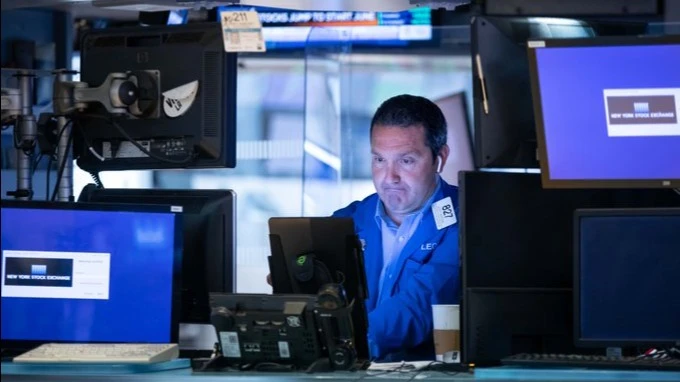
Earnings reports from Microsoft and Alphabet confirmed exceptionally high demand for AI infrastructure, but investors reacted in the opposite way / Photo: X / NYSE
A daily review and forecast of events in the U.S. stock market by Mikhail Denislamov, Deputy Director of Freedom Capital Markets Research.
We expect
Earnings reports from Microsoft (MSFT) and Alphabet (GOOGL) confirmed exceptionally high demand for AI infrastructure: Azure revenue grew 48% year-over-year, while Google Cloud revenue rose 103%. However, investor reaction was the opposite: MSFT shares are up about 3–4%, while GOOGL is down 10–11%. Microsoft’s free cash flow totaled $18.6 billion, but lower-than-expected capital expenditures are partly attributable to the deferral of computing capacity deliveries. Alphabet’s negative cash flow of $9.1 billion is due, in part, to a one-time payment of a $5.2 billion fine to the European Commission and an increase in equipment inventory. Thus, the difference in cash flows does not fully reflect the differences in the two companies’ financial profiles.

Concerns about the impact of AI agents on Google’s search advertising model have added to the pressure on Alphabet. As AI search evolves, users will increasingly receive ready-made answers and ask agents to perform tasks instead of clicking on traditional links. In 2027, this process could accelerate, creating the risk of a slowdown in advertising revenue amid as-yet-unclear prospects for monetizing new formats. Overall, the results from both companies confirm the resilience of demand for AI, but investors are increasingly concerned about the scale of future investments, their payback periods, and the ability of tech giants to finance further growth using their own capital.
The next tests for the market will be the September PCE inflation data and the first estimate of third-quarter GDP, followed by Amazon’s (AMZN) earnings report after the market closes. We forecast a 0.3% month-over-month increase in the core PCE index, in line with average market expectations, though about a quarter of Wall Street analysts expect a 0.4% rise. Such a result would increase the risk of a more hawkish stance by the Fed in December and intensify pressure on certain stock sectors.
The overall PCE index is expected to rise by 0.5% MoM after 0.3%, while the core index is expected to rise by 0.3% after 0.25%. Personal income may rise by 0.3% MoM after 0.2%, while personal spending may increase by 0.5% after 0.9%. Estimates for GDP growth vary significantly: the market consensus suggests 3.0% on an annualized basis after 2.2%, while we forecast 2.6%. The main uncertainty relates to inventories and net exports, for which yesterday’s data sent mixed signals.
WTI crude oil is consolidating in the $101–102 per barrel range following yesterday’s rise. Risks to Middle Eastern supplies remain, but they are partially offset by diplomatic efforts regarding Iran.
Before the main session opens, Eli Lilly (LLY), Merck (MRK), Mastercard (MA), Caterpillar (CAT), Altria (MO), Intercontinental Exchange (ICE), and L3Harris (LHX) will report their earnings. After the market closes, Amazon (AMZN), Intel (INTC), Gilead Sciences (GILD), Starbucks (SBUX), Mondelez (MDLZ), Monolithic Power Systems (MPWR), Coinbase (COIN), and Digital Realty (DLR) will report their results.
S&P 500 futures are showing a moderately negative trend, while Nasdaq-100 contracts are down more than 1%. We assess the risk balance as negative and expect increased volatility. Nevertheless, opportunities for selective buying on dips will arise if Microsoft (MSFT) reaches a new all-time high and inflation comes in within expectations. Pressure will be concentrated in the communications sector amid Alphabet’s (GOOGL) earnings report and in the software segment due to earnings reports from ServiceNow (NOW) and Fortinet (FTNT).
What to Watch for in the Pre-Market
— Alphabet (GOOGL) is down nearly 11% in premarket trading. Third-quarter EPS came in at $2.12, below the market consensus of $3.02, partly due to a loss on equity investments. Google Cloud revenue ($30.7 billion) exceeded expectations, while the search segment ($63.3 billion) unexpectedly fell short. Capital expenditures reached a record $51.4 billion, and the company expects them to grow significantly by 2027. The strong performance of the cloud business has not yet addressed concerns about the return on investment in AI.
— Microsoft (MSFT) is up nearly 3%. Revenue for Q1 of fiscal year 2027 ($92.3 billion) and adjusted EPS ($4.89) exceeded the market consensus estimates ($90.7 billion and $4.73). Azure grew by 48%, compared to management’s guidance of around 45%, and the company forecasts 49–50% growth in constant currencies for the next quarter. Capital expenditures totaled $45.2 billion, compared with the expected $50 billion, although the company plans to accelerate investments in the next quarter. These results set Microsoft apart from its competitors, which have faced cash outflows.
— Major software companies ServiceNow (NOW) and Fortinet (FTNT) are down 18% and 26%, respectively, despite reporting revenue that exceeded expectations. ServiceNow forecasts a slowdown in cRPO growth to 18.5% in the fourth quarter, down from 21% in the third quarter on a constant-currency basis. Fortinet raised its full-year revenue forecast to $9.57–9.72 billion but warned of pressure on product margins due to rising component costs. High expectations continue to weigh on the software sector.
— Marvell Technology (MRVL) is down 11%, while Lumentum (LITE) is up about 5% on reports from Bloomberg and Reuters that Marvell is in advanced talks to acquire Lumentum. The market capitalization of the manufacturer of optical components for AI data centers is about $83 billion, which is many times greater than Marvell’s cash reserves (about $3.9 billion). Investors will be watching the financing structure of a potential deal.
The Market on the Eve of...
Trading on October 28 on U.S. stock markets ended higher. The S&P 500 gained 0.28%, the Dow Jones rose 0.19%, the Russell 2000 gained 0.41%, and the Nasdaq-100 rose 0.55% thanks to gains in semiconductor and memory manufacturers, while shares of major tech companies were mostly lower. At the same time, market breadth remained weak: on the NYSE, decliners outnumbered advancers by a ratio of 1.21:1, on the Nasdaq, gainers outnumbered losers by a ratio of 1.56:1, and the equally weighted S&P 500 once again underperformed the main index. Among sectors, IT (+0.80%) led the way amid a continued rebound in the AI segment, while utilities (−0.84%) and real estate (−0.73%) underperformed the market.
The Fed’s decision came as no surprise: the central bank kept the target range at 3.75–4.00%, though Lisa Cook and Beth Hammack voted against it, advocating for a rate hike. Kevin Warsh offered no guidance on the path of monetary policy, acknowledging the tightening of financial conditions. Nevertheless, the long end of the yield curve rose significantly: the yield on 10-year Treasuries rose by 4 basis points to 5.03%, the 30-year yield rose by 5 basis points to 5.35%, while the 2-year yield fell by 2 basis points to 4.71%. Following the meeting, the market estimates the probability of a rate hike in December at more than 80%.

Corporate news confirmed the resilience of demand for AI infrastructure. Oracle (ORCL: +10.7%) predicted $30 billion in free cash flow for fiscal year 2029 at its investor day, compared to the market consensus of $7.3 billion, and pledged to fund growth with internal cash, which eased concerns about capital expenditures. Vertiv (VRT: +16.5%) and Flex (FLEX: +11.6%) raised their full-year guidance amid demand for cloud and energy infrastructure. However, high expectations limited the reaction to GE Vernova (GEV: −1.9%), despite 96% organic order growth and a doubling of buyback volume to $20 billion. Outside the tech sector, weak demand and costs weighed on stock prices: CoStar (CSGP: −14.0%) reported a 56% year-over-year decline in net new contracts, Lennox (LII: −10.6%) lowered its full-year forecast by 10% due to weakness in the residential HVAC segment, and Boston Scientific (BSX: −5.8%) lowered its guidance, citing the impact of the August cyberattack and weakness in its endoscopy division.
This article was AI-translated and verified by a human editor