High-ROIC names are ~40% cheaper than other profitable RUT stocks. How to find them.
Based on Royce Premier Fund investment criteria, Oninvest proposes six financial screens and identifies three quality small caps

Among the current constituents of the Russell 2000, the stocks with the highest ROIC are trading at a discount of nearly 40%, Oninvest estimates / Photo: Shutterstock.com
Stocks with high returns on invested capital are not necessarily rich, according to a new post by Royce Investment Partners, the asset manager specializing in small-cap investing. Oninvest has tested this theory on the Russell 2000, and on our numbers, the small caps with the highest returns on invested capital trade at valuation multiples almost 40% below those of other profitable companies. Oninvest analyst Aldiyar Anuarbekov has identified 34 such quality stocks using Royce’s approach and picked three that look poised to maintain high returns for years.
High ROIC for cheap
The Royce Premier Fund selects small caps that consistently generate high returns on invested capital (ROIC), a metric that shows how much operating income a company generates from the capital invested in its business, and free cash flow without taking on excessive debt. In their research, the Royce portfolio managers note that quality companies are not necessarily rich.
Historical data supports this: from June 2001 through June 2026, the top fifth of companies by ROIC in each Russell 2000 sector delivered an average annualized return of 11.6% over rolling 10-year periods, versus 9.1% for the index itself. As of June 30, these companies traded at an enterprise value/earnings before interest and taxes multiple of 14.6, versus 29.7 for the Russell 2000. In other words, the most profitable companies were cheaper than the index, not more expensive.
What Oninvest found
Oninvest looked at whether this trend persists among the current constituents of the Russell 2000. We used the holdings of the iShares Russell 2000 ETF as a proxy for the index. Financial companies were excluded from the sample because their debt and operating income work differently, making comparisons with industrial or tech companies based on the same metrics inappropriate.
Based on Oninvest calculations, the top fifth of companies by ROIC in each sector trades at 13.9 times annual operating income, based on EV/EBIT. Profitable companies in the remaining 80% trade at a multiple of 22.6. In other words, the companies with the highest ROIC are around 38% cheaper.
How to identify quality stocks
A low valuation alone does not make a stock attractive. So-called compounders generate high ROIC and reinvest their profits at similar rates for years. As a result, their earnings grow at a compounded rate. If a company reinvests all its earnings and maintains a 20% annual return, its profit would theoretically increase around 6.2-fold over 10 years. At a 5% return, it would grow only 1.6-fold, based on Oninvest calculations.
Oninvest distilled the Royce Premier Fund’s stock-selection principles into six specific criteria, each of which can be found in a company’s financial statements:
ROIC must exceed 15% for several consecutive years;
free cash flow must remain positive for four years;
net debt must not exceed one year of EBITDA;
revenue must be growing;
the number of shares outstanding must not have increased more than 5% over the last several years;
EV/EBIT must not exceed the market median, currently around 19 for Russell 2000 companies.
When screening stocks, it is important to consider that high returns may prove temporary, for example, because of a favorable economic cycle or a rally in sector prices.
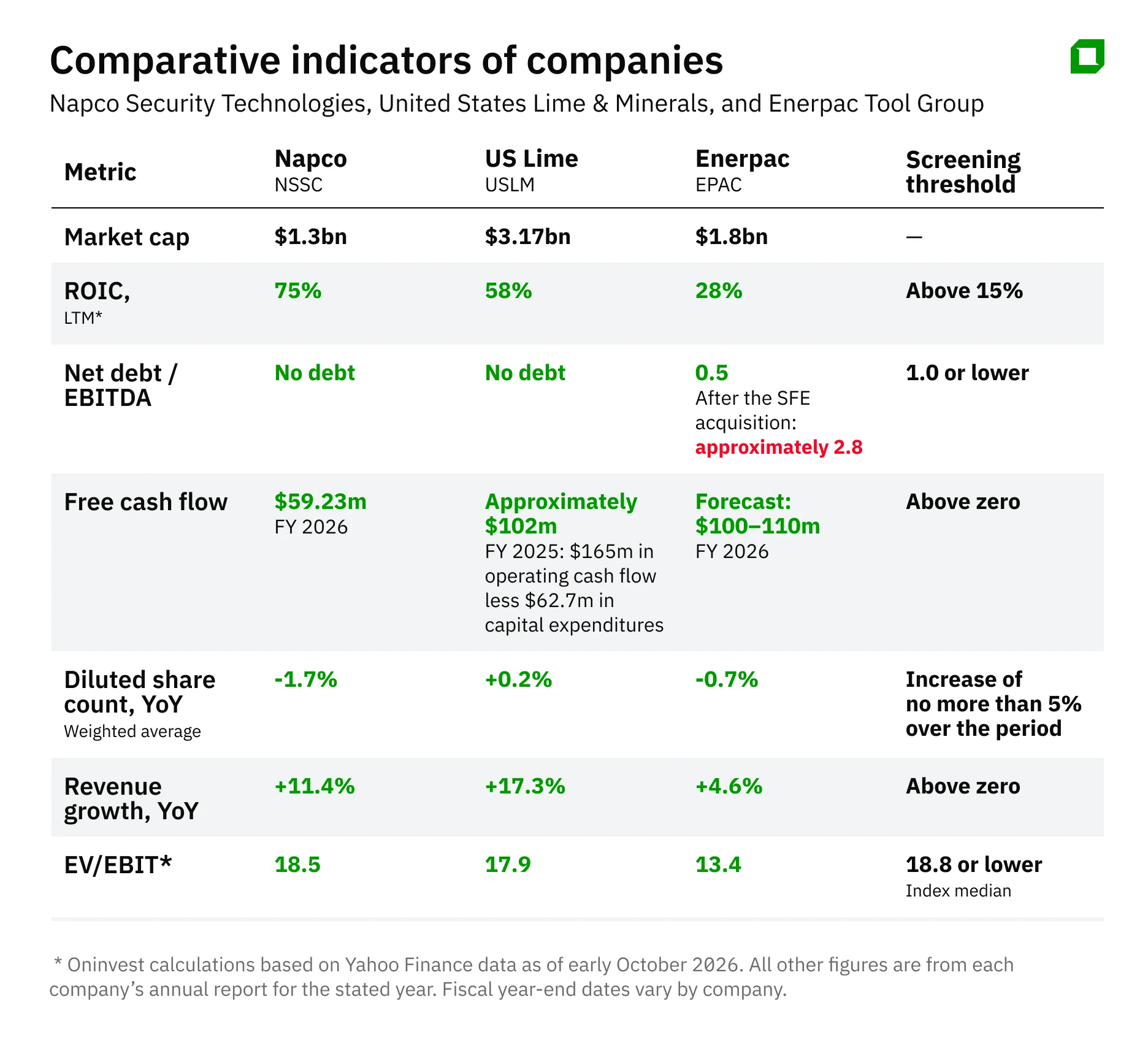
Just 34 of the 1,420 Russell 2000 companies met all six criteria. Oninvest has picked three qualifying small caps whose competitive advantages appear durable: Napco Security Technologies, United States Lime & Minerals, and Enerpac Tool Group.
Napco Security Technologies (NSSC)
Napco manufactures security and fire alarm systems and StarLink radio communicators, which transmit alarm signals to monitoring centers. Once a radio is installed and activated, the dealer pays Napco a monthly fee for connectivity and access to its platform. “Radio sold today become recurring revenue tomorrow,” Napco CEO Kevin Buchel said.
In fiscal 2026, ended June 30, Napco’s revenue rose 11.4% to $202.3 million. Recurring service revenue increased 13% to $97.5 million, with a gross margin of more than 90%. Free cash flow grew 15.2% to $59.23 million. The company has no debt and held $126.93 million in cash as of June 30.
The consensus among six analysts polled by S&P Global rates the stock a “strong buy.” The average target price of $50.67 per share implies around 40% upside from Monday’s close. On August 24, TD Cowen analyst Lance Vitanza raised his target price to $55 per share from $53 per share while maintaining a “buy” rating on the name. The main risk involves nonrecurring items. Tariff refunds added around 6 percentage points to the gross margin in the fourth quarter. In addition, Napco recognized a $16 million charge to settle litigation related to previous financial disclosures, while two other legal proceedings remain ongoing.
United States Lime & Minerals (USLM)
The Dallas-based company quarries limestone and uses it to produce lime for road construction, steelmaking, water treatment, and agriculture. Lime is inexpensive and heavy, so it is generally shipped no farther than 400 miles, or 640 kilometers, from a plant. To enter such a local market, a competitor must find a deposit, obtain permits, and build production facilities close to customers. U.S. Lime therefore considers the industry’s barriers to entry high.
Second-quarter 2026 revenue rose 8.3% year over year to $99.13 million, while net income increased 11.9% to $34.51 million. For the first six months as a whole, however, revenue rose just 2.3%, while net income came in 0.2% higher.
Second-quarter operating profit was $40.66 million, or 41% of revenue. The company had no debt, while cash at the end of 2025 stood at $371.1 million. “Looking ahead, we anticipate that data center projects should continue to support strong construction demand, and that the new kiln at our Texas facility will come online this summer,” U.S. Lime & Minerals President and CEO Timothy Byrne said. The company has yet to announce that the kiln has begun operating, so investors should look for confirmation in its third-quarter earnings.
In March, Freedom Broker raised its target price on the stock to $138 per share from $125 per share while maintaining a “buy” rating. The TP implies 24.5% upside from Monday’s close. The company’s risks include the cyclical nature of construction and fuel and transportation costs, which held back gross profit growth in the first half.
Enerpac Tool Group (EPAC)
The Milwaukee-based company, founded more than a century ago, manufactures high-pressure hydraulic tools and systems for the precise positioning of heavy loads.
In the fiscal third quarter, which ran from March through May, revenue rose 6% year over year to $167.6 million, while net income increased to $29.8 million from $22 million. Capex for the first nine months of fiscal 2026, -ended May 31, was $9.24 million, versus operating cash flow of $69.26 million. The ratio of net debt to EBITDA stood at 0.5, and the company repurchased $81.13 million of its stock over the nine months.
At the same time, the management lowered its full-year guidance: the revenue forecast was cut to $635-645 million from $635-650 million, while the adjusted EBITDA forecast was reduced to $151-156 million from $158-163 million.
In July, Enerpac agreed to acquire SFE Group, a manufacturer of welding and machining equipment, for $472 million and expects to close the deal between September and November. The management estimates that net debt/EBITDA will rise to around 2.8 once the deal closes. Another risk involves the service business, where revenue declined 8% organically.
The stock has two “buy” ratings versus one “hold,” according to MarketWatch data. The average target price is $48 per share, 33% above Monday’s closing price.
Implications for investors
These screens weed out weaker companies but do not guarantee returns. Quality can underperform the market for years, as it did over the last year: in the 12 months ended June 30, Royce Premier gained 31.17%, versus a total return of 40.78% for the Russell 2000.
Even the company Royce cites in its post as a model compounder in its portfolio has a flaw. Quaker Houghton manufactures industrial lubricants and process fluids for the metals and manufacturing industries. The portfolio managers acknowledge that acquisitions have added debt to Quaker Houghton’s balance sheet. For the same reason, Enerpac formally passes the screen based on its latest report, but its leverage will exceed the threshold set by Oninvest once the SFE acquisition closes.
This text is for informational purposes only and does not constitute personalized investment advice.