Investment banker and prisoner: Ruben Vardanian's mistakes that deprived him of his freedom
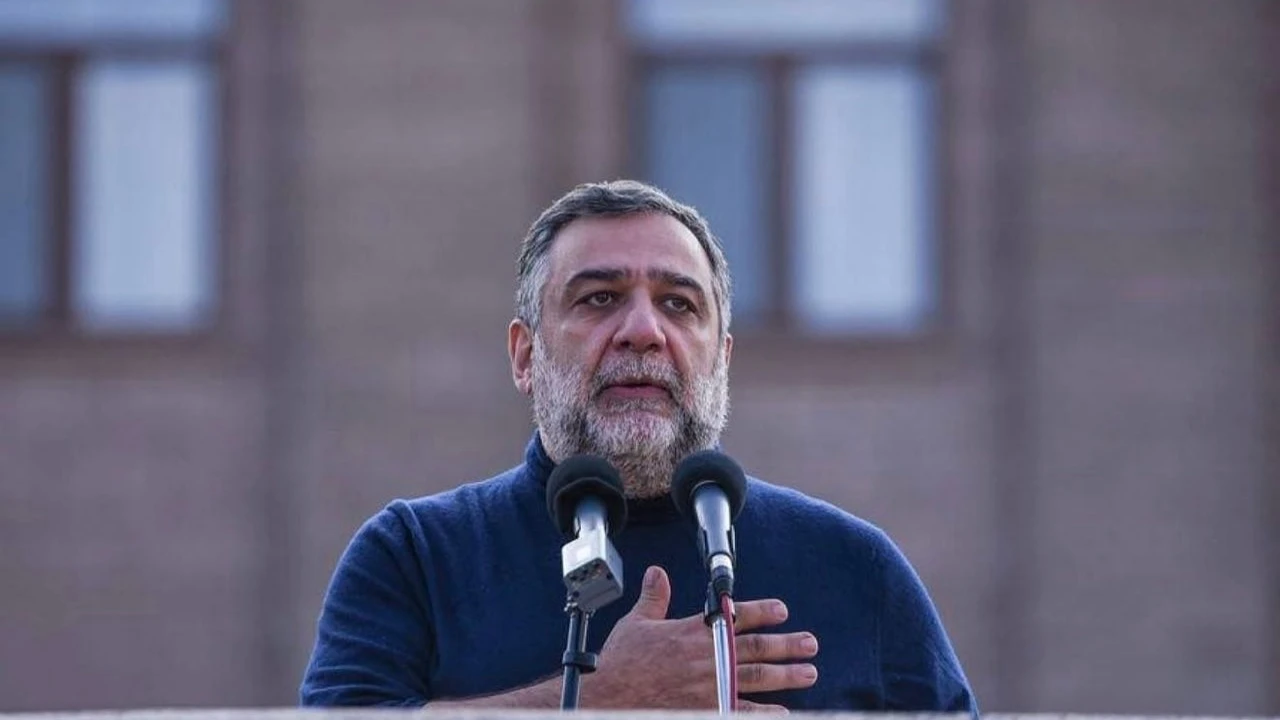
Going into politics cost investment banker and billionaire Ruben Vardanyan his freedom. Photo: freevardanyan / Instagram
In February 2026, a Baku military court sentenced Ruben Vardanian, an investment banker who pioneered the stock market in Russia, to 20 years in prison. Prior to that, he served as prime minister of the unrecognized Nagorno-Karabakh Republic (NKR), which was the steepest turn in his 30-year career and led him to an Azerbaijani prison. Oninvest looked into how Vardanyan went from Forbes list member and investment banker to politician and prisoner.
"Leading a fight that wasn't theirs to lose."
Since the start of Russian military action in Ukraine in 2022, major Russian businessmen have severed ties with Moscow one after another because of disagreement with Kremlin policy or the threat of being placed on Western sanctions lists.
In September 2022, Ruben Vardanian, co-founder of Troika Dialog and one of Russia's most prominent investment bankers, announced his renunciation of Russian citizenship and departure.
But his scenario was fundamentally different from other members of the Russian Forbes list: he did not sell off his assets in Russia, but transferred them to a family foundation. He also consistently avoided any public criticism of the Kremlin regarding the Ukrainian conflict (and as a result fell under Ukrainian sanctions).
Another important difference was that Vardanian went not to the West, but to the unrecognized Nagorno-Karabakh Republic, the perennial "stone of discord" between Armenia and Azerbaijan.
Nagorno-Karabakh is a region in Transcaucasia, a place of compact residence of Armenians and Azerbaijanis. After the establishment of Soviet power in Transcaucasia, the region became part of the Azerbaijan SSR as an autonomous region. Since the late 80s, the Council of People's Deputies of the Nagorno-Karabakh region of the Republic, where the Armenian population predominated, began to raise the issue of transferring the autonomy to the Armenian SSR, but was unable to legally formalize these changes. After the collapse of the USSR, Nagorno-Karabakh announced its secession from Azerbaijan and the establishment of the independent Republic of Artsakh. In 1992, the First Karabakh War broke out, as a result of which Armenia took control of the autonomy itself and several adjacent districts. The Azerbaijani population left their homes. Until 2020, the unrecognized republic was effectively controlled by Armenia. As a result of the Second Karabakh War in 2020, Azerbaijan regained a significant part of the lost territories. The remaining lands were controlled by the authorities of the unrecognized Nagorno-Karabakh Republic. Russian peacekeepers were stationed in the region to maintain a ceasefire from November 2020 to June 2024. But in late 2022, Azerbaijan blockaded the territories of the unrecognized republic, cutting off the Lachin corridor, the only road between the NKR and Armenia. This led to shortages of food, medicine, electricity and fuel in Karabakh. Armenia accused the peacekeepers of failing to protect NKR civilians. After the military operation, in the fall of 2023, the head of the NKR signed a decree on the termination of its existence. The Armenian population began to leave the region.
Many acquaintances tried to dissuade him from moving, but Vardanyan was undeterred, two of his former colleagues told Oninvest. He himself noted that after the Second Karabakh War his life was divided "into before and after" and forced him to reflect on his purpose.
A month after his move, in October 2022, he announced his appointment as state minister - prime minister - of the unrecognized republic. In December of the same year, Azerbaijan blocked the Lachin corridor connecting Karabakh with the outside world. The NKR found itself in a blockade.
And this played a key role in Vardanyan's political career - already at the end of February 2023, he was dismissed from the post of prime minister. His resignation and departure from Karabakh was sought by Azerbaijan, which was Baku's key condition for unblocking the Lachin corridor.
Vardanyan left his post but refused to leave the NKR. "Ruben stayed with his people to help them despite all the risks for them," David, Vardanyan's eldest son, explains his motives to Oninvest.
The former investment banker's ambitions were not limited to NKR: in parallel, he tried to build a political career in Armenia. In 2021, he received a passport of this country. This was a natural step for Ruben: he was born in Yerevan and grew up in Armenia, according to his business partner and co-founder of VB Partners (formerly Vardanyan, Broitman and Partners) investment butique Mikhail Broitman.
When asked about his political ambitions, Vardanyan said he was ready to be "even a janitor or president" in his homeland. But four sources - former colleagues and an acquaintance of Vardanyan - told Oninvest that his main goal was to become prime minister of Armenia.
Armenian media referred to Vardanyan as one of the founders of the opposition Country for Life party, registered in 2021. The party consistently advocated for an independent Artsakh (as the NKR is called in Armenia), which went against the course of Armenian Prime Minister Nikol Pashinyan, who urged the country to abandon territorial conflicts with Azerbaijan.
The businessman denied being a member of this party, although one of his former colleagues in the investment business and an acquaintance who often communicated with Vardanyan referred to it as "Ruben's party" in a conversation with Oninvest. Vardanyan himself claimed that the only thing that connects him with its leaders - former NKR Minister of Labor, Social and Migration Issues Mane Tandilyan and former Armenian Minister of Labor Mesrop Arakelyan - is The Future Armenian project.
A colleague of the businessman in the investment business claims that Vardanian was involved in the affairs of a party with which he could go to the upcoming elections. A successful government career in Karabakh could have been his main political trump card, he believes.
Vardanyan probably did not consider the outcome of the Second Karabakh War to be the final point in the conflict and went to the NKR "definitely not for captivity," but rather hoped to "turn the situation around" from within through international publicity and mediation by Russia, France or the United States, where the Armenian diaspora is strong, he notes.
"In 2026, parliamentary elections will be held in Armenia, Ruben did not want to wait for the next electoral cycle, so he actively took up the most pressing topic of Armenian politics - Artsakh," says an acquaintance who often communicated with Vardanian.
But Vardanyan apparently chose an unfortunate time for his political project - after 2020, when Azerbaijan regained a significant part of the region's lands and Armenia and Azerbaijan eventually began discussing the possibility of a peace agreement, the NKR issue was no longer so acute.
"In fact, Reuben led a fight that wasn't theirs to lose," he agrees.
In September 2023 - almost a year after moving to Karabakh - Vardanyan was detained by the Azerbaijani military as he was traveling to Armenia in a convoy of Armenian refugees from the NKR. His family pointed to the military's selectivity: Baku allowed certain officials of the unrecognized republic to cross the border.
This is how the former investment banker found himself in a detention center in Baku.
What happened in Baku?
In December 2024, the Azerbaijani prosecutor's office brought more than 40 potential charges under 20 articles of the Criminal Code of Azerbaijan against Vardanyan, Siranush Sahakyan, who represents Armenian prisoners of war in international courts, told Oninvest. Among them are charges of financing terrorism, crimes against peace and humanity, kidnapping, and torture.
Siranush Sahakyan considers them "politically motivated and legally unfounded". For example, he was accused of illegally crossing the Azerbaijani border when he arrived in NKR. But at that time, the Lachin corridor was under the control of Russian peacekeepers, and Azerbaijan pledged to guarantee freedom of movement along it in accordance with the trilateral agreement of November 9, 2020. Finally, Vardanyan is accused of war crimes, although he was not a military man and did not take part in military operations, the human rights activist lists.
Vardanyan's case was heard in the Baku Military Court, although the defense insisted on the illegality of the choice of jurisdiction, and was separated into a separate proceeding, although the businessman applied for its consolidation with the cases of other NKR leaders and was refused. The first hearing was held in January 2025.
Throughout the proceedings, the defense pointed out violations of the judicial process: the international defense counsel was denied to visit Vardanyan in Baku, the defense and the accused were not provided with translations of some documents from the Azerbaijani language, in some translations Vardanyan's defense found distorting errors. For example, the translated decision on the results of the preliminary hearing contained references to the legislation of Belarus, which was not relevant to the case. In addition, the prosecution witnesses were not personally acquainted with Vardanyan and could not prove his involvement in the incidents they described. The hearings were closed to human rights activists and independent media, listed his lawyer Abraham Berman.
In protest, Vardanyan started a hunger strike - in February 2025 - and kept it for 23 days. All Armenian prisoners, including Vardanyan, were subjected to torture, human rights activists filed a complaint with UN bodies, Siranush Sahakyan added.
Official Baku has consistently denied all the accusations. The former leaders of the unrecognized republic are accused of grave crimes, which Azerbaijan has the right and obligation to investigate in accordance with international and national criminal law, explained Foreign Ministry spokesman Ayhan Hajizadeh. Even if the accused are prisoners of war, under the Third Geneva Convention they can be detained until the end of the trial and, if necessary, until the execution of the sentence. The allegations of mistreatment were investigated and proved to be false, he said.
Vardanyan urged to "fight at any cost" to maintain Armenia's control over the Nagorno-Karabakh region, although it has always been officially recognized territory of Azerbaijan, and this makes him "an unambiguous criminal" in Baku's eyes, says Tofik Zulfugarov, a political scientist, former head of the Azerbaijani Foreign Ministry and an expert on the Karabakh conflict. He has been following the case in detail.
"Vardanyan's trial was adversarial, independent media and observers were present at the trial, and the defendant could take advantage of the lawyer's defense," he believes.
In February 2026, the Baku Military Court sentenced Ruben Vardanyan to 20 years in prison, 10 of which he will spend in prison and the rest in a correctional institution. Rasim Musabekov, a political scientist and member of the Milli Majlis (National Assembly) of Azerbaijan, called the sentence "in principle an expected decision," recalling that the prosecution had requested a life sentence, which some NKR leaders have received. Musabekov did not respond to Oninvest's request.
David Vardanyan, speaking to Oninvest, claims that his father was engaged in "exclusively humanitarian activities" in the NKR.
"More than 280 tons of food was delivered to its residents, hundreds of families received generators and construction materials, and a power plant was installed for the republican medical center. Separately, mobile primary health care teams were set up for residents of remote areas cut off from access to doctors," he lists.
Vardanyan refused to challenge the verdict, but this does not mean he agrees with the court's decision, explains David Vardanyan.
It is a conscious refusal to legitimize a process that had no signs of justice from the beginning. Family and friends support the father in this decision.
According to Siranush Sahakyan, if Ruben Vardanyan had appealed in Azerbaijan, his case would have been considered in the country's Court of Appeal, which has jurisdiction over military cases, and then in the Supreme Court of Azerbaijan. But she calls this option "theoretical": the ECHR has repeatedly pointed out systemic shortcomings in Azerbaijani courts in cases involving ethnic Armenians.
Azerbaijan has acceded to the European Convention on Human Rights and its Fifth Optional Protocol, so a complaint can be filed with the ECHR in Strasbourg and the UN Human Rights Committee, Ilya Khaimanov, senior lawyer at Legal Principles, explained to Oninvest. But he also notes that the appeal and cassation must be passed first, otherwise there is a high probability that the complaint will be rejected.
However, it is still possible to circumvent the national jurisdiction, Khaimanov notes. The defense can challenge the impartiality of the court in Azerbaijan, in which case the complaint may be accepted by the ECHR. The defense can also point to the risk of irreparable harm to the defendant. In addition, international bodies (the UN Human Rights Committee and the Venice Commission) believe that trials of civilians in military courts are admissible only in exceptional cases, the defense can use this argument.
Vardanyan's lawyers and his family have neither confirmed nor denied the possibility of appealing to the ECHR or the UN Human Rights Committee.
Caucasian prisoner
Armenia has not taken enough steps to recover Ruben Vardanyan, its citizen, says David Vardanyan: "We have seen certain steps, but it is not enough. Beyond public statements, we have no information".
Publicly, Armenian Prime Minister Pashinyan has said that Armenian prisoners ended up in Azerbaijan as a result of the conflict, so a peace treaty between the two countries increases the likelihood of their return home.
However, Pashinyan was critical of Vardanyan and his activities in the NKR, insinuating that the businessman represents the Kremlin's interests in the region.
"How did it happen that Ruben Vardanian renounced his Russian citizenship? Who advised or instructed him to take this step? Who sent him in this sense, who sent him to Armenia, who sent him to Nagorno-Karabakh, for what purpose, with what guarantees, with what assurances, with what promises?" - he stated on August 31, 2024.
An acquaintance of Vardanyan's who has often spoken to him suggests in a conversation with Oninvest that Vardanyan at large could become a strong opposition leader and critic of Pashinyan's foreign policy, so efforts to free him will be minimal.
The issue of releasing the NKR leaders was raised by US Vice President Joe D. Vance during his visit to Azerbaijan, President Ilham Aliyev admitted in an interview with France24, but such a scenario is unacceptable for Azerbaijan. He compared the trial of the NKR leaders to the Nuremberg trials of 1945-1946.
Attempts were made to "go to the Kremlin" to talk about Vardanian, one of his former colleagues in the investment business knows. But "the official machine started if Vardanian had kept his Russian passport." Russian President Vladimir Putin, when asked about Vardanyan, only referred to his renunciation of citizenship and Aliyev's promise to ensure the safety of the Armenian population of Nagorno-Karabakh. Moscow is saving the "silver bullet" for other needs: relations with Azerbaijan "have not been easy lately," he admits.
In the summer of 2025, Armenia and Azerbaijan approved a peace agreement. But the problems between Yerevan and Baku are not exhausted by the NKR, says Ruben Yenikolopov, a professor at Pompeu Fabra University. His family is from Nagorno-Karabakh, and Yenikolopov himself has participated in Vardanyan's projects, such as The Future Armenian initiative.
"Will Armenians and Azerbaijanis be able to establish relations like the French and Germans did after the wars of the 20th century? For this to happen, more than one generation must change and some kind of joint project must emerge," he argues.
Postwar France and Germany had the Schuman Declaration, France's plan to merge its coal and steel industries with Germany, which was later joined by a number of other European countries. "So far, Armenia and Azerbaijan have more differences than points of contact," Yenikolopov says.
Under such conditions, the issue of Ruben Vardanyan's release will not be a priority for the Pashinyan government, Yenikolopov believes: "Yerevan could raise him, but then it will have to offer Azerbaijan something in return".
Azerbaijan has no need to exchange Vardanyan, Tofig Zulfugarov believes. On the contrary, the prisoner, "whom investigators have found to be guilty of corruption and money laundering by the Russian elite through a network of offshore companies, may be of interest to Baku and its allies as a source of information," he suggests.
Vardanian and Troika Dialog have repeatedly been the subject of anti-corruption investigations - the investment banker and the company have been accused of using offshore schemes to hide the income of the Russian elite and people close to Putin. Investigators also wrote about Vardanian's friendship with Sergey Chemezov, head of Rostec, which serves Russia's military-industrial complex.
Vardanian himself denied the laundering allegations: he claimed that Troika was created when the investment banking industry did not exist in the country, so its activities cannot be assessed outside the context of that time. The offshore companies belonged to Troika's clients, and he himself did not delve into every transaction.
"The key advantage of Troika is that no official can say that it is his pocket company, whether it is Chemezov, Chubais, Gref, Yakunin, Dmitriev, and you can go on down the list," he argued.
What's left of Vardanian's business?
"It was not me who created Troika, but Peter Derby, who had as much as $35,000 in capital, one computer and a two-room apartment on Old Arbat, where we worked alternately," Vardanian recalled the story of the creation of the company, which became the country's largest investment bank. Vardanian believed in the American Derby's project and in 1991 gave up his career at Menatep-Invest for it.
In 1997, due to changes in Russian legislation, Derby sold his stake to Bank of Moscow. Vardanian remained in the company and in parallel built the infrastructure of the Russian stock market. First of all, the RTS exchange (which later merged with MICEX to form the Moscow Exchange), which began to specialize in stock trading on the model of Nasdaq.
"Troika held RTS's turnovers, and Troika created market-making in Russia in general. I don't want to offend any of our competitors, but if there had been no Troika, RTS would simply not exist in the format in which it has been operating for many years," he said.
In addition, Vardanian was at the origin of Russia's first self-regulatory organization of the stock market, NAUFOR.
According to him, until 2002 he was just a hired manager (as president of Troika) and its minority shareholder (with a 10% stake). Another 80% of the company was owned by the Bank of Moscow, 5% by the Opel family fund Hansa AG, and the rest by Troika's managers. Subsequently, Troika's management bought out the stakes of the Bank of Moscow and Hansa, and by 2006, 100% of the company was owned by its top management.
International players have also tried to become co-owners of Troika. Investment companies named CSFB and JPMorgan among potential buyers. In 2007, Vardanian said that several major players offered him various options, from asset swaps to a joint venture with a global bank at a valuation of $2.5-3 billion, which was 7-10 times its book value that year, but he never sold the company.
"I wanted to prove against all odds that a Russian independent investment bank should be in Russia," he explained.
In 2009, at the height of the financial crisis, investment companies around the world began to experience liquidity difficulties. That year, Troika Dialog posted a net loss, and South Africa's Standard Bank joined its shareholders, buying 33% from management.
Five years later, in 2013, management sold Troika to state-owned Sberbank for $1.4 billion (it became part of Sber under the Sberbank CIB brand). Forbes estimated the amount that Vardanian received as a result of the deal at $400 million, while his total fortune, including shares in Kamaz and Avtovaz owned by Troika (the bank did not buy them out), the Romanov Dvor business center and other assets, was estimated by the magazine at $800 million that year.
"Ruben created an investment business in Russia literally on nothing, and, unlike other Forbes list members, he did not privatize anything. He was a man who could dream of ambitious goals that seemed unattainable to others and could easily negotiate with people," recalls economist and former colleague of Vardanian at Troika and Skolkovo Andrei Sharonov.
According to Sharonov, over time, investment business ceased to be the main thing for Vardanian. He had several global impact projects that he focused on: the Skolkovo School of Management in Moscow, the UWC International School in Dilijan, and the Aurora Prize.
Armenia has always been in his focus (for example, he looked at scenarios for the country's development in his book "At the Crossroads"), this later led him to Artsakh.
Sharonov was the rector and president of Skolkovo from 2013-2021, while Vardanian was its co-founder.
Vardanian's other well-known projects included Matena Leadership School in Yerevan, Tatev Ropeway, Noôdome Community, Atlanta Business Club, The Future Armenian initiative, Idea Armenian Charitable Foundation, etc.
"You have to try to see yourself in the context of generations - what kind of a mark you will leave. I have always liked to make the impossible possible, to try to show perspective, because a person should live with an idea of tomorrow. Even stealing will be different if they do it for a long time. In Russia, everyone lives in one day, but those in power seem to think that they will live and rule forever..... And such inconsistencies, inconsistencies in everything amaze me," Vardanyan said to himself.
According to Forbes Real-Time Billionaires, Vardanian's fortune is estimated at $1.3 billion. He recently sold his stakes in KAMAZ and Atom (KAMAZ's project to build electric cars), and got rid of his stake in Avtovaz back in 2013. After moving to Karabakh, Vardanian withdrew from the management of all business projects, says David Vardanian. Including - in 2022 - from the investment butika "Vardanyan, Broitman and Partners", which is engaged in the organization and structuring of club deals and direct asset management, says Mikhail Broitman. The company itself has been renamed VB Partners.
According to David Vardanyan, the family continues to support educational and socially significant projects that his father was engaged in before moving to NKR. He did not disclose the structure of the family's assets.
According to SPARK-Interfax, in Russia Vardanian's wife Veronica Zonabend is a co-owner of Q Capital, which manages the family's assets. Her 0.02% stake was previously registered to Vardanyan himself, while the main owner is Tim DY EDWAYSORS, Ltd. from the British Virgin Islands. Q Capital's 2025 financial statements state that Zonabend is the ultimate beneficiary of the company. She is also the owner of Ervez (Noôdome project), among others. Vardanian also owns stakes in the company Charity Infrastructure and Philgood LLC (consulting in the field of charity).
"Vardanyan always treated his projects like children. Why would he abandon them?" - says one of Oninvest's interlocutors.
Unlike the Russian passport, which prevents participation in the political life of Armenia, Vardanyan had no real reasons for refusing to do business in Russia: he did not quarrel with anyone and did not slam the door, concludes another.
This article was AI-translated and verified by a human editor