Investors have survived Trump's 500 days in power. What should they factor into their strategies next?

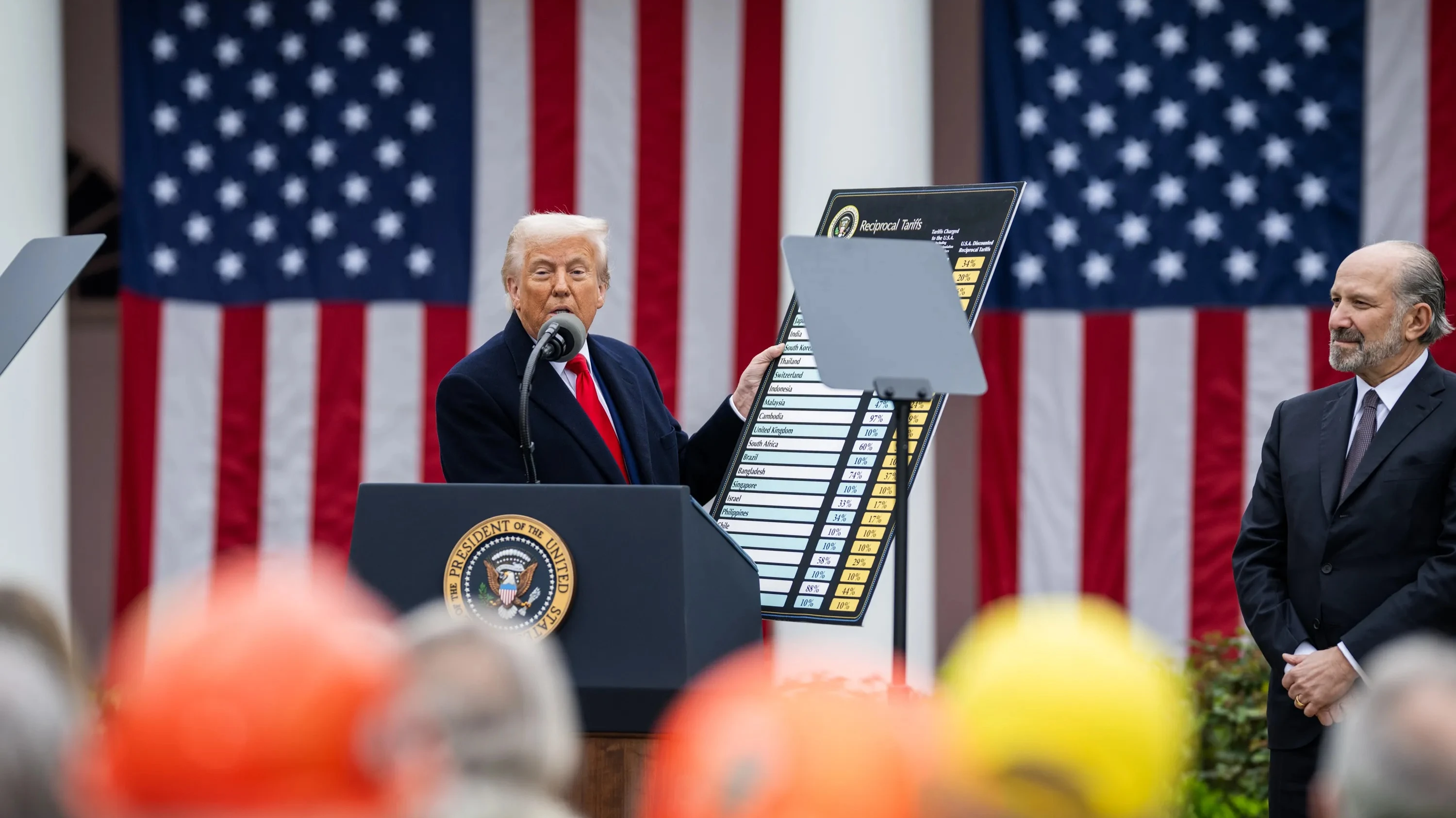
US President Donald Trump announced the imposition of duties on all US imports in 2025. Later, a US court recognized some of the import tariffs as illegal and canceled them. / Photo: The White House
On June 3, 500 days ago, Donald Trump took office as President of the United States. His second term in power became a stress test for global markets - his decisions, statements and posts on Truth Social brought down the value of assets by several trillion dollars, and then also quickly triggered a rebound in the markets. Oninvest discussed the events that took place during this time with Vadim Merkulov, Director of the Analytical Department of Freedom Finance Global: which of them have long-term consequences, and which can be called one-time shocks. And most importantly, how to distinguish between them?
War with Iran: 'It looked atypical even for Trump'
For investors, the most unexpected event of Trump's second term was the war with Iran, says Vadim Merkulov. The current US president criticized previous political approaches to Iran for years, and in 2018 he withdrew from the nuclear deal with the country. It was clear that a new agreement was needed, otherwise the United States would literally be sitting on a powder keg next to a regime that had consistently developed a nuclear program.
The need to somehow "deal" with the Iranian issue was obvious, but a full-scale war was not. This seemed atypical even for Trump. Iran is not a small country, it is not a story about "a quick operation in a few days".

At first, everyone watched Trump 's showy pulling of an armada of U.S. ships to Iran's shores and Trump' s loud threatening statements to Tehran. But there was a sense that it was just a show of force. But on the morning of Feb. 28, the U.S. attacked Iran. And it quickly became clear that the Islamic Republic had leverage over the US and the rest of the world - especially when the IRGC blocked the Strait of Hormuz and the level of regional tensions rose dramatically. All of these problems were essentially created by the hands of the White House administration itself. "In my opinion, this [starting a war with Iran] is a strategic mistake from which it will be very difficult to come out," Merkulov believes.
He believes that from a policy standpoint, one way to at least partially make up for the mistake with the Iran war is to have a "small victory" campaign in Cuba to score points before possibly losing his congressional majority in the November elections. But, he said, if the president loses his majority, his tweets will stop meaning so much to quotes, and by the end of his term, the market will simply learn to ignore them.
Lap tariffs
The second major shock of the first 500 days of Trump's second presidency was the decision to impose duties on imports from U.S. trading partners. Against the backdrop of the war in Iran, the tariff war took a back seat, but its impact was nevertheless significant.
Vadim Merkulov sees this as a classic example of how a political action creates an immediate drawdown in the markets, and then the president himself comes out and says, "It's time to buy back in," after seeing the scale of the decline.
The situation was made worse by the way Trump announced a trade war with the whole world. At a press conference, he showed some kind of table with the size of duties, which in itself was poorly understood. The idea was to impose duties on all U.S. imports, and to offer higher rates for countries that levy higher tariffs on U.S. goods. When analysts looked into it, it became clear that the document was drafted very crudely: the states announced the imposition of duties on imports even from those countries for which no such pressure was originally intended.
"There was a feeling of very fast, 'made on the knees' work, which definitely does not add to the president's reputation," Merkulov notes.
As a result, the U.S. postponed the deadline for imposing "mirror" duties several times, and then concluded separate trade agreements with partner countries. Later, a U.S. court recognized some of Trump's tariffs as illegal and actually canceled them. But the US administration found other legal grounds for imposing trade tariffs. And in the end, all of this created even more uncertainty for business.
The market itself formulated its strategy as early as last year under uncertainty as TACO, a meme and real pattern that stands for Trump Always Chickens Out. It describes the behavior of the US president: first he announces harsh or drastic measures and then at the last moment postpones, softens or partially reverses them. But at the same time, investors first had the idea of "sell America" - they started to get rid of assets in the US market. Then it transformed into the idea of "hedge America", which is based on the need for greater diversification of investments to reduce the risk of unpredictability of the US administration's policies.
As a result of the trade war, the main question is how to return the duties already collected. From the investment point of view, this is a vivid episode that will haunt the markets as a case study, although it will not become a structural factor for decades, Merkulov is convinced
What Trump's actions have long-term consequences
The main "long-lasting" factor is the adoption of the law increasing the US budget deficit - the so-called "Big Fine Law", believes Vadim Merkulov. He recalls that the document adds about $3-4 trillion to the deficit over a ten-year horizon. This automatically raises the forecast for the national debt from the current 123% of GDP to 124-125% by the end of 2030.
We can already see the effect: interest payments on the debt have exceeded $1 trillion a year and have become larger than the military budget of the United States. This creates a critical situation for the debt market - from the point of view of an investor in U.S. Treasuries, it is a net negative.

However, in the short term, this is a stimulus for the US economy, Merkulov notes: additional budget injections fuel it.
The second factor with long-term consequences is immigration restrictions. In January 2025, by Trump's decision, the United States virtually suspended the issuance of some immigrant visas and adopted tough deportation measures. Because of this, last year, for the first time in half a century, the U.S. lost more migrants than it took in.
The American economy will not be able to survive without labor force replacement, so there will not be a complete stop of migration, Merkulov is convinced. But in the segments traditionally dominated by migrants (construction, service, low-paid labor), there is likely to be a significant increase in wages due to a shortage of labor. This will create additional pressure on inflation, simultaneously increasing both incomes and expenditures of households.
A war with Iran could also have a long-term effect, Merkulov continues. Each side is likely to declare itself the winner, and there is likely to be no substantive deal that would enshrine all the agreements - from the nuclear program to the terms of passage of ships through Hormuz. For investors, this means the emergence of a high geopolitical risk, says Merkulov.
The introduction of trade duties against this background has more of a one-time effect: markets have already adapted to them, besides, Trump will leave with his administration and the new president will be able to cancel them.
Even if the "Trump" duties remain in place somewhere, it's already embedded in stock and bond prices, and it won't be a separate drama.

How to distinguish long-term factors from one-off shocks
Vadim Merkulov emphasizes two aspects. The first is to look at the long-term trend in US Treasuries.
"The point is how yields behave over a horizon of months and years. If we look at ten-year treasuries from the Covid-19 period, we see a jump from zero to 4.5%, and it is quite possible that this is not the limit. This is already a pure structural risk, which should be taken into account when building a portfolio", - explains the expert.
The second aspect is the nature of the market's reaction to political events. Trump is a reactionary president, Merkulov points out: he starts the process and then looks at the response of markets and countries. Somewhere he "passes" under pressure, as, for example, in the case of duties, and somewhere he prolongs conflicts.
For an investor, it is important to watch whether the reaction turns into a sustainable one: if the market remains in a new mode for a month or more, an investment thesis is clearly starting to form around it. This is the signal that we are facing not just a spike in volatility, but a new anchor, a structural risk.

What are the main risks shaping the markets
Due to the escalating conflict in the Middle East, the yield on the 10-year Treasury bond from February 22, 2026 rose from 3.96% to 4.46% on Monday, June 1, and the intraday high, as CNBC writes, reached 4.52%. Yields on 30-year bonds even approached 5%, reflecting rising inflation fears due to the spike in oil prices.
Vadim Merkulov points out that this is happening against the backdrop of high US debt and budget deficit. This is gradually creating expectations that investors will need more compensation for the risk of owning US debt.
Ten-year bond yields could reach 5% or even 6%, Merkulov believes. He stipulates that the latter is unlikely, but it could become a very unpleasant scenario for risky assets: both the stock market and the market of high-yield bonds could lose a lot in valuation.
"And this is just an example of a long-term trend that is beginning to take shape," the expert emphasizes.
The risk of pressure on the Fed and attempts to put the regulator under direct White House control is also loud, Merkulov notes. Trump, in his second term, has regularly publicly demanded lower discount rates and threatened to fire previous Fed chief Jerome Powell.
But it looks like an extremely low-probability scenario, he assesses.
"Despite the proceedings and threats, I don't see a sustainable pricing of this risk in the markets. Sometimes short sell-offs appear, but this is definitely not something around which to build a structural trend," the expert concludes.
Will the dollar remain the key defensive currency?
Vadim Merkulov answers this question positively, but with a small reservation. After Trump won the presidential election, the market revised its attitude to the dollar. The role of a protective asset is still preserved, but the attitude towards it is becoming more critical, Merkulov says.
Since January 6, 2025, when the U.S. Congress officially certified Trump's victory in the 2024 presidential election, the dollar index - its ratio to a basket of six world currencies - has fallen from 109.65 points to 99.29.
At peaks of tension, we see classic dollar strength and rising demand for US Treasuries, but as soon as the situation "stabilizes", some of the protective flow goes away and the dollar weakens again.

Whether the "sell America" strategy will persist through the end of Trump's presidential term will depend primarily on his activism, Merkulov argues. This pattern is only sustainable if the administration continues to regularly create new reasons for markets to be nervous.
If Democrats win a majority in Congress in the November elections and are subsequently able to rein in Trump, the "sell out America" thesis will continue to be relevant, but, Merkulov adds, it will no longer be the main one.
This article was AI-translated and verified by a human editor