Italy's SJI promoted "Superjets" abroad. How does it survive under sanctions?
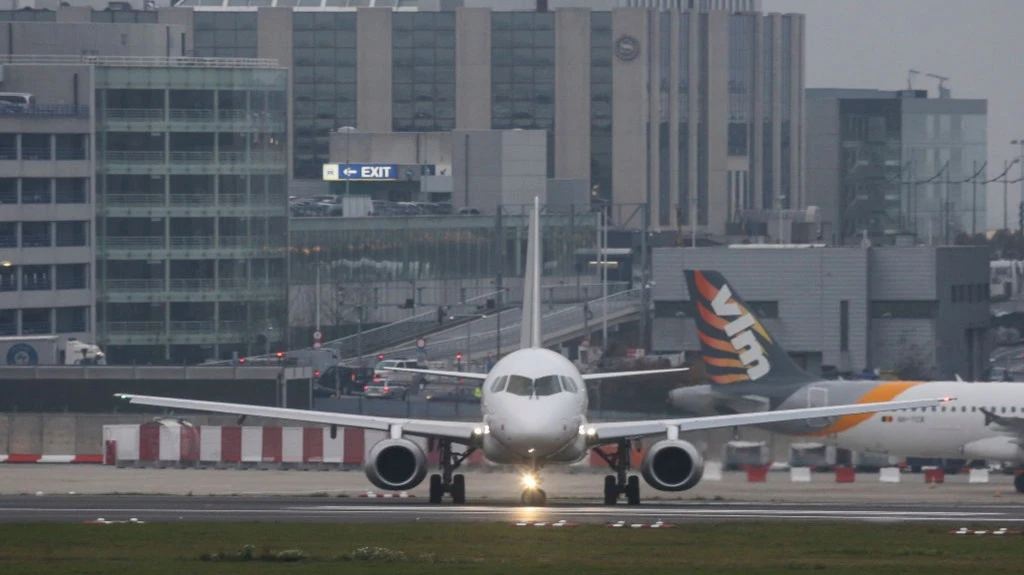
An Irish CityJet SSJ100 leased to Brussels Airlines performs a flight at Brussels International Airport. Photo: Nicolas Economou/NurPhoto, Getty Images
Superjet International (SJI), the Italian-Russian company that was created almost 20 years ago to promote and provide after-sales services in foreign markets for the SSJ-100 aircraft, is in crisis. Its €150 million in assets have been frozen since 2022 in fulfillment of EU sanctions, and the company has failed in several attempts to find money for operations. In May, SJI's board of directors decided to apply to the court to start a crisis management procedure. According to a source familiar with the situation at SJI, "only a miracle" can save it.
How did it start?
In 2007, the Sukhoi Superjet 100 (SSJ100), the "Superjet," was rolled out at the aircraft factory in Komsomolsk-on-Amur. "We were looking forward to it," First Deputy Prime Minister Sergey Ivanov said at the time. By then, Russia had not produced civilian airplanes for 16 years.
The SSJ100 was to become a symbol of Russia's return to the global aviation industry and a competitor to Brazil's Embraer and Canada's Bombardier in the class of short-range jet passenger airplanes. As a rule, they have a flight range of no more than 3,000 kilometers and a seating capacity of up to 100 seats.
Although the airplane was called Russian, its developer, Sukhoi Civil Aircraft Company (SCAC), relied on foreign partners. The share of foreign components in it amounted to 80%. French Snecma and Russian Saturn worked on the engine at the PowerJet joint venture created specifically for this project. Other suppliers included French Thales and Messier-Dowty, American B/E Aerospace, German Liebherr Aerospace, etc. The project was advised by the American company Boeing.
"We did not make decisions to put stools instead of seats in the aircraft only because we produce stools, but seats - no," - this is how Mikhail Pogosyan, who was then the head of the United Aircraft Corporation (GSS was part of it), suppressed remarks about localization of equipment.
GSS's ambitions extended to Western markets as well. In 2007, GSS and Italy's Finmeccanica announced the launch of a joint venture, Superjet International, headquartered in Venice. Alenia Aeronautica (Finmeccanica's subsidiary) owned 51% of the company and GSS 49%. The authorized capital amounted to €15 million.
The Venice office was to be responsible for SSJ100 marketing and after-sales services in Europe, North and South America, Africa, Oceania and Japan. Its Moscow branch took over the CIS, India, China, the Middle East and Southeast Asia. In addition, Alenia became a shareholder of GSS, buying 25%+1 share of the developer.
Between 2001 and 2010, total investment in the SSJ100 reached $1.5 billion: only $70 million of this was from GSS, and another $180 million from Alenia, the rest being loans from Russian banks, mostly state-owned, and from Italy's Intesa. $450 million was provided by the Russian budget.
A snowball of problems
Already in 2008, the SSJ100 made its maiden flight in Russia, and its world premiere at Le Bourget took place a year later.
In accordance with the original plans, GSS planned to start serial production in 2009, and to pass the break-even point in 2012.
Aeroflot became the first customer of the "hope of the Russian aviation industry" back in 2005. Under the contract, the national carrier was to receive 30 aircraft, with an option for another 15.
Russia's largest airline received these airplanes at a significant discount - for $19 million instead of $28 million, below cost, as Aeroflot shared the risks of the project.
These problems manifested themselves almost immediately: the first airplane was expected only in 2008, but GSS delayed the delivery for two years and failed to meet the declared technical specifications. However, this did not prevent the parties from renegotiating deliveries.
The problems were not limited to these. In 2010, an important state contract with Italian national carrier Allitalia failed to materialize. The SSJ100 had no commercial flight at that time, but the company applied for the tender hoping for a price lower than that of its competitors and partners' connections. Allitalia chose Embraer. This hit the project, says independent aviation expert Anastasia Dagaeva.
In addition, passenger confidence in the airliner began to decline due to a series of disasters. The first one happened in Indonesia in 2012: the Sukhoi SuperJet-100 crashed during a demonstration flight on Ma 9. More than 40 people were on board. The investigation showed that human error was to blame. But after the tragedy in Jakarta, many people started to change their ticket if they saw an SSJ on the schedule, Dagaeva notes.
In total, according to Aviation Safety Network, from spring 2012 through spring 2026, there were 118 incidents involving SSJ100s.
"For any manufacturer, the first years of an airplane's release are not without out-of-the-ordinary situations. In aviation this is called 'childhood diseases'. Boeing and Embraer had them too," a source familiar with the situation at SJI tells Oninvest. Accidents and catastrophes have happened to many manufacturers, but they do not mean a verdict on the airplane, adds Oleg Panteleyev, executive director of Aviaport.
In 2011, it was certified by the Russian aviation register MAK, and in 2012 it passed the European certification of EASA, the EU's flight safety agency. When the company received the airworthiness certificate in the Russian Federation, the government actually stopped budget financing (it is not obliged to do so, since at this stage the project is moving to serial production), and the project was on the verge of survival. There was not enough money for production, and borrowing was expensive.
In 2012, Yuri Lastochkin, then director of Saturn, admitted that the original business plan to build the Superjet 100 was "derailed" and that on each aircraft, "companies are generating $10-15 million in losses."
Domestically, the airplanes were idle due to a shortage of spare parts, and carriers preferred the airplanes of foreign competitors. As a result, even in 2018, 10 years after its first flight in Russia, the SSJ100 failed to catch up with Boeing and Airbus in terms of flight hours in Russia. The Superjet's spare parts were expensive and sometimes had to wait for weeks: they were supplied only by GSS, which did not have time to provide all airlines with the necessary components in time. For comparison, dozens of suppliers provide spare parts and consumables for Boeing and Airbus.
Aftermarket service from the early years "didn't take off". Aircraft were idle on the ground for too long. Poor logistics and spare parts problems are practically a "red flag" in the aviation market.
In 2019, the Ministry of Industry and Trade "killed" the idea of building a 75-seat Superjet, although Russia's S7 already wanted to take 75 such aircraft and even signed a letter of intent with SSS. But the authorities then recognized it as null and void, said Vladislav Filev, co-owner of the Russian carrier S7 Group: "Their main customer is Aeroflot, and it is taking a 100-seater. But we know that Aeroflot is being broken over their knees! <...> This really pissed me off!" - he was indignant.
By this time, the Russian authorities had a new flagship project - the MS-21 passenger airplane from Irkut Aircraft Corporation.
Sanction dominoes
The 2014 sanctions against Russia put the overseas promotion of the SSJ100 in question.
In the same year, the first foreign customer, Armenian Armavia, refused to deliver the second airplane. But SJI still managed to find customers. In 2013-2016, Mexican low-cost carrier Interjet received 22 airplanes. And in 2016-2017, Irish carrier CityJet leased seven more aircraft. But both companies, as well as Russian operators, reported parts shortages.
A source familiar with the situation at SJI describes these years as "difficult": the first wave of sanctions complicated relations with almost all suppliers of components.
They did not refuse (from the aircraft - ed.), formally cooperation continued, but the processes of deliveries, approvals and service interaction became much longer and more complex
But in 2019, CityJet gave up and returned all the planes to the lessor. Interjet stopped flying in December 2020, and in 2023 the court declared it bankrupt. The SuperJets that belonged to it are still sitting idle at Mexico City airport. The company was unable to sell them due to sanctions.
SJI considers it "inappropriate" to answer questions regarding previous customers who have not operated SSJ100 aircraft for many years, company spokesman Giacomo Perfetto told Oninvest. He did not give a substantive answer to a question about the spare parts shortage.
In January 2017, SJI announced that Italy's Alenia had withdrawn from its shareholding. It also reduced its stake in SJI to 10%. That is, 100% of its own shares and 90% of SJI's securities reverted to GSS.
From a legal point of view, this is an important fork in the road: SJI became dependent on a product manufactured and certified in Russia, but had to sell it in markets where predictability of supply, service and political-sanctions risk are key factors
From 2022 - with a new wave of anti-Russian sanctions - Italy's financial police froze 5 SSJ100 aircraft at Venice's Marko Paulo airport, €150 million of SJI's authorized capital and a 90% stake in SJI owned by Russians (GSS and UAC are now part of PJSC Yakovlev. It is under massive blocking sanctions). Leonardo's stake (Alenia was part of it) is not under seizure.
Russian media report that the Federal Tax Service for the Kirov region has applied to the Moscow Arbitration Court to declare SJI's executive director and Italian native Camillo Perfido bankrupt. The amount he owes to the Russian budget as an individual for personal income tax exceeds approximately 1.1 million rubles. The Russian register of arbitration managers shows that the claim was filed in March 2026. Oninvest was unable to contact Perfido. A representative of SJI said that the lawsuit does not concern the company's activities and relates to the events of the period when Perfido did not work for SJI.
All Western partnerships of SJI after 2022 fell like a house of cards. Russian-French Powerjet has stopped repairing and maintaining SSJ100s in compliance with sanctions, other suppliers do not supply spare parts as long as the company has a Russian shareholder. The Moscow branch of SJI is operating in a limited mode - no one has been fired, but the office is not actually active.
Hope for the salvation of SSJ100 flashed in 2023, when UAE-based investment fund MarkAB Capital decided to buy the Italian business from the Russians. SJI issued a press release stating that the parties had signed an agreement. The new shareholder structure could look like this: the share of SJI would be divided between Mark AB Capital (49%) and Studio Guidotti International (41%), with Leonardo retaining 10%.
Behind the operation to raise the fund from the UAE was Vittorio Guidotti, a Rome-based manager formerly with Finmeccanica who "has an extensive network of connections in the defense and aerospace sectors," Italian media wrote about the new figure in the deal.
In 2024, SJI named the amount of the deal as €500 million, including capital investments and bank guarantees. The company predicted that it would be able to sell 240 airplanes of various modifications to customers from the UAE and India. But Italy's Financial Security Committee blocked the deal.
After 2022, any deal with SJI shares has become a sanctions compliance issue, says Mr. Karkov. Questions arise: will the Russian side benefit directly or indirectly, will unfreezing actually legalize the disposal of a sanctioned asset, to whom will the money, rights, documentation, service capabilities, spare parts, access to technical information go? Italy has found itself in a tight sanctions corridor to harmonize everything, he says.
In 2026, SJI employees protested in front of the Leonardo plant. The unions tried to get a part of Leonardo's production transferred to SJI's sites in Venice and to accept its employees. SJI's management was in talks with Italian institutional structures about possible support measures, an Oninvest source familiar with the situation at SJI knows. It also requested a €7 million loan from the Italian Ministry of Economy and Finance to save the business, but was refused.
It needs the money to maintain operations and fulfill its obligations to its staff.
The official register of Italian companies shows that on Ma 20, 2026, the company's board of directors decided to apply to the Tribunal of Venice (the city's main judicial authority) to initiate a formal crisis management process. SJI is requesting access to restructuring instruments that will allow it to continue operating.
According to a source familiar with the situation at SJI, "only a miracle" can save the business. For example, the company will suddenly find €7 million from a minority shareholder or from a potential buyer of the airplane who can give such an advance.
Italian media have already been discussing the scenario of the company's liquidation since the end of 2025. For example, Venezia Today, Il Gazzettino, Il Fatto Quotidiano wrote about it. A representative of SJI called it "unfounded rumors".
Now any projects "with Russian heritage" have become toxic for the West, says Oleg Panteleyev. He believes that the SSJ100 can already be called "a piece of history": restoring cooperation between Russia and Western partners in the project is "a task so difficult and long that the airplane will be obsolete by that time and will become an uncompetitive product," he believes.
The Russian Federation has been working for six years on a new Superjet model, the SJ-100 with a Russian-made engine; Russian authorities call it a "fully import-substituted" airplane. "The king is dead, long live the king," Pantelev ironizes.
This article was AI-translated and verified by a human editor