Key Developments in the Kazakh Market: The Stakes of the Oil War and Signals from the National Bank
A Review of the Major Economic Developments in Kazakhstan Over the Past Week

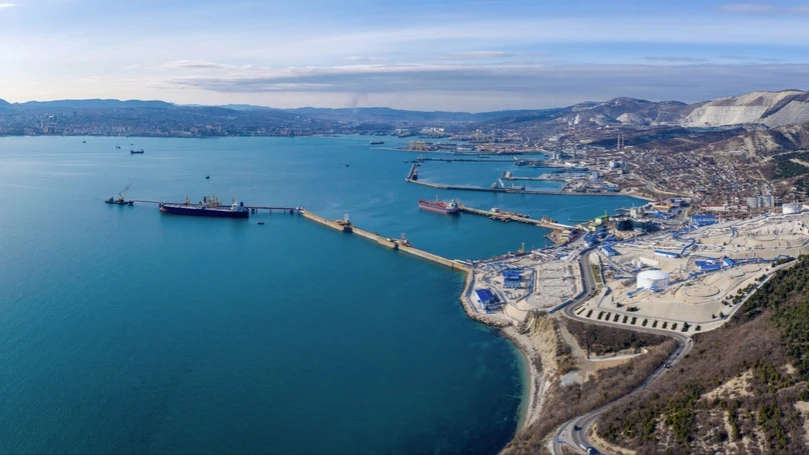
Today, there are no longer any tankers visible off the coast of Novorossiysk. Photo: Shutterstock.com
On Friday, the National Bank of Kazakhstan cut its benchmark interest rate by 0.25 percentage points, from 17% to 16.75%. This move came despite the fact that the pace of inflation decline slowed for the fifth consecutive month: in June, it fell by only 0.1 percentage points to 10.3%. Food prices rose 10.4% year-over-year, compared with 10.7% a month earlier, while non-food inflation remained unchanged at 11.7%, and the rise in service prices even accelerated from 8.7% to 9%.
In its commentary, the regulator noted that, overall, the decline has been ongoing for nine months now. However, it refrained from offering any encouraging signs for the future. “Price pressures persist, and the emerging disinflationary trend, although it exists, remains fragile. Therefore, the current easing of monetary policy is measured and balanced,” said National Bank Chairman Timur Suleimenov. “There is also a risk of accelerating growth in gasoline prices; the impact of this factor is not limited to its direct contribution to inflation. “It is clear that rising energy costs can be passed on to transportation and production costs.” He cited the accelerating economic growth as a positive factor: in the first half of the year, Kazakhstan’s GDP grew by 4.1%, but he also noted that as business activity accelerates, there is a growing risk that the expansion of domestic demand will outpace the economy’s ability to increase supply.
“The rate cut was modest, which indicates the regulator’s caution due to uncertainty regarding future trends in utility rates and fuel prices following the end of the price freeze in April. Another reason for this caution is that this time, the National Bank did not have much inflation data available since its previous decision,” explains Freedom Broker analyst Daniyar Orazbaev. He notes that the next decision will be made in early September, which means the National Bank “will have data for July and August at its disposal, helping it make a more confident decision.”
Unwanted Oil
The main news story of the week was the latest development in the long-running conflict surrounding the Kashagan oil field, whose operator, NCOC, had until July 20 to pay a fine of nearly $5 billion for improper storage of sulfur. However, so far only KazMunayGas, which holds a 16.88% stake in the project, has agreed to pay its share of the fine. Since 97% of the company’s shares are controlled by the Kazakh government itself—meaning its dividends are primarily transferred to the state budget—only minority shareholders will feel the impact of the decline in profits in this case. The remaining NCOC shareholders, just as they have for the past three years that this saga has dragged on, have stood by their position: the case is before an international arbitration tribunal, and even threats of not only administrative but also criminal prosecution have so far failed to deter them.
However, as early as Tuesday, July 21, dividends in the broadest sense—and for literally everyone—were called into question: Kazakhstan lost the ability to ship oil via the CPC pipeline, which accounts for up to 80% of its exports. The country’s authorities can hardly do anything about this: due to attacks on tankers in the Black Sea, oil shipments from Novorossiysk have been suspended. On Thursday, two more tankers were damaged, one of which was scheduled to load oil from KazMunayGas—after which there were simply no tankers left in the port area.
Since there are few options for rerouting oil exports away from the CPC, Kazakh oil companies have no choice but to cut production and hope for a swift resolution to the conflict.
The loss of revenue from oil exports poses a very serious risk to the state budget. “Of course, in an extreme scenario involving a complete shutdown lasting six months to a year, this would have major negative consequences for the oil industry, the economy, and the tenge,” says Daniyar Orazbaev.
Everything will work out, I guess
Monetary authorities are confident that resolving the issue is a matter of a few days. “We hope that the situation will be resolved shortly, and that the issues regarding the unimpeded pumping of Kazakhstani oil, its shipment for export, and the receipt of export foreign exchange proceeds will be resolved. As far as I can tell, we are not facing any fundamental changes in operations at this time. There are some issues related to certain tankers, but I hope that these will all be resolved in the near future,” Timur Suleimenov told Oninvest. He noted that the CPC is the main export pipeline, and, accordingly, export foreign exchange earnings also depend largely on its operation; however, no sharp market fluctuations have been observed so far. “We have a whole range of tools to respond to any sharp fluctuations. This includes gold and foreign exchange reserves, as well as mirroring operations; in other words, we are capable of stabilizing the exchange rate in the event of sharp non-market fluctuations,” said the head of the National Bank.
“Our base-case scenario is a temporary suspension of the CPC for a few days, and this is not expected to have a significant impact on the tenge. We’ve seen similar shutdowns several times in recent years, and they’ve had little effect on the exchange rate,” agrees Daniyar Orazbaev of Freedom Broker.
However, the standstill has now lasted five days, and so far the only political statement aimed at resolving the issue has been a request from the U.S. administration to Ukraine to limit attacks on “non-Russian” vessels. But since tankers flying any flag can come to load Russian oil, this is hardly feasible. In particular, the Kazakhstani tanker Alatau, which was attacked on July 23, flies the flag of the Marshall Islands, while the tanker Hera—mentioned as having been loaded with oil from Russia’s Lukoil—flies the Vietnamese flag. Both types of oil are shipped from the Yuzhnaya Ozeryevka terminal.
The tenge has so far reacted calmly to the situation. The dollar exchange rate, which fluctuated between 471 and 472 tenge last Friday, even beganto decline gradually starting Monday, reaching 466–467 tenge by July 24. On Friday, the exchange rate rose sharply in the morning to 478.5 tenge and attempted to rise again following news of the rate cut, but against the backdrop of reassuring comments from the head of the National Bank, it quietly returned to 474 tenge—that is, practically to the level of a week ago.
What's available on the market?
On Friday, the KASE index fell by 0.63% to 7,672.54 points; however, it remained up 0.57% for the week. Leading the gains were the preferred shares of “SNPS – Aktobemunaigas,” which rebounded from the previous week’s losses and jumped 11.01%. The rest of the results were much more modest: only the common shares of Air Astana (1.53%) and Kcell (0.56%) rose in line with the market.
This article was AI-translated and verified by a human editor