Morning in New York: Rotation Supports the Market Amid AI Challenges

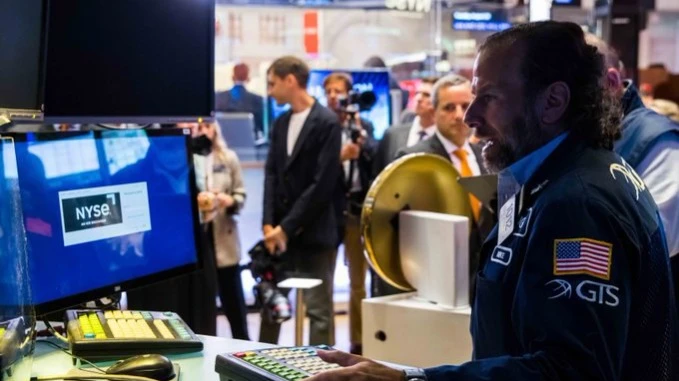
Photo: X / NYSE
A daily review and forecast of events in the U.S. stock market by Mikhail Denislamov, Deputy Director of Capital Markets Research at Freedom Broker.
We expect
The main concern remains the stress in the AI sector, which is increasingly spreading from the equity market to the debt market: the spread on CoreWeave’s (CRWV) five-year credit default swaps briefly exceeded 1,140 basis points, while the market capitalization of the 20 largest AI and semiconductor stocks fell by more than $1 trillion over the week. Analysts at Freedom Broker cite the combination of expensive financing and the AI infrastructure’s significant capital requirements as the main constraint on optimism. A further widening of credit spreads in the AI segment could not only hold back the Nasdaq-100 but also call into question the sustainability of the rotation into other sectors.
Yesterday’s trading session showed that the weakness in tech stocks is still being offset by demand for stocks in other sectors. However, it is too early to speak of a sustained improvement in market breadth: only 44% of S&P 500 components are trading above their 50-day moving averages. Continued rotation will be a key factor in the indices’ stability, especially if pressure on AI companies persists.
Today’s macroeconomic calendar is less packed. Market consensus forecasts suggest that industrial production will rise by 0.4% MoM in September, following flat growth the previous month, and that capacity utilization will increase to 76.5% from 76.3%. Data on import prices will also be released (forecast: 0.8% MoM, prior: 0.7%), which, following the sharp acceleration in the PPI, will be important for assessing inflationary pressures. Speaking at the IMF’s annual meetings in Bangkok, Federal Reserve Chairman Kevin Warsh gave no signals regarding interest rates, calling the October and December meetings key milestones for assessing the economy. Cleveland Fed President Beth Hammack, a voting member of the FOMC, adopted a more hawkish tone after the market closed yesterday. According to her, if inflation expectations deteriorate significantly, the Fed may have to raise rates more aggressively.
Following yesterday’s rise, oil prices are pulling back: WTI is down about 0.7% to $97.3 per barrel. Decisions by the IEA are putting pressure on prices: the agency’s member countries will complete the release of the remaining 100 million barrels of oil from their reserves and will also accelerate diesel fuel deliveries, including more than 20 million barrels as soon as possible. At the same time, risks to supply persist amid attacks on ships in the Strait of Hormuz and statements from Ukraine regarding the resumption of strikes on Russian oil refineries. The G20 finance ministers’ meeting in Bangkok concluded without a joint communiqué.
Before the market opens, Travelers (TRV), Truist Financial (TFC), M&T Bank (MTB), Citizens Financial (CFG), and Regions Financial (RF) will report their earnings. Today also marks the monthly options expiration, which could increase intraday volatility.
U.S. index futures are trading sideways. We assess the risk balance as neutral and expect elevated volatility to persist. Falling Treasury yields and broader participation in the rally beyond the technology sector are providing support to the market; however, future performance will largely depend on the stabilization of the debt market for AI companies. A further widening of credit spreads could once again intensify selling pressure in the technology sector and limit the recovery of the indices.
What to Watch for in the Pre-Market
— Tesla (TSLA) has unveiled the next generation of its Roadster sports car, which was first announced back in 2017. The model, featuring compressed-air engines developed in collaboration with SpaceX, accelerates to 60 mph in less than a second; however, production will not begin until 2028, and the price has not yet been disclosed. For Tesla’s financial performance, the unveiling will have limited significance in the coming years. Nevertheless, TSLA shares are up more than 4%.

— Varonis Systems (VRNS) is up about 2%: Proofpoint will acquire the company for $49.75 per share in cash, or about $6.3 billion. The transaction is expected to close in the first half of 2027. The acquisition will allow Proofpoint to strengthen its position in the data protection and AI security segments.
— J.B. Hunt (JBHT) is down more than 1%: rising costs continue to weigh on profitability. Third-quarter revenue rose 20% year-over-year to $3.68 billion, exceeding the market consensus ($3.58), though EPS ($1.82) matched the consensus, and operating income rose by only 2%. According to management, expenses increased by more than $50 million compared to the second quarter, primarily due to driver and health insurance costs, and restoring margins will be the top priority for 2027. The growth in freight volumes has not yet led to a comparable increase in profits.
— Alcoa (AA) is up more than 2% after beating earnings expectations. Adjusted EPS for the third quarter came in at $1.82, compared with the market consensus of $1.54, while revenue ($3.7 billion) fell short of the consensus estimate ($3.78 billion) and declined 7% quarter-over-quarter due to lower aluminum prices and shipment volumes. The company also agreed to sell part of its Massena East facility in New York State for up to $315 million and reaffirmed its full-year production guidance. Operating results are currently offsetting the price pressure on aluminum.
The Market on the Eve of...
At the close of trading on Thursday, the S&P 500 rose 0.33%, the Dow Jones rose 1.08%, and the Russell 2000 gained 1.38%, while the Nasdaq-100 fell by only 0.05%, rebounding sharply from its intraday low. The rally was accompanied by a noticeable broadening of market participation: the equally weighted RSP rose 1.37%, closing the session near its intraday high with trading volume 1.75 times higher than the average over the previous 20 sessions. At the same time, the number of sector ETFs with an RSI above 50 increased from four to eight out of 11. This indicates a revival of demand beyond the largest companies, although most sectors remain below their 50-day moving averages. The healthcare sector (XLV: +1.84%) led the way amid a shift of funds into defensive sectors. Housing stocks also rose significantly: the ITB sector ETF gained 4.03% on trading volume 1.69 times above average, demonstrating unusually strong momentum amid falling Treasury yields. The worst performers were energy (XLE: −1.55%) and IT (XLK: −0.54%): pressure on the AI sector persisted, with the SOX semiconductor index falling for the seventh consecutive session, although some memory chip manufacturers and cloud providers partially recouped their losses. In particular, CoreWeave (CRWV: +5.94%) rebounded after Nvidia CEO Jensen Huang stated that the company does not need corporate support and that its financial position is improving.
Macroeconomic data pointed to a weakening in consumer demand amid accelerating inflation. Retail sales rose 0.8% month-over-month in September, exceeding the 0.3% consensus estimate, but the growth was largely driven by gas stations. The reference group used in GDP calculations grew by only 0.15% (consensus: 0.3%)—the lowest level since January. This is in line with the estimate from Freedom Broker analysts (0.1%), who anticipated that rising fuel prices would crowd out other purchases. Meanwhile, producer inflation accelerated sharply: the overall PPI rose 1.3% month-over-month against a forecast of 0.5%, while the core PPI rose 0.7% against a forecast of 0.3%, reaching its highest level since April. This increases risks for the core PCE deflator—a key inflation indicator for the Fed. Regional indices diverged: the Empire State index rose to 25.5 percentage points against a forecast of 10 percentage points, while the Philadelphia Fed index fell to 20.9 points (consensus estimate: 28 points), but price components accelerated in both. Initial jobless claims (199,000) were close to the consensus forecast, indicating stability in the labor market.
Corporate news reflected the same rotation. TSMC’s earnings report (TSM: −1.8%) pointed to strong demand for AI, but its fourth-quarter guidance fell short of inflated expectations. The market reacted more favorably to the earnings reports from major regional banks than to the results from the largest financial institutions earlier in the week. Among other companies reporting: BNY (BNY: +3.2%) beat expectations for net interest income and commissions, while Charles Schwab (SCHW: −2.7%) disappointed with its net interest margin and trading revenue.
This article was AI-translated and verified by a human editor