Russell rebalancing in June: 5 small-caps that could enter the index


More than $11 trillion in assets are tied to Russell indexes - composition changes are causing significant capital inflows from index funds and ETFs / Photo: Unsplash / Kanchanara
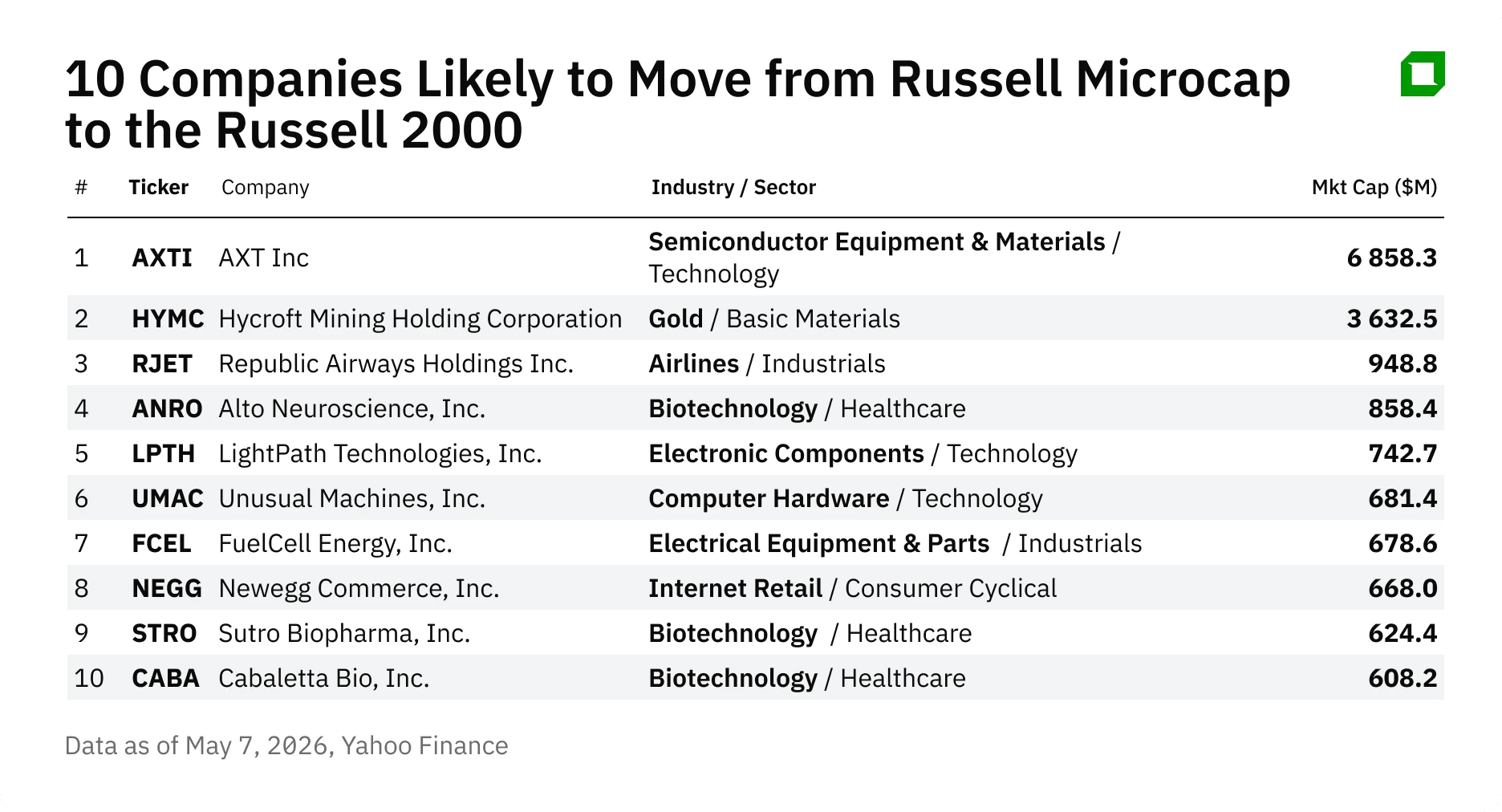
At the end of June 2026, the first semi-annual rebalancing of the Russell indices will be completed. Why this is important for investors was discussed in detail here. Now we have selected five companies that can get into the index, as well as four likely candidates for elimination.
What's important to know about revising Russell
The Russell 2000, the main benchmark for U.S. small-cap companies, will switch to a new update format in 2026: the composition of the FTSE Russell indices will be reviewed twice a year - in June and December. Ranking Day, the date on which the market capitalization of companies is recorded to determine the future composition of the indices, passed on April 30, 2026. The preliminary lists of companies to be added and removed will be published a week later on Ma. 22.
There are more than $11 trillion in assets tied to Russell indexes, so any changes in composition trigger significant capital flows from index funds and ETFs. According to Nasdaq data, trading volume on rebalancing day in 2025 exceeded $200 billion. At the end of the 2025 rebuild, the boundary between the Russell 1000 and Russell 2000 remained at about $4.6 billion in market capitalization, with the smallest company in the Russell 2000 composition valued at $119.4 million.
We analyzed the fund compositions of BlackRock's iShares Russell 2000 ETF (IWM) and iShares Micro-Cap ETF (IWC) and identified 378 tickers present only in the micro-cap segment but absent from the Russell 2000. In addition, there are now more than 130 companies with capitalizations below $180 million at the bottom of the Russell 2000 itself.
According to Nasdaq, inclusion in Russell indexes typically attracts new long-term investors and increases a stock's liquidity for months ahead. The opposite is also true: exclusion from the index can lead to forced sales by passive funds tracking roughly $2 trillion in assets.
We selected five companies as likely candidates for inclusion in the index, and four more for potential exclusion based on current market data:
AXT (ticker: AXTI)
Manufacturer of substrates for optoelectronics and data centers. As recently as a year ago, the company's stock was trading around $1, and by Ma 2026, it has a capitalization of about $8 billion - technically allowing it to go straight into the Russell 1000, bypassing the Russell 2000.
In the first quarter of 2026, AXT increased revenue by nearly 39% year-over-year to $26.9 million. Adjusted loss was $0.01 per share versus the $0.04 loss expected by Zacks analysts. The order book surpassed $100 million amid demand from artificial intelligence-related projects. In April, the company raised $632.5 million through a stock offering to expand production capacity.
On Ma 1, Wedbush Securities raised their target price on AXT stock to $93 from $80 and recommended buying the stock (Outperform). B. Riley Financial - to $73 from $72, maintaining a Neutral rating (Neutral). The stock is already up about 645% since the beginning of the year and as of May 14, the stock is trading around $120. The main risk for investors is that with negative earnings over the past 12 months, the company continues to raise capital through equity issuance to fund growth, which reduces the stake of existing shareholders.
According to MarketWatch, AXT stock is advised to buy by three Wall Street analysts, with an equal number advising to hold. The average target is $81.2.
Unusual Machines (UMAC)
A manufacturer of components for NDAA-compliant drones has become one of the beneficiaries of the U.S. Drone Dominance program. The company doubled revenue to $11.2 million on a 2025 basis, with gross margin rising to 36% in the fourth quarter from 24% in the first quarter. GAAP net loss was $19.2 million, but $15.7 million of that came from non-cash stock-based compensation expense.
Unusual Machines has received an order in excess of $5 million for drone countermeasure system components, and has partnered with Lantronix to develop autonomous components with onboard AI. Analyst Barry Sain of Litchfield Hills reiterated a buy recommendation with a target price of $25. The main risk is that the company remains unprofitable and continues to raise capital through equity offerings, which dilutes the stake of existing shareholders.
Capitalization at the beginning of Ma is about $753 million. According to MarketWatch, the stock has six Buy ratings from analysts. The average target is $24.3, with a potential upside of nearly 60%.
LightPath Technologies (LPTH)
The company supplies infrared optics and thermal imaging systems to the defense and commercial sectors. In the third quarter of fiscal 2026, its revenue grew 109% year-over-year to $19.1 million, gross profit increased 161% to $7 million, and adjusted EBITDA remained positive for the third consecutive quarter at $1.1 million. In February, management unveiled a strategy to achieve revenue in excess of $300 million within five years.
The company's order book reached a record $110.6 million, up 196% from the beginning of the fiscal year. At an investor day in February, management presented a strategy to grow revenue to more than $300 million over the next five years. Notably, Ondas Holdings and Unusual Machines invested $8 million in LightPath Technologies to develop infrared solutions in the drone segment.
LightPath Technologies' market capitalization is about $760 million. On Ma 11 Canaccord Genuity reiterated a Buy rating and raised its target price to $16.5 from $15.5. Risks include a net loss of $16.4 million for the nine-month period, as well as negative operating margins persisting as the business scales. Lightpath Technologies stock has four Buy ratings, according to MarketWatch. The average target is $15.98, with a potential upside of 31.5%.
FuelCell Energy (FCEL)
One of the pioneers of hydrogen power, founded in 1969 - is experiencing a second birth thanks to the growing demand for power from data centers. The company is positioning its carbonate fuel cells as a distributed power solution, effectively competing with Bloom Energy.
In the first quarter of fiscal 2026, FuelCell Energy's revenue grew 61% year-over-year to $30.5 million and its order book totaled $1.17 billion compared to $1.31 billion a year earlier. During the quarter, the company submitted commercial bids for more than 1.5 GW of data center capacity and entered into an agreement with SDCL for projects totaling 450 MW.
Market capitalization of about $1.14 billion. In March 2026, Wells Fargo analysts lowered their target price on the stock to $6 from $7 and maintained a "below market" recommendation. The bank noted that competitor Bloom Energy is not facing capacity constraints, while FuelCell Energy lacks the appearance of sustained profitability. Risks include a gross loss of $5.9 million for the quarter and a net loss of $26.1 million: the company remains deeply unprofitable. The stock has five Hold ratings from Wall Street analysts and two Buy ratings. The average target is $8.4, 2.5 times the stock's current price.
Republic Airways Holdings (RJET)
Republic Airways is one of North America's largest regional airlines, operating approximately 1,300 flights per day under the American Eagle, Delta Connection and United Express brands on a fleet of 314 Embraer E175 aircraft.
In the first quarter of 2026, the company's revenue increased 34% year-over-year to $527.4 million. Net income declined within 1% to $26.9 million. The company reaffirmed its revenue growth guidance to approximately $2 billion for 2026.
Republic Airways completed its merger with Mesa Air Group at the end of 2025. After the merger, Republic Airways Holdings became the owner of the world's largest Embraer fleet - 310 E-Jet series aircraft, the company said in a statement.
Republic Airways has a market capitalization of more than $1 billion. The stock is now only included in the Russell Microcap index, but with its current capitalization, the company is well within the Russell 2000 range. Republic Airways currently has only one Hold rating: large investment companies do not cover Republic Airways shares, which may change after inclusion in the index. Risks include high dependence on contracts with three airline customers, $1.2 billion in debt, and a sharp rise in jet fuel costs amid the closure of the Strait of Hormuz.
Candidates for expulsion from the Russell 2000
Hain Celestial Group (HAIN).
Hain Celestial, once one of the leading companies in the healthy food segment with the Celestial Seasonings and Earth's Best Organic brands, has lost nearly 75% of its market value over the past year. The company's market capitalization fell to $72 million. In the third quarter of fiscal 2026, net sales fell 13% year-over-year to $338 million, with net loss reaching $106 million versus a loss of $135 million a year earlier.
In late March, Nasdaq gave Hain Celestial a notice of non-compliance with the minimum share price of $1. Barclays maintained a Sell recommendation, Mizuho cut its target price by a third to $1 and maintained a Neutral rating. Hain Celestial shares have a total of four Hold ratings and one each Buy and Sell rating. The stock was worth $80 cents at the close of trading on Ma. 14.
Sleep Number Corporation (SNBR)
Adjustable-firmness mattress maker Sleep Number, whose shares were trading above $12 as recently as February 2026, had collapsed to about $1.6 per share by Ma. 14. With a market capitalization of about $37 million, the company reported substantial doubt about its ability to continue as a going concern in its 2025 annual 10-K report. In late April, Sleep Number obtained a $55 million emergency loan due June 30, 2026 - effectively a temporary measure to maintain liquidity before the selling season.
In May 2026, Piper Sandler lowered its target price to $3 with a neutral recommendation and UBS lowered its target price to $2, citing that a $55 million emergency loan expires at the end of June and no sources of new financing have been identified.Sleep Number stock now has four Hold ratings.
DocGo Inc. (DCGO)
The provider of mobile health services and medical transportation - saw its revenue plummet 48% in 2025 after losing its contract with New York City to serve migrants: the figure dropped from $617 million to $322 million.
However, the first quarter of 2026 showed signs of a turnaround, with revenue excluding migrant programs up 19% year-over-year to $75.6 million. Management also raised its 2026 revenue guidance to $300-315 million, noting strong demand for SteadyMD's virtual medical services.
Capitalization is about $58 million. Analysts at Canaccord Genuity lowered their target price on the stock to $1 from $1.5, maintaining a "hold" rating. At the same time, Stifel maintained a "buy" recommendation, but lowered the target price to $2.5 from $4.
Bloom Energy Corporation (BE)
Bloom Energy, a manufacturer of solid oxide fuel cells for distributed power supply to enterprises and data centers, is worth a special mention. The company is still in the Russell 2000, but its market capitalization has grown by more than 1,800% over the year to $86 billion. This is about 17 times the threshold for inclusion in the Russell 1000.
For the first quarter of 2026, Bloom Energy reported revenue growth of 130% year-over-year to $751 million. Adjusted earnings came in at $0.44 per share versus the consensus estimate of $0.09, 389% above guidance. Management also raised its full-year revenue guidance to a range of $3.4-3.8 billion, with one catalyst being an expanded agreement with Oracle to supply up to 2.8 GW of fuel cell capacity for data centers. The stock is up 109% in April alone, with the company's rebuild almost certainly moving from the Russell 2000 to the Russell 1000.