Small-Cap ETF Mid-Year Results: The Oil Rally Gave Way to Broad-Based Growth. Who Came Out on Top?


At the end of the first half of the year, the S&P Small Cap 600 ETF—which includes only profitable companies—outperformed funds tracking the Russell 2000 / Photo: Shutterstock.com
The first half of 2026 ended with a convincing victory for U.S. small-cap companies. The Russell 2000 Index rose 21%, significantly outperforming the Russell MidCap (+13%), the Russell 1000 (+8%), and the S&P 500 (+9.3%). By comparison, Germany’s DAX gained 2% over the same period, while Hong Kong’s Hang Seng fell by 10.7%.
While growth in the first quarter was driven primarily by a small group of high-value companies, mainly from the energy sector, the rally in the second quarter spread to virtually the entire small-cap market.
One of the reasons was the de-escalation of the conflict in the Middle East. After the U.S. and Iran signed a ceasefire agreement, oil prices began to fall. BofA strategists predicted (the report is available on Oninvest) that in the second half of the year, the average price of Brent would be $70–80 per barrel, compared to about $90 in the first half. Against this backdrop, the fundamentals of small-cap companies continued to improve: since the beginning of the year, the consensus earnings forecast for companies in the Russell 2000 has been raised by 13% thanks to the recovery in the industrial sector, notes BofA.
Half-Year Leaders: Broad-Market ETFs Outperformed Value Funds
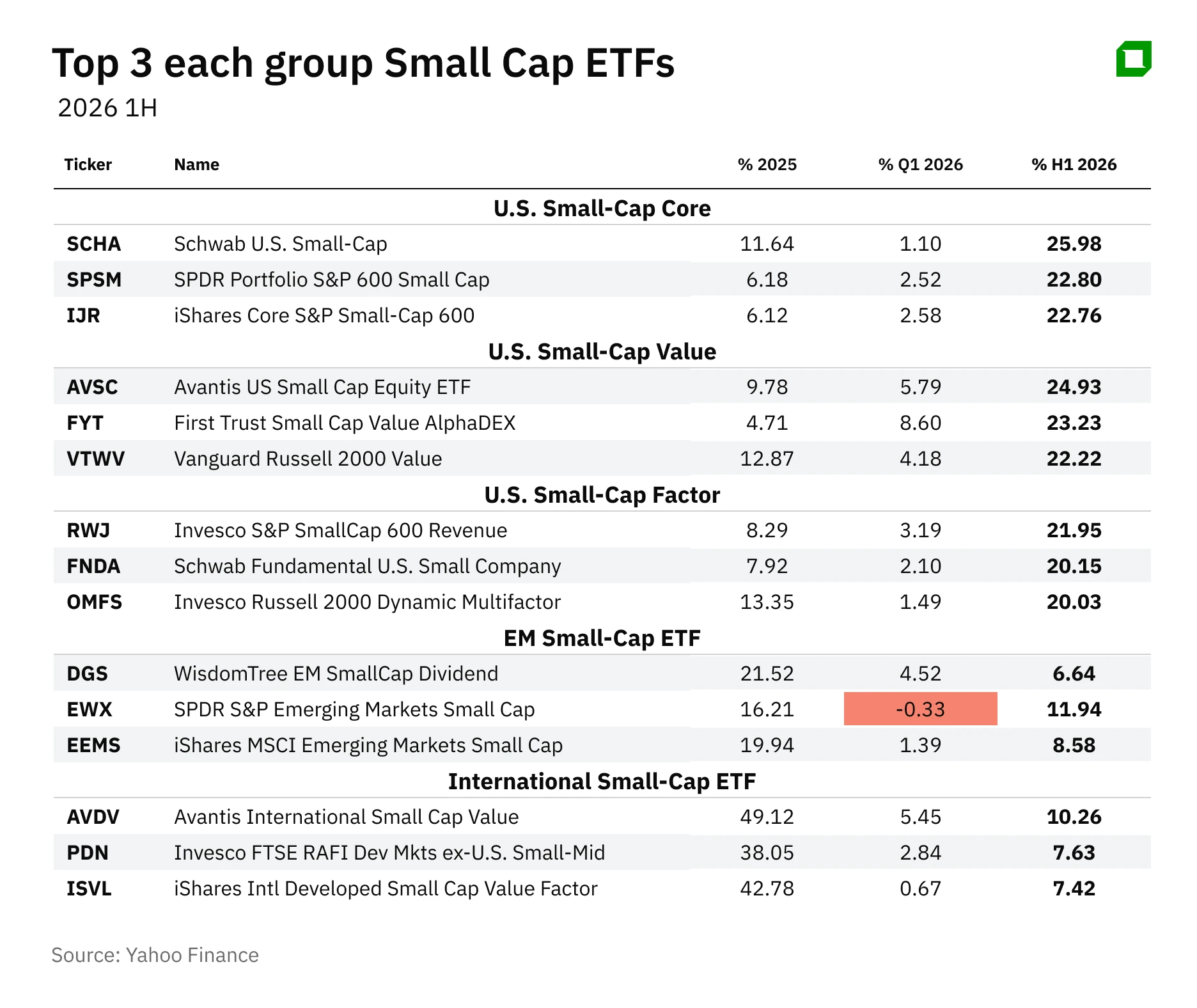
In Oninvest’s sample of 38 small-cap ETFs, the Schwab U.S. Small-Cap ETF posted the best return in the first half of the year, gaining 25.98%. The fund tracks the Dow Jones U.S. Small-Cap Total Stock Market Index, which includes companies ranked 751st through 2,500th by market capitalization. As a result, the portfolio includes not only mature companies but also smaller, fast-growing issuers that are not included in the S&P SmallCap 600 Index. An additional advantage is one of the lowest fees in the sector: as of June 11, 2026, Schwab reduced it to 0.03%.
The Avantis U.S. Small Cap Equity ETF took second place with a return of 24.93%. This is an actively managed fund that invests in approximately 1,500 companies. When selecting securities, it considers their valuation, profitability, and investment volume.
The First Trust Small Cap Value AlphaDEX ETF came in third, gaining 23.23%. The fund invests in small-cap value stocks from the NASDAQ US 700 Small Cap Index. Despite the decline in oil prices in the second quarter, its performance was supported by strong holdings in the financial and industrial sectors.
It is telling that ETFs tracking the S&P SmallCap 600 Index—which includes only profitable companies—outperformed funds tracking the Russell 2000.The SPDR Portfolio S&P 600, the iShares Core S&P Small-Cap ETF, and the Vanguard S&P Small-Cap 600 ETF gained 22.7–22.8%, while the iShares Russell 2000 ETF and the Vanguard Russell 2000 ETF rose by 21.3–21.4%.
At the same time, value funds no longer outperformed the market: the Avantis U.S. Small Cap Value ETF rose 21.74%, while the Vanguard Russell 2000 Value ETF rose 22.22%, essentially mirroring the performance of the broad indices.
Emerging markets outperformed developed markets
Small-cap funds in developed markets lagged significantly behind their U.S. counterparts. The Avantis International Small Cap Value ETF posted the best performance, gaining 10.26% in the first half of the year, while the other funds in this group rose by only 5–7.6%. By comparison, the MSCI ACWI ex U.S. Index gained 13% over the same period.
Funds focused on emerging markets performed better. The WisdomTree Emerging Markets SmallCap Dividend Fund led the way with a return of 14.03%. It was followed by the SPDR S&P Emerging Markets Small Cap ETF, which rose 12.86%, the iShares MSCI Emerging Markets Small Cap ETF, up 11.93%, and the Avantis Emerging Markets Small Cap Equity ETF, up 10.42%. At the same time, the funds’ performance stood in stark contrast to Hong Kong’s Hang Seng Index, which fell by 10.7% in the first half of the year.
The scale of the segment’s growth was also confirmed by the June rebalancing of the Russell indices, which—for the first time since the 1980s— began to take place every six months. The new index compositions took effect after the market closed on June 26. Over the year ending on the cut-off date of April 30, the Russell 2000 index rose 44.4%, compared with 30.4% for the Russell 1000. At the same time, the threshold separating large-cap companies from small-cap companies rose by 24% to a market capitalization of $5.7 billion. This means that a company whose market capitalization was sufficient for inclusion in the Russell 1000 a year ago may now find itself in the Russell 2000.
Which companies have emerged as growth leaders?
— Schwab U.S. Small-Cap ETF
The Schwab U.S. Small-Cap ETF’s high returns were largely driven by a single stock. The fund’s largest holding, with an unusually high weighting of about 6.6%, was SanDisk —a manufacturer of NAND flash memory that was spun off from Western Digital in February 2025. At the time of its inclusion in the index, the company’s market capitalization was approximately $5.6 billion. However, over the following year, the stock rose so much that its market capitalization exceeded $260 billion, and the company moved out of the small-cap category. Nevertheless, the fund continues to hold these shares because the Dow Jones U.S. Small-Cap Index reviews its composition once a year—in September—and quarterly rebalancing does not provide for the exclusion of companies whose stock prices have risen too sharply.
During the first half of 2026, SanDisk’s stock rose by approximately 780% due to strong demand for memory for data centers powering artificial intelligence systems. At the end of the third quarter of fiscal year 2026, the company’s revenue increased by 251% year-over-year to $5.95 billion, while sales in the data center segment rose by 645%.
Following the release of the report, Bernstein raised its price target for SanDisk shares to $3,000—nearly double their current price. Bank of America and Citigroup maintained their price targets at $2,500. However, such a high concentration in a single stock increases risk: if SanDisk’s stock price falls, the fund will suffer more than more diversified funds.
— Avantis U.S. Small-Cap Equity ETF
The largest holding in the Avantis U.S. Small Cap Equity ETF as of July 9, 2026, with a weighting of approximately 0.59%, was MYR Group —a contractor specializing in the construction and modernization of power grids, which has become one of the beneficiaries of the data center boom. By mid-July, Materion —a manufacturer of specialty materials for the electronics, aerospace, and defense industries—had become the portfolio’s top holding. The change in the top holding is due to the fact that Avantis U.S. Small Cap is an actively managed fund, so the portfolio managers can quickly adjust the weightings and composition of the portfolio without waiting for a scheduled rebalancing.
In the first quarter of 2026, MYR Group increased its revenue to $1 billion, up $166.8 million from a year earlier, and also posted record net income ($46.8 million) and order backlog ($2.84 billion). Since the start of the year, MYR Group’s stock has risen by more than 230%. Meanwhile, analysts at Oppenheimer, who began covering the company in June, assigned it a neutral “Perform” rating, noting that the current valuation already appears high compared to its peers.
— First Trust Small Cap Value AlphaDEX ETF
The composition of the First Trust Small Cap Value AlphaDEX ETF’s largest holdings has changed significantly following the oil rally. As of July 5, the fund’s largest holding, with a 1.02% weighting, was GEO Group —an operator of migrant detention centers and the second-largest private prison company in the U.S., which operates under contracts with Immigration and Customs Enforcement (ICE) (Immigration and Customs Enforcement).
In the first quarter of 2026, GEO Group reported a 17% increase in revenue—to $705.2 million—and a 96% increase in earnings—to $0.29 per share. The company raised its full-year outlook and announced that contracts secured in 2025 could add up to $520 million in annual revenue.
The shift in the portfolio’s top performer—from oil producer Kosmos Energy in the first quarter to GEO Group—shows just how quickly changes in the geopolitical landscape can reshuffle the leaders within the value segment.

What's next?
The scenario of sustained de-escalation, on which investment firms’ June forecasts were based, turned out to be premature. In July, the U.S. and Iran resumed exchanging blows, Washington revoked the license to sell Iranian oil, and Donald Trump declared that the truce was over. Against this backdrop, Brent crude returned to around $80 per barrel. This reinforces the scenario that was relevant in the first quarter: rising oil prices could support value funds with a high weighting of energy companies.
The second risk for small-caps in the second half of the year is a possible shift in the Fed’s monetary policy. BofA analysts expect three rate hikes of 25 basis points each in September, October, and December. According to the bank’s estimates, each rate hike could reduce the operating profit of Russell 2000 companies by approximately 2%, as more than 40% of their debt has short-term or floating rates.
Against this backdrop, BofA favors mid-cap companies over small-cap ones in the second half of the year and recommends focusing on quality within the segment while avoiding the most heavily indebted issuers. Investors have already begun to reduce risk: over the week ending June 24, $9.2 billion was withdrawn from U.S. small-cap equity funds, and U.S. equity funds as a whole recorded outflows for the first time in the past 13 weeks, according to data from BofA (the report is available at the editorial office).
The main argument in favor of small-caps remains: According to UBS, small-cap companies are trading below their historical valuations, while large-cap companies remain significantly more expensive. At the same time, according to FactSet, the consensus forecast calls for an acceleration in S&P 600 (small-cap) earnings growth to 36% year-over-year in the fourth quarter.
For investors, the key question for the second half of the year is whether earnings growth will be able to offset potential pressure from interest rates and ongoing geopolitical instability in the Middle East.
This is not intended as individual investment advice.