Stocks Rise After Plunge; BofA Warns of “Populist Socialism” — Online
Market jitters persist—the “fear index” remains at a seven-month high, and Wall Street analysts are divided on whether stocks have bottomed out and whether it’s time to buy

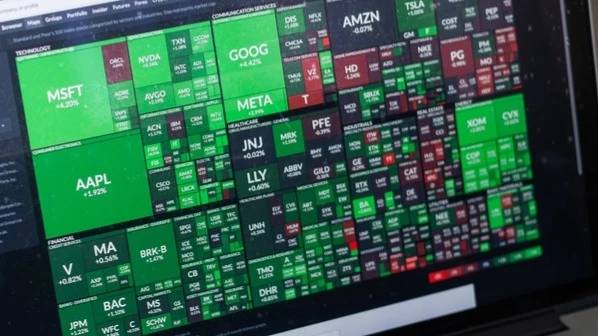
The sell-off in U.S. tech stocks, which on November 5 led to a record drop in the market capitalization of the S&P 500 and the Nasdaq Composite, appears to have come to an end. The Nasdaq 100 index is rising during the main trading session. Nevertheless, investor anxiety persists—the CBOE Volatility Index (VIX), known as the “Wall Street fear index,” remains at 25 points. Oninvest will be monitoring market developments in this live update.
May 20, 20:05 CET: With two hours left until the close of trading in New York, here's the situation on the stock markets:
The Nasdaq Composite Index has accelerated its gains and is now up 1.5%. Among the “Magnificent Seven” stocks, Tesla is performing the best, rising 5% after yesterday’s plunge. Microsoft is performing the worst, as it is the only stock in the group trading in the red.
The S&P 500 broad-market index is up 0.7%. The Dow Jones index is down slightly.
The Philadelphia Semiconductor Index (SOX) is up 4%. Nvidia shares are up 3%, Micron shares are up nearly 6%, Marvell shares are up 3.5%, and Intel shares are up 9%.
The decline in Wall Street's "fear index," the VIX, has accelerated—the index fell 13% and dropped below 25 points.
8:00 p.m. CET: The recent U.S. election could trigger a significant revaluation of risky assets, analysts at BofA Global Research warn. In their view, this represents a political shift “from populist capitalism to populist socialism.”
According to BofA, such a shift would lead to higher taxes and tighter regulation. This will create additional obstacles to corporate profit growth and jeopardize the current K-shaped consumer boom and the rapid growth in capital expenditures on artificial intelligence, which have so far supported the markets.
BofA Global Research points to American public sentiment as one of the key factors driving political change. The cost of living and artificial intelligence infrastructure are becoming the top issues for voters.
“Voters want lower living costs, an end to wars, and a slowdown in the expansion of AI data center infrastructure,” BofA noted. According to analysts, this suggests that political pressure on the technology sector—which is actively expanding its infrastructure—will intensify.
7:45 p.m. CET: Microsoft is calling off a deal with Oracle to lease computing power for artificial intelligence, according to Bloomberg sources. This is part of a broader reassessment of the company’s approach to the billions of dollars it spends on contracts with cloud partners, the agency reports.
Oracle shares plunged 5% immediately after the Bloomberg report was published, falling to a nearly three-year low, although they later recouped some of their losses. Prior to the drop, the stock had actually been rising—by as much as 4% at its peak. Microsoft shares fell 0.7% during trading on November 6.

Microsoft was one of the main driving forces behind the boom in so-called non-cloud companies, with which the corporation signed contracts worth tens of billions of dollars. However, the day before, Bloomberg reported that Microsoft had tightened oversight of data center projects being built by third-party providers of computing power for artificial intelligence under contracts with the company—specifically, Nebius Group, IREN, and Nscale. According to the agency’s sources, Microsoft has begun to pull out of projects it considers risky, and its management is holding internal discussions about whether to enter into new deals with non-cloud providers.
7:25 p.m. CET: Today’s jobs report, which showed a sharp increase in new jobs, contradicts the pessimism of recent days and reminds investors that artificial intelligence does not define the entire economy, says Florian Ielpo, a portfolio manager at Lombard Odier Asset Management.
“The key point is that this report once again confirms the economic strength the Fed has been talking about and practically settles the question of a rate hike in December,” he added. “Ordinary Americans are doing just fine, thank you.”
The employment data dispel fears of a significant slowdown in economic growth, but investors shouldn’t draw far-reaching conclusions from a single strong report, as tighter financial and credit conditions are likely to affect business activity in the future, noted Edward Jones strategist Angelo Kurkafas. “Nevertheless, this report is a good reminder that the economy remains on solid footing, despite the recent market volatility caused by the U.S.,” he said.
6:50 p.m. CET: U.S. stocks have slowed their gains. The Nasdaq Composite is now up 0.9%, while the S&P 500 is up 0.4%. The Dow Jones Industrial Average has turned lower and is down 0.2%.
The Philadelphia Semiconductor Index (SOX) is up 2.6%. Nvidia shares are up 2%, Micron’s are up 3.7%, Marvell Technology’s are up 1%, and Intel’s are up 5%. Broadcom is down slightly.
Wall Street's "fear index," the VIX, is hovering around 26 points.
10:10 p.m. CET: Goldman Sachs analysts see a signal that the market is set to rise
Panic in the U.S. stock market on November 5 reached a level that historically heralds a strong recovery in the medium term, Bloomberg reports, citing Goldman Sachs traders.
The bank’s Vol Panic Index jumped to 9.57 out of 10 points on Thursday. Over the course of the day, the Vol Panic Index rose by nearly five points—the third-largest daily jump on record. Combined with Wednesday’s drop—which was the fourth-largest on record—the index posted its largest two-day swing in history, the bank’s traders wrote.
“The cumulative two-day fluctuation was the largest on record, and I think this shows just how quickly the market shifted from relief to outright panic,” noted Lee Koppersmith of Goldman Sachs.
The sharp reversal in sentiment followed a strong surge in demand for protection against a market decline ahead of the U.S. midterm elections. During the post-election rally, investors sold their hedges, leaving their stock positions without adequate protection by the time the market reversed. When prices plummeted and a wave of forced liquidations swept through hedge funds, investors rushed to buy back their hedges, traders said. The demand for hedging was reflected in options trading volumes: on Thursday, more than 11 million put option trades were executed on the Cboe, primarily on indices.
At the same time, Goldman’s historical analysis shows that the market’s medium-term outlook becomes more favorable when panic reaches such levels. In the 15 previous instances when the Vol Panic Index exceeded 9.5, the S&P 500 index gained an average of 4.6% over the following three months, with gains recorded in 80% of those cases. Over six months, the average gain was 9%, and the proportion of positive outcomes was 73%.
17:50 CET: Exchange-traded funds (ETFs) that use leverage have added fuel to this week’s sell-off, according to the WSJ. Using borrowed funds can boost returns, but it also amplifies losses.
According to JPMorgan estimates, leveraged exchange-traded funds sold more than $60 billion worth of stocks this week, with technology companies accounting for about 90% of that volume.
17:20 CET: Shortly before the close of trading yesterday, many retail investors apparently decided that the market had bottomed out, according to data from the analytics firm Vanda. According to its estimates, during the last 10 minutes of trading, investors bought over $100 million more in shares than they sold.
At the end of the day, the outflow from stocks totaled $151 million.
4:50 p.m. CET: Trading in New York has been underway for an hour and a half, and all major stock market indices are in positive territory:
The Nasdaq Composite Index is up 1.7%. The S&P 500 broad-market index has accelerated its gains and is up 0.9%. The Dow Jones Industrial Average, a blue-chip index, is rising moderately, gaining less than 0.1%.
The so-called Wall Street "fear index," the VIX, has fallen by nearly 10% and is currently hovering around 25 points.
4:40 p.m. CET: An old Wall Street saying goes: “When shoe shiners start talking about stocks, it’s time to sell.” Anthony Willis, an economist at the investment management firm Columbia Threadneedle, advises investors to heed this wisdom:
"This morning I was driving the kids to school, and the market sell-off was the top story on the BBC. I thought, 'Well, I guess the hard times are probably over now.'"
16:25 CET: Analysts , describing yesterday’s trading, are talking about “flashbacks” and comparing the events to the market crashes of 2001 or 2008. In terms of the breadth of the sell-off, Thursday was more reminiscent of 2000, according to Yahoo Finance.
The publication notes that the Technology Select Sector SPDR Fund (XLK), an exchange-traded fund designed to provide broad exposure to the technology sector, plummeted 8% on Thursday—its worst performance since March 16, 2020. Since 1989, the fund has experienced six similar drops of 6% or more near record highs. In five of those instances, the decline quickly came to a halt, but April 12, 2000, was an exception—on that date, the sector subsequently fell another 78% and did not reach a new record high until 2017. In cases where the decline ended quickly, at least eight out of ten S&P 500 stocks fell along with the tech sector. On April 12, 2000, by contrast, most stocks in the index rose, even though the index itself lost about 2%.
Thursday turned out to be a mixed bag: about 85% of S&P 500 stocks fell, but 74% of them outperformed the index—according to an analysis of Norgate Data conducted by Yahoo Finance.
Five brief episodes were triggered by events outside the technology sector itself—ranging from a failed airline takeover in 1989 to the Asian financial crisis, the collapse of Long-Term Capital Management, the pandemic, and trade wars. In most of these cases, the market received prompt assistance from the Fed or government authorities. In 2000, the problem lay within the tech sector itself. Now, according to Yahoo Finance, both factors have converged—a political trigger and concerns about companies’ spending on AI.
In terms of the sector’s weight, there is also a parallel with the year 2000: in October, the technology sector reached a record 39% of the S&P 500 index, surpassing the peak of 35% recorded in 2000. The greater the sector’s weight in the index, the more its decline drags down the entire market.
At the same time, the trend in corporate earnings appears less alarming. In the year leading up to the March 2000 peak, technology stocks doubled in price, while earnings estimates rose by only 23%. In the year leading up to the October 2026 record, prices rose by 32%, while earnings estimates jumped by 73%. Currently, the sector is trading at about 24 times forward earnings, compared with 62 in March 2000.
Richard Bernstein, head of macro and discretionary investments at Janus Henderson Investors, sees unpredictability as the main risk. “The risk of momentum investing is that no one can predict when it will reverse,” he said Thursday on Yahoo Finance’s “Market Domination” program. “It’s always a bit like the Coyote from the cartoon: you’re running at full speed, and then suddenly you realize there’s no ground beneath your feet, and you fall to the bottom of the canyon.”
3:55 p.m. CET: HSBC Holdings strategist Max Kettner, who predicted yesterday’s stock sell-off, has issued a new warning—according to his forecast, Anthropic’s potential IPO could turn out to be a more significant event for the market than the U.S. midterm elections.
“Anthropic’s IPO in two weeks—if it goes ahead—will most likely be a real turning point for the market. In the best-case scenario, the company will go public with a valuation of $1 trillion instead of $1.5 trillion,” Bloomberg quotes Kettner as saying.
The offering must be priced low enough for the shares to start rising as early as the secondary market trading or, at the very least, not fall by 20–30% in the first week—“that would be terrible,” says the strategist. Anthropic’s plans to go public are also being hampered by a sell-off in the AI sector, which has made the market environment less favorable, and the change in administration in Washington, which is altering expectations regarding how the company will manage its relationships with regulators.
In recent years, Kettner has become known on Wall Street as one of the first strategists to predict the current bull market. However, last month, for the first time in a long while, he reduced his holdings of U.S. stocks due to sharp swings in investor sentiment ahead of the midterm elections.
On Thursday, the S&P 500 index suffered its steepest decline since April 2025, while the Nasdaq 100 and the chipmakers’ index posted their worst performance since March 2020. Kettner noted that this sell-off resembles forced liquidation of positions due to the unwinding of trend-following strategies rather than a reassessment of fundamentals. The strategist believes that the bet on AI remains generally justified, despite this week’s massive sell-off. Semiconductor stocks, he said, are capable at some point of “jumping 20–30% in two days simply due to short-squeeze,” though he acknowledged that he does not know exactly when that will happen.
3:30 p.m. CET: The trading session in New York has begun; let's see what's happening:
Shares of chipmakers are rebounding from their decline. The Philadelphia Semiconductor Index (SOX) rose by more than 5% at the start of trading. Nvidia shares are up nearly 6%, Micron Technology shares are up nearly 6%, Broadcom shares are up 4%, Qualcomm shares are up 2%, Marvell Technology shares are up 8%, and Intel shares are up 5%.
Investors were also snapping up shares of so-called “neoclouds,” which had plummeted the day before: Nebius and CoreWeave shares are up 7%. IREN shares soared nearly 20% after the company reported a threefold increase in revenue from cloud services and a reduction in losses for the past quarter.
The Nasdaq Composite Index is up 1.5%. The S&P 500 broad-market index, which lost more than 4% the previous day, is up 0.2% on Friday. The Dow Jones Industrial Average, a blue-chip index, remains in the red, down 0.9%.
The so-called Wall Street "fear index," the VIX, is down 5% but remains above 26 points, signaling that anxiety persists.
14:50 CET: What Does the Sharp Rise in Employment Mean for the Fed? Today’s report is unlikely to change the Fed’s stance on interest rates, according to the WSJ. The central bank’s primary concern right now is inflation, which remains significantly above its 2% target. It would take a sharp deterioration in the labor market to keep the Fed from raising rates at its December meeting, the publication notes.
14:35 CET: What’s happening in the market following the jobs report: Nasdaq 100 futures are up 1.5%, and S&P 500 futures are up 0.2%. Dow Jones futures are down 0.8%. The so-called Wall Street “fear index,” the VIX, is just above 27 points.
2:30 p.m. CET: The employment report far exceeded expectations!
According to the U.S. Bureau of Labor Statistics, nonfarm payrolls rose by 165,000 in October. Economists surveyed by The Wall Street Journal had expected about 59,000 new jobs. Earlier reports indicated that September’s gain was only 29,000, but today the figures were revised upward to 60,000 new jobs.
The unemployment rate unexpectedly fell to 4.1%, although economists had expected it to remain at 4.2%.
Bloomberg calls the jobs report a "big positive surprise."
13:55 CET: Yesterday’s sell-off in AI stocks was “an overreaction,” wrote strategists at Yardeni Research in a note cited by the WSJ. In their view, investors are overreacting to political opposition from Democrats to the construction of data centers in the U.S. Yardeni Research believes these are merely “bumps in the road, not roadblocks.”
Yardeni notes that Texas Governor-elect Gina Inohosa has already stated that approved construction projects will be completed. According to Yardeni’s assessment, this applies to “virtually all” of the computing capacity in Texas scheduled to come online in 2027 and, likely, a significant portion of that scheduled for 2028.
Yardeni strategists advise investors to take advantage of the sell-off to buy stocks that have fallen in price and continue to expect the S&P 500 index to rise to 7,900 points by the end of the year — which is 7% above the current level.
1:30 p.m. CET: Investors are awaiting the release of monthly U.S. employment data today, which could provide clues about the trajectory of the Fed’s interest rate. According to a Bloomberg Economics forecast, nonfarm payrolls will show moderate growth, while the unemployment rate is likely to remain around 4.2%. Neither of these figures will prevent the Fed from raising rates in December, the agency’s analysts noted.
“The market’s immediate focus will likely remain on AI and data centers, but a strong jobs report could help ease some of the current market jitters by bolstering confidence in the sustainability of the economic cycle, — said Francisco Simón, a strategist at Santander Asset Management. — We continue to believe that cyclical employment has room for further expansion amid corporate earnings and investment.”
10:10 a.m. CET: What Wall Street analysts are saying:
“I expect a moderate rebound today—opportunistic investors will be picking out the hardest-hit stocks,” Bloomberg quotes Singular Bank strategist Roberto Scholtes as saying. According to him, the market is waiting for signals regarding the Democratic Party’s intentions concerning data centers—if politicians assure the market that they do not plan to impose a nationwide moratorium on the construction of new facilities, investor sentiment will turn around.
The main question for investors is whether the November 5 sell-off was a temporary correction or the start of a deeper stock market pullback. “I would expect selective buying following such a sharp correction,” noted Mapfre AM strategist César Jimeno. “However, in the short term, investors will likely remain cautious, avoid aggressively increasing their risk exposure, and wait for greater clarity—especially after the less-than-convincing reports and forecasts from key players in the sector.”
Investors shouldn't get too excited about the movements in the futures markets, warns UBS equity strategist Jerry Fowler—he expects the sell-off to continue. According to him, the modest rise in Nasdaq futures does not look like a genuine rebound—rather, it reflects tentative buying in the less liquid futures market. “We just need to keep an eye on the flows closer to the opening of U.S. trading, rather than reading too much into the recovery we’re seeing today,” he told the WSJ.
“We do not believe that yesterday’s price movements marked the beginning of a reversal in AI-related trading,” said Mohit Kumar, chief European economist at Jefferies. “We acknowledge that the political uncertainty following the ‘blue tsunami’ is raising concerns about AI investments and the pace of data center construction. However, data centers and AI infrastructure also create jobs, and Democrats will not want to let those jobs go to other states or abroad.”
1:00 p.m. CET: There are less than three hours until the main session opens in New York.Here's what's happening in the markets right now:
Nasdaq 100 futures rose 1.7% after falling 6.4% the previous day. In premarket trading, Nvidia shares are up nearly 4%, Micron Technology shares are up nearly 10%, Broadcom shares are up 5%, Qualcomm shares are up 4%, and Intel shares are up nearly 7%.
Investors are snapping up shares of so-called “neoclouds,” which had plummeted the day before: Nebius’s pre-market price is up more than 10%, and CoreWeave’s is up 9%. IREN shares soared more than 19% after the company reported a threefold increase in revenue from cloud services and a reduction in losses in the past quarter.
S&P 500 futures are showing a moderate gain of 0.4%. Dow Jones futures are down 0.9%.
The so-called Wall Street fear index, the VIX, is down 5%—but that doesn’t make up for yesterday’s rise. The index remains near the 27-point mark, a level it last reached in April 2026 amid the escalation of the war in the Middle East.
Asian stock markets closed lower: South Korea’s KOSPI index fell 6%, and Japan’s Nikkei 225 dropped by the same amount. Hong Kong’s Hang Seng Index fell 1.3%.
The Stoxx 600, a benchmark index of European stocks, is down 1.8%.
Updating...
This article was AI-translated and verified by a human editor