The Crisis in the Strait of Hormuz and Routes to China: How to Invest in a Changing Transportation Market
The share price of Breakwave Tanker Shipping, an exchange-traded fund that tracks tanker freight rates, has risen by more than 3,000% since the beginning of the year

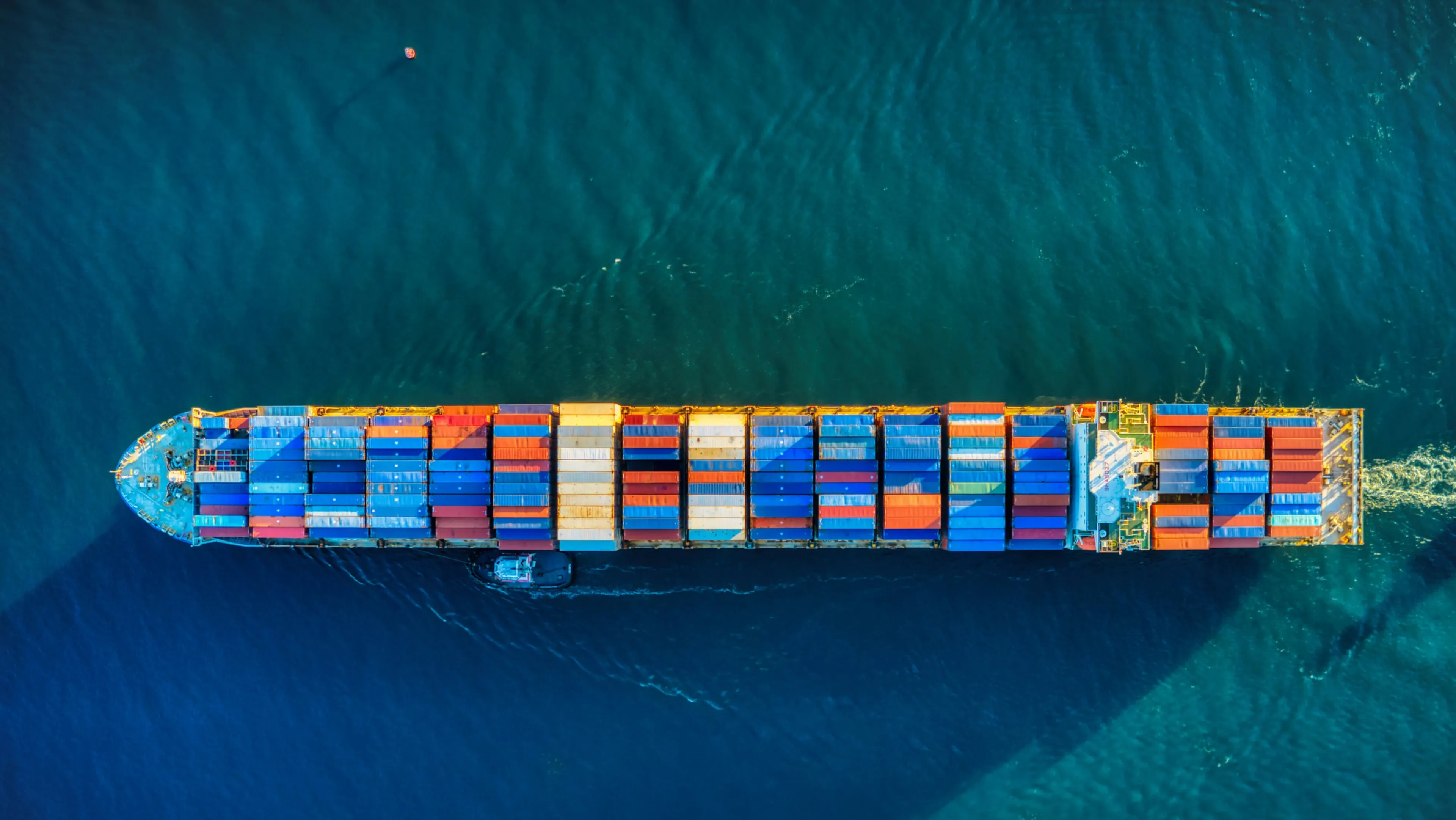
In September, the cost of ocean container shipping under spot contracts from China to the U.S. East Coast returned to pre-COVID-19 pandemic levels. Photo: Venti Views / Unsplash.com
Last weekend, U.S. President Donald Trump announced that he had rejected Iran’s proposal for a ceasefire and the reopening of the Strait of Hormuz. Against this backdrop, problems with the export of oil and other cargoes from the Persian Gulf countries persist, and the maritime shipping market remains in the spotlight for investors. The crisis has already led to a significant rise in the prices of several funds that track freight rates. Zaman Rizvanioglu Gabibov, an investment analyst at ATLAS Capital, explored what other investment opportunities exist in the logistics sector.
Growth in the thousands of percent and exceptional volatility
The price of the Breakwave Tanker Shipping ETF (BWET), which allows investors to bet on oil tanker freight rates, has risen by nearly 3,700% since the beginning of the year. This dizzying rally was accompanied by equally exceptional volatility and became one of the most striking market consequences of the crisis surrounding shipping through the Strait of Hormuz.
On September 28, BWET’s market price was $730, and its net asset value (NAV) was $736.33. On September 18, the fund’s price reached a high of $872.14, compared to $19.26 at the end of 2025. At its peak, the gain exceeded 4,400%—more than 45 times the initial value. This trend illustrates how much the fund’s performance depends on the chosen calculation date and how quickly a sharp rise can give way to a price correction.
This crisis has led not only to rising oil prices: the cost of chartering supertankers (capable of carrying up to 2 million barrels) exceeded $1.2 million per day last week on routes between the Middle East and Asia — compared to $20,000–50,000 per day for most of last year, the Financial Times reported. The war in Iran has restricted shipping through the Strait of Hormuz and reduced the availability of supertankers: some vessels are rerouting or waiting longer for safe passage, while refineries are seeking alternative supplies from more distant regions.
What's actually inside this ETF?
Legally and economically, it is more similar to commodity pools—they do not own shares in shipping companies, tankers, or oil.
The fund’s main holdings are freight futures, also known as Forward Freight Agreements (FFAs)—financial contracts that allow investors to lock in the future cost of maritime transportation or profit from changes in freight rates. They are calculated based on the average value of the Baltic Exchange indices for the corresponding month. There is no physical delivery of a vessel or cargo.
FFA transactions are typically negotiated through brokers outside the central exchange trading system and then submitted for clearing through major international exchanges: the Intercontinental Exchange, the Chicago Mercantile Exchange, the European Energy Exchange, and the Singapore Exchange.
This structure reduces bilateral credit risk but does not make the market as transparent and continuous as, for example, the oil futures market or the S&P 500 index. The fund’s prospectus explicitly states that there are no market makers in the underlying market who are required to quote prices continuously, and that quotes may occasionally be limited or unavailable.
The "oil" freight ETF holds a long position (90% of its exposure) in futures on the TD3C route—the transport of 270,000 metric tons of crude oil by supertanker from the Middle East to China. The remaining 10% is allocated to TD20—the shipment of 130,000 metric tons from West Africa to continental Europe via Suezmax vessels. The fund uses the nearest monthly contracts, gradually shifting its exposure to the next calendar quarter, and in December returns the ratio between the two contract groups to the target level of 90% to 10%.
Why did it grow tenfold?
The fund is almost directly linked to the most vulnerable route affected by the crisis. Any risk to transit through the Strait of Hormuz is immediately reflected in the availability of supertankers, insurance premiums, waiting times, and the cost of voyages to Asia.
The physical flow of ships through the Strait of Hormuz has dropped sharply, and the market has been faced with a shortage of available tonnage—not just rising oil prices. Shipowners are demanding a military risk premium; part of the fleet is avoiding the region; and ships are either waiting longer for a safe window or participating in oil transshipments outside the Gulf. This reduces the effective supply of tankers even without a change in their total number.
Transportation distances have also changed. Refineries in Asia and Europe are partially replacing Middle Eastern oil with supplies from the United States, Brazil, Guyana, and other countries in the Atlantic Basin. More kilometers per barrel means increased demand for tonnage in ton-miles and longer utilization periods for each vessel.
The high returns are partly due to the low starting point: BWET ended 2025 at $19.26. When freight rates rise tenfold, the fund itself can also see growth in the thousands of percent. But if the market returns to normal levels, those same futures contracts could quickly lose most of their value.
What should an investor keep in mind?
After a nearly 40-fold increase, buying BWET is not simply a bet on the potential to profit from high freight rates. Investors are, in fact, anticipating that actual rates on specific routes will be even higher in the coming months than futures prices already suggest.
However, the argument that any further escalation automatically drives up BWET's stock price oversimplifies the situation.
For the shipping industry, the most favorable scenario is one in which cargo continues to move, but transportation becomes longer, slower, more dangerous, and more expensive.
A complete and prolonged halt to exports from the region would lead to the opposite situation: the number of available voyages would drop, the TD3C route would lose its physical representativeness, and the liquidity of freight futures would deteriorate. The market’s initial reaction is usually a sharp rise in the risk premium, but subsequently, the lack of cargo could reduce demand for shipping.
A medium-term cap on this fund’s price growth is already taking shape. In 2026, shipowners ordered a record number of supertankers: Reuters cites estimates of 164–217 new vessels, compared with 83–93 the previous year. Most of these vessels are expected to be delivered in 2029–2030. All else being equal, the arrival of new vessels could lead to a decline in freight rates, but the ultimate impact will also depend on the retirement of older vessels and changes in demand.
Another investment idea: betting on dry cargo ships
Another exchange-traded fund is the Breakwave Dry Bulk Shipping ETF (BDRY).
On September 4, its price rose to an intraday high of $16.71—up 90.5% since the beginning of the year. On September 28, they fell to $14.9—which is still more than 70% above the level at the end of 2025. The fund’s NAV as of that date was $14.96.
BDRY presents another investment opportunity—focusing on the transportation of iron ore, coal, and grain, where China, the global industrial cycle, and the availability of the dry-bulk fleet play a decisive role.
The fund operates on a principle similar to that of BWET, but is linked to dry bulk freight futures. There is also no physical delivery of a vessel or cargo here. Capesize vessels—the largest—primarily carry iron ore and coal. Panamax vessels are medium-sized ships that primarily carry coal and grain, while Supramax vessels are more compact ships designed for various bulk cargoes. Within the fund’s portfolio, freight rates for these vessel types account for 50%, 40%, and 10%, respectively.
The management company positions both funds as non-leveraged instruments: the nominal futures exposure should not systematically exceed the fund’s capital. However, the absence of leverage does not mean that the funds carry low risk: freight rates can fluctuate sharply, and futures positions require margin collateral and are revalued daily. The funds’ available cash is primarily held in cash and short-term U.S. Treasury bonds. Interest from these investments partially offsets the funds’ expenses.
The approximately 70% rise in the BDRY index reflects strong growth in freight rates for dry bulk cargo, particularly for large Capesize vessels. In early September, the Baltic Dry Index rose above 3,500 points, and the average daily rate for Capesize vessels exceeded $50,000.
The market was supported by strong demand for iron ore, long shipping routes from Brazil and West Africa to Asia, a shortage of available vessels, and seasonal restocking in China.
For the fund, it is not only the volume of cargo being transported that matters, but also the distance over which it must be delivered. For example, transporting 1 million metric tons of ore from Brazil to China requires far more ships and time than transporting the same volume from Australia to China. The availability of ships is also affected by the construction of new vessels and the decommissioning of old ones, their speed, delays at ports, repairs, weather, and restrictions on shipping channels.
Unlike BWET, 90% of whose exposure comes from the crude oil route to China via the Strait of Hormuz, the key fundamental question for BDRY is this: Will shipments of iron ore, coal, and grain grow faster than the available carrying capacity of the dry-bulk fleet?
The conflict in the Middle East affects BDRY indirectly. If ships avoid dangerous areas, their voyages become longer, and the available fleet size is temporarily reduced. At the same time, rising fuel prices increase transportation costs, and a slowdown in the global economy could reduce demand for raw materials and, consequently, for their transportation.
BDRY’s return performance clearly illustrates the scale of the risk. In 2021, the fund rose by nearly 274%, but by 2022 it had already lost 68.35%. In 2023, BDRY recovered part of its losses, gaining more than 24%, but in 2024 it fell again—by just over 48%. The maximum drawdown from its September 2021 peak to its August 2023 low was 86.4%. In 2025, the fund posted a return of +45%.
This is not an anomaly, but a reflection of the cyclical nature of the freight market.
How Investors Can Invest in the Logistics Market
It is possible to profit from the restructuring of global logistics, but you must first choose a segment.
The term “logistics” encompasses various markets whose returns can move in opposite directions. BWET tracks oil tanker routes, while BDRY tracks bulk cargo. However, neither of them tracks container rates, warehouse real estate, freight forwarders, railways, courier delivery, or port operators.
Meanwhile, the container market is also growing in September: the cost of ocean container shipping under spot contracts from China to the U.S. East Coast has returned to the levels seen after the start of the COVID-19 pandemic, when it disrupted global trade. Spot rates on this route have more than quadrupled since the start of the war in Iran, reaching nearly $11,000 per 40-foot container, Reuters reported on September 17, citing data from the Xeneta platform, which tracks freight rates. And due to rising fuel prices, rates could reach new record highs.
On the one hand, rising container rates allow carriers to increase their revenue; on the other hand, they reduce the income of shippers, retailers, and some freight forwarders. For a logistics company, the outcome depends on its ability to pass on rising costs to the customer, volume trends, contract structure, and working capital.
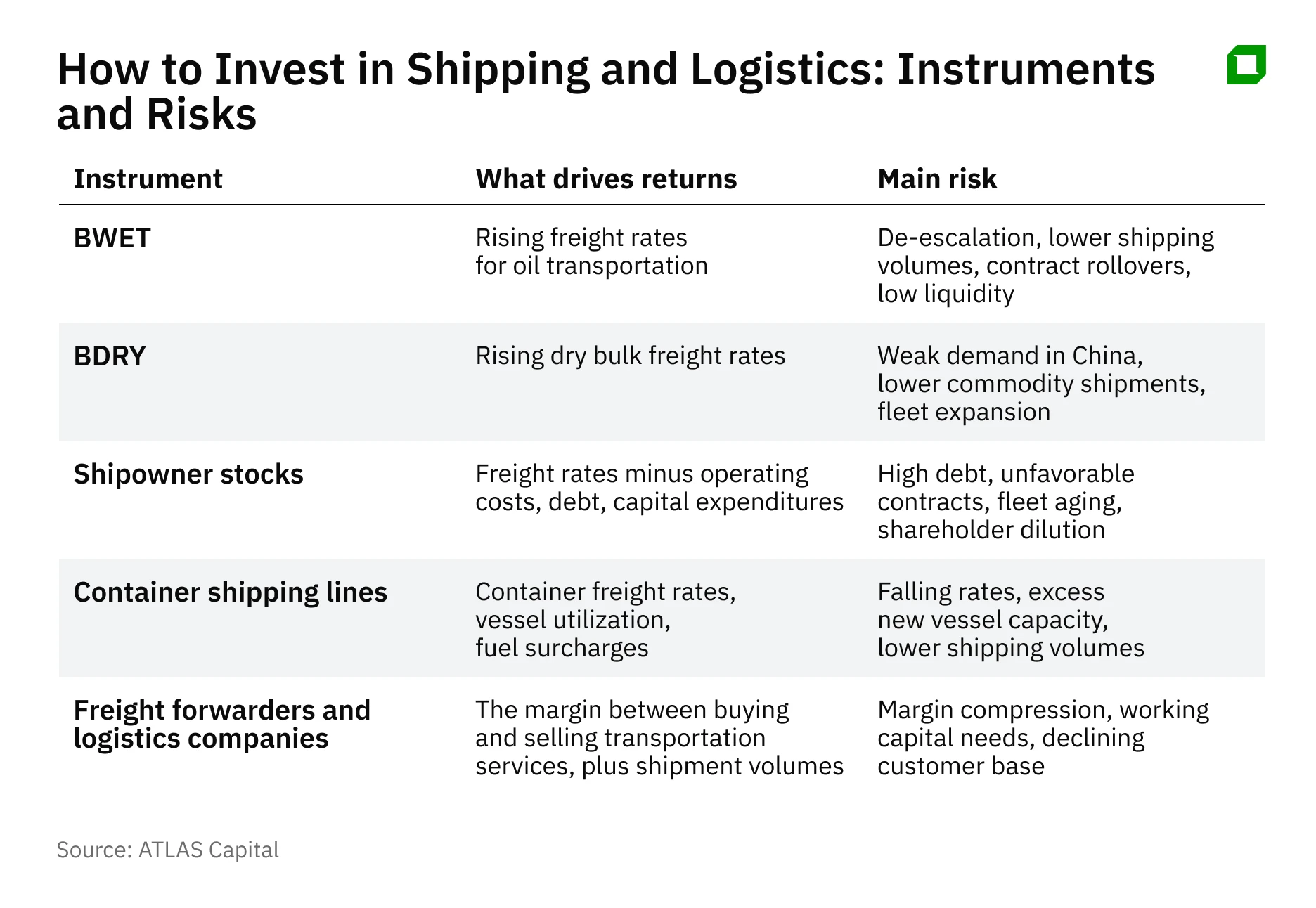
What should I choose?
— Freight ETFs, such as the aforementioned BWET and BDRY
They respond directly to changes in freight rates and are primarily suited for short-term contracts with a predetermined time horizon. The returns on these funds depend not only on shipping costs but also on futures prices. When contracts are rolled over to the next period, returns may decline, especially if the market is in contango—when new contracts are more expensive than previous ones.
The annual expenses for both funds are 3.5% through the end of 2026. In addition, due to low market liquidity, ETFs may trade at a price that differs significantly from their net asset value, and the difference between the bid and ask prices—the spread—may widen.
— Shares of shipping companies, such as Frontline and Star Bulk Carriers
Profits in this sector depend on freight rates, but not directly. A company with a high proportion of spot contracts benefits more quickly from a spike in rates, while an operator with long-term fixed contracts may see almost no benefit from the increase.
— Container shipping lines, freight forwarders, port operators, and infrastructure companies, such as A.P. Moller–Maersk and Kuehne+Nagel
This represents a broader bet on the restructuring of trade flows, but high freight rates do not guarantee profit growth for every participant. A shipping line may benefit from the rates, a port from transshipment volumes, while an importer or freight forwarder without sufficient bargaining power will, on the contrary, lose margin.
— Freight Rate Futures (FFA)
They require a specialized broker, clearing, collateral management, and an understanding of the market. For most individual investors, this option is more complicated than ETFs.
This material is for informational and analytical purposes only and does not constitute individual investment advice. Past performance is not a guarantee of future results. The availability of instruments, tax implications, and reporting requirements depend on the investor’s jurisdiction and the broker’s terms and conditions.
This article was AI-translated and verified by a human editor