What Bill Eckman Is Buying: Investor Reveals His Hedge Fund's First Trades Since Its IPO
Pershing Square USA has invested more than 85% of the capital it has raised in its former favorites and “old-school” technology companies

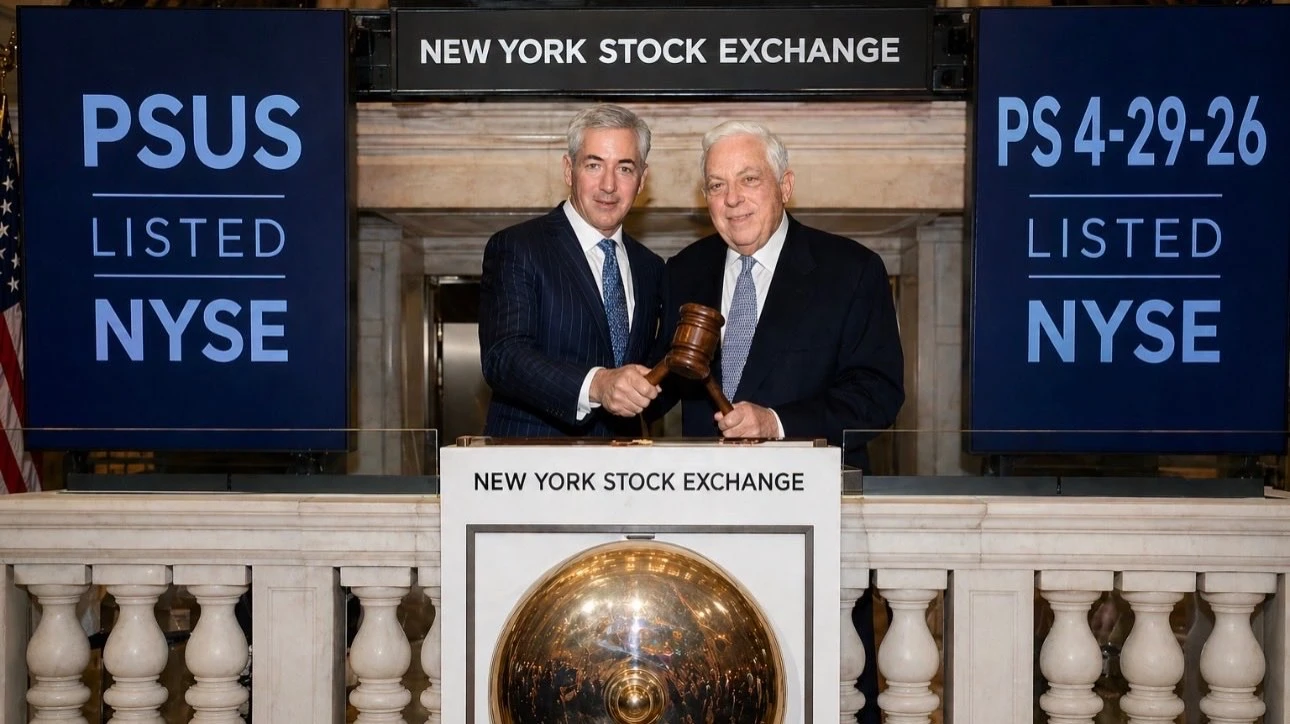
Pershing Square USA (PSUS) invested 85% of the capital raised during its IPO in 12 companies / Photo: X / Bill Ackman
In the seven weeks following its IPO, Bill Ackman’s new private equity fund, Pershing Square USA, has invested nearly 85% of the capital it raised. The investor has disclosed eight of the twelve companies in its portfolio. Which stocks did he buy?
Details
The Pershing Square USA (PSUS) fund has invested approximately $4.25 billion—85% of the capital raised during its IPO—in 12 companies, Ekman reported on the social media platform X. He disclosed eight of them: tech giants Amazon, Microsoft, and Meta; ride-hailing service Uber; mortgage agencies Fannie Mae and Freddie Mac; Canadian investment firm Brookfield; and fast-food restaurant operator Restaurant Brands.
Four other stocks in Pershing Square USA's portfolio remain undisclosed. Ekman has promised to disclose them in the second-quarter report.
"We believe that, as of today, the PSUS portfolio is invested in a number of the world's highest-quality companies with sustainable growth, which are trading near their all-time lows."

Ekman previously referred to Amazon, Microsoft, and Meta as “old-fashioned” companies in the age of OpenAI. Due to the widespread craze for artificial intelligence and semiconductors, he says, high-quality businesses may remain out of investors’ focus. Ekman believes these stocks are undervalued. This is confirmed by the trades of Ekman’s public fund, Pershing Square: in the first quarter, he sold Alphabet shares to free up cash to buy Microsoft, which became the fund’s only new position and accounted for 15.3% of the portfolio, valued at $2.09 billion.
Another portion of the Pershing Square USA closed-end fund’s portfolio is invested in companies that are not included in the S&P 500. According to Ekman, inclusion in major indices supports a company’s valuation: a large amount of capital is concentrated in index funds, which automatically flows into the securities included in the index. Restaurant Brands and Brookfield are Canadian companies, so they cannot be included in the U.S. S&P 500. As a result, Restaurant Brands trades at a discount to McDonald’s, and the investment firm Brookfield trades at a lower multiple than the U.S. investment firm KKR, according to Motley Fool.
Ekman himself has held shares in the American mortgage giants Fannie Mae and Freddie Mac for more than ten years. The investor said that the companies’ shares are “absurdly cheap” due to the uncertainty surrounding their status: following the 2008 crisis, Fannie Mae and Freddie Mac came under government control and are traded on the over-the-counter market. According to Ekman’s assessment, the companies’ return to the New York Stock Exchange and their exit from government oversight could eliminate this discount. In March, he predicted that the shares could rise tenfold from their prices at that time.
Context
On April 29, Bill Eckman took two of his companies public on the New York Stock Exchange: the private equity fund Pershing Square USA under the ticker symbol PSUS, and the management company Pershing Square Inc. under the ticker symbol PS. Through the IPO, he raised $5 billion, $2.8 billion of which had been secured in advance during a private placement.
For Ekman, this was his second attempt to bring a private fund to the U.S. market. In 2024, he had planned to raise up to $25 billion, then scaled back the target to $4 billion and $2 billion, before ultimately canceling the IPO due to weak demand.
Following its IPO, Pershing Square’s stock price fell sharply. On April 29, the fund went public at $50 per share, but closed at $40.90 on its very first trading day. On June 11, the fund’s stock hit a low of $37.26. On June 22, the shares were trading at $38.57—about 23% below the IPO price.
______________________
In the “Guru Portfolios” section on Oninvest, you can track the composition and changes in the portfolios of the world’s largest investors and funds. The service allows you to analyze the largest holdings, new ideas, and changes in asset allocations based on 13F filings, as well as compare performance trends.
This article was AI-translated and verified by a human editor