A 10-fold growth, Korea’s golden age, and a lesson from China: Highlights from an interview with the head of Nvidia
Company CEO Jensen Huang believes the semiconductor industry will have to grow tenfold. Who will become one of the key suppliers of AI infrastructure?

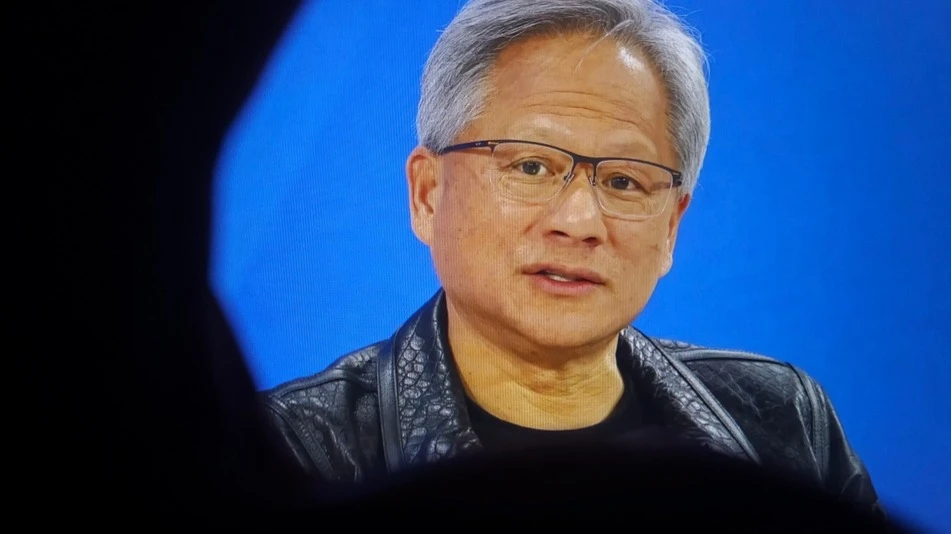
Huang believes that South Korea is capable of helping the entire world build AI infrastructure / Photo: FotoField / Shutterstock.com
In an interview with Bloomberg Tech, Nvidia CEO Jensen Huang discussed the company’s investments in South Korea and its partnership with SK Group, the country’s second-largest conglomerate. The new projects are linked to the expected growth in demand for computing power: According to Huang’s estimates, the number of users will reach 100 billion in the future, and to ensure their stable operation, the semiconductor industry will need to grow tenfold over the next decade.
The Future of the Semiconductor Industry
According to Huang, a new phase is beginning for the semiconductor industry. In the past, computers were built for people; now their computing power is used to run AI; and in the future, the primary users will be 100 billion AI agents and billions of robots. The current scale of the computer and semiconductor industries will not be sufficient to support such a large number of new users.
"According to my estimates, the semiconductor industry is expected to grow roughly tenfold over the next ten years or so. That is precisely why it is so important for us to work with partners in Korea and around the world to expand our supply chains in preparation for this AI-driven future.”
However, it will be difficult to expand capacity at the same pace. According to Huang, the shortage is already affecting not only HBM and LPDDR memory—used for artificial intelligence servers and mobile devices, respectively—but nearly the entire supply chain: there is a shortage of sites, electricity, and workers for building data centers. Unlike the production of electronic devices, this kind of infrastructure cannot be scaled up quickly. Therefore, it will take years to develop the entire supply chain—from memory production to data center construction.
Nvidia's Foothold in Korea
At last week’s AI summit, Huang announced an expansion of Nvidia’s collaboration with South Korea’s largest companies. The key agreement was a partnership with SK Group: the total volume of purchases and deliveries between the parties is expected to exceed $500 billion. Nvidia will purchase memory from SK Hynix, while SK will acquire supercomputers from Nvidia to build an AI cloud infrastructure with a capacity of up to 2 GW. In addition, Nvidia and SK will jointly develop the next generations of HBM memory.
In addition, Nvidia will invest $1 billion in Naver, Korea’s leading provider of cloud services for AI. The company plans to increase its computing capacity in the country to 200 MW and expand into the international market.
“Korea is currently experiencing a golden age: both its semiconductor sector and its industry as a whole are on the rise. You know, this country is capable of helping the entire world build out its AI infrastructure. They’re adopting new technologies at an incredible pace; it’s truly a cutting-edge society where people genuinely love AI. Artificial intelligence has already become deeply embedded in both their daily lives and manufacturing, so the timing is simply perfect for them.”
Two Approaches to AI Models
Huang also spoke out in defense of open models, noting that, in his view, there is a widespread misconception in the industry about their lack of security. He dedicated his first post on X to this topic, publishing a letter signed by the CEOs of major U.S. tech companies.
Huang called the recent hack of the Hugging Face platform—where AI projects are published and downloaded—along with OpenAI’s new developments, illustrative of the debate over open and closed AI models: a closed model does not guarantee security, whereas open-source projects provide other companies with the tools to protect themselves. For example, Hugging Face used the open-source GLM 5.2 model to identify a point of entry into its systems and fix the vulnerability.
According to Huang, off-the-shelf closed services are suitable for companies that do not require full control over the model: they are easier and cheaper to use than deploying a system on their own. Open models are necessary when a system needs to be adapted for specialized tasks, to maintain the confidentiality of internal developments, or to comply with the requirements of a regulated industry.
Staff vs. Tokens
The difference between the American and Chinese approaches to AI is often boiled down to the fact that China aims to reduce the cost per token, while the U.S. focuses on its quality. Huang considers this contrast to be overly simplistic. There are various ways to obtain a high-quality response: by increasing the information density of each token, reducing their number, or giving the model more time to reason and explore options.
In his view, both the U.S. and China will continue to develop AI, despite their differing resources and constraints. One of China’s main advantages is the scale of its training programs for specialists: according to Huang’s estimates, the country produces more AI researchers annually than, perhaps, the rest of the world combined. Therefore, China will develop powerful AI technologies, and it is important for the American industry to continue learning from Chinese experts, collaborating with them, and keeping pace with the competition.
This article was AI-translated and verified by a human editor