Apple is once again making a push into the smart home gadget market. Amazon and Google have already taken over that market.

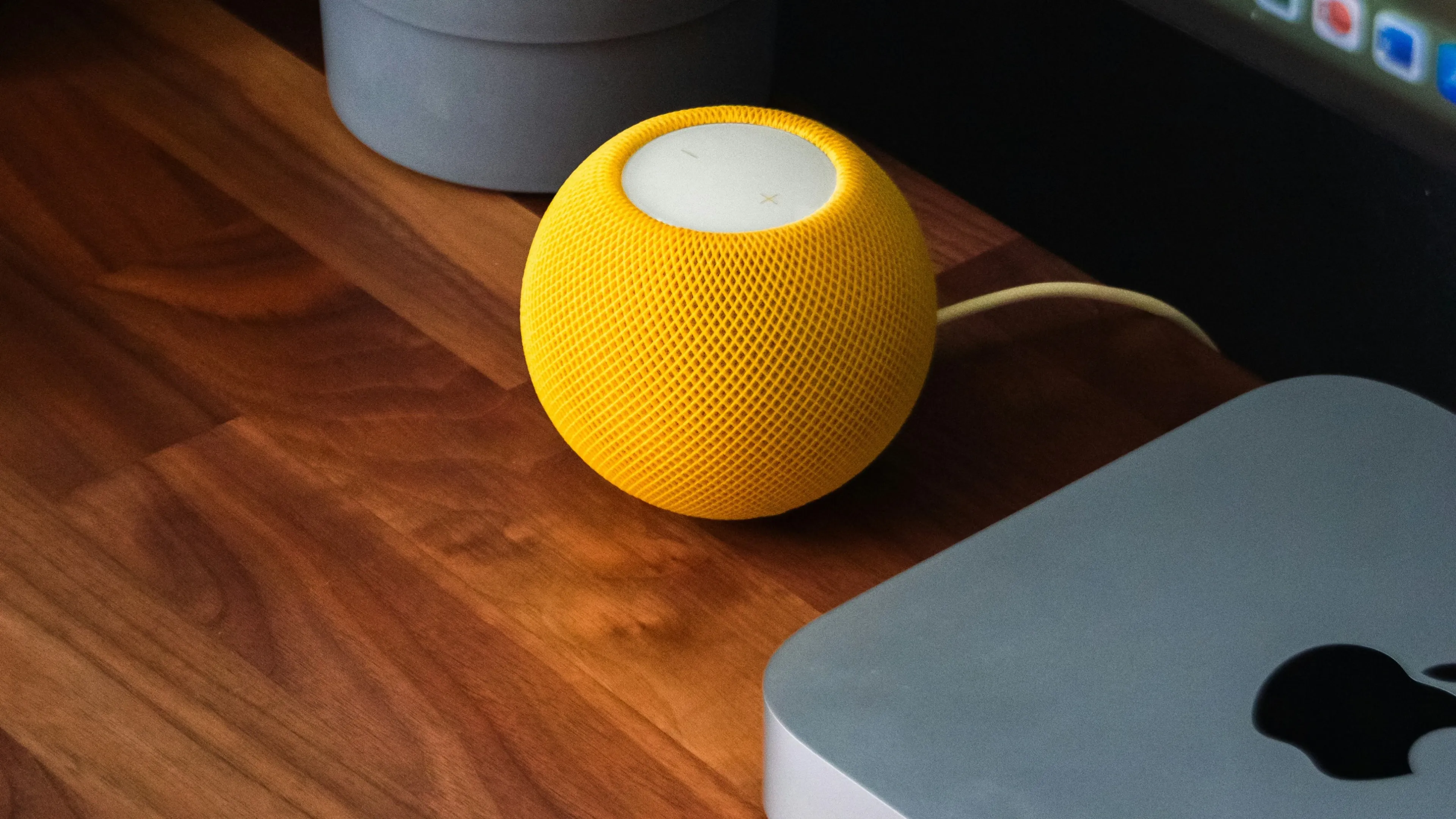
Apple introduced its first smart speaker, the HomePod, in 2018, and released the compact HomePod mini in 2020. However, neither model gained widespread popularity. Photo: Matúš Gocman / Unsplash.com
In September, Apple unveiled a new product—the first foldable iPhone Duo in its history. But under the leadership of its new CEO, John Turnus, the company shows no signs of slowing down—on October 13, it unveiled a lineup of both updated versions of existing products and entirely new smart home products. Perhaps this will help it catch up to Amazon and Google, which have been building out this category for over 10 years.
What Apple Showed
The company unveiled several categories of smart home devices at once.
At the heart of the strategy is the HomeView smart screen , a 7-inch square display about as thick as an iPhone, with a quarter-inch black bezel and rounded corners. The device’s design is reminiscent of the famous 2002 iMac G4—a hemispherical base with a small hinge to which the screen is attached. This design allows you to adjust the tilt angle, adapting the device to furniture of any height. There is also a version designed for wall mounting: beneath the screen is a slim, square base with speakers and microphones.
But the main feature isn’t the design. HomeView can identify up to six family members using facial recognition. When the husband approaches, the screen displays his contacts, messages, calendar, and favorite apps. When the wife approaches, the interface automatically adapts to her. Control it with your voice or via the touchscreen. The devices have no battery and must be constantly connected to a power source via USB-C.
Apple envisions having several of these displays throughout the home: one in the kitchen for recipes and FaceTime calls while cooking, one in the bedroom for an alarm clock and lighting controls, and one in the living room for iCloud slideshows and music. The interface, of course, includes classic icons and widgets—both those familiar from the iPhone and special ones for controlling other smart home devices.
But that’s not all. According to Bloomberg, an improved version of HomeView is being developed in parallel—a 9-inch display mounted on a robotic arm that allows the screen to rotate 360 degrees. This device will follow the user around the room, turning the screen just like a sunflower follows the sun. Imagine this: you’re cooking in the kitchen, and the screen turns toward you as you move from the stove to the refrigerator. It’s somewhat reminiscent of Tony Stark’s famous robots from the Iron Man movies. However, on October 13, Apple made no mention of this project.
The HomePod mini smart speaker has received its first update since its release in 2020. It features the same design but a faster processor to handle the more powerful new Siri models—plus new colors, including green and pink. Apple recommends using four speakers together with the new Apple TV 4K to create surround sound—everything sets up automatically. And of course, the HomePod mini can also be used for voice control of your smart home.
Interestingly, Apple has chosen not to tightly tie its smart home products to its own ecosystem. The company developed some of the devices—known as the Apple Home Collection —in collaboration with South Korea’s LG and France’s Schneider Electric. These include indoor and outdoor cameras, thermostats, temperature sensors, as well as a video doorbell and a smart door lock.
All devices support Matter—an open smart home standard—which will allow devices from other manufacturers to be connected to the ecosystem.
Using the built-in features of the iPhone or Apple Watch, users can set up Apple Home to recognize key moments throughout the day: when the last user leaves for work, the thermostat adjusts for an empty home, the door locks, and the cameras resume monitoring. Before they arrive home, the thermostat begins adjusting the temperature, and the front door automatically unlocks as they approach.
Will There Be a Gentle Rain, or What Is Apple Trying to Make Up For?
The idea of creating a smart home capable of best meeting human needs began to capture people’s imaginations at the start of the 20th-century Industrial Revolution. As early as 1909, the English writer Edward Foster wrote a short story titled “The Machine Stops” —about people living in a completely controlled environment, operated by numerous buttons and a thick instruction manual. It wasn’t very convenient, but at the time, people didn’t know of any other ways to control machines.
Much has changed with the advancement of electronics. In 1950, Ray Bradbury wrote one of the most poignant short stories in the history of science fiction, “It Will Rain Gently” — about an automated house that continues to function even after its owners have perished in a nuclear war. Incidentally, the story takes place on August 4–5, 2026.
Bradbury was wrong (let’s hope) about the year of World War III, but he predicted with striking accuracy almost everything that makes up a real smart home today: robotic cleaning, voice control, access control, a weather station, and controls for windows, lighting, and irrigation. Perhaps the only piece of equipment described in the story that doesn’t yet exist in reality is fully automated food preparation, although experiments are already underway.
According to analysts' estimates, the global smart home device market was worth approximately $77 billion in 2025, with projections for growth to $185 billion by 2035. The average annual growth rate during this period is projected to be 9.2%.
This is no longer a niche market, but one of the largest consumer markets, which Apple has yet to really tap into.
The leaders have long since established themselves. Amazon launched the Echo smart speaker with the Alexa voice assistant back in 2014. And since then, it has been steadily building a vast ecosystem of smart home devices, encouraging not only its own products but also those from third-party manufacturers to connect to it.
That same year, Google acquired Nest—a startup developing smart home devices (founded, incidentally, by former Apple employees)— for $3.2 billion and also began building an ecosystem around a smart speaker simply called the Google Home Speaker. It didn’t hit the market until 2016.
What about Apple? The HomePod smart speaker with Siri debuted in 2018 and was widely regarded as a commercial failure due to its high price and lack of interesting features. The company’s second attempt—the 2020 HomePod mini, priced at $99—sold somewhat better, but it never became a major hit.
“Even I have to admit that… there are plenty of other small smart speakers that are more affordable, sound better, and look almost the same. Alexa and Google Assistant are still much smarter than Siri,” wrote Adrienne So, a Wired columnist and, by her own admission, a huge fan of Apple products, about the HomePod mini.
The result is unsurprising: by the end of 2024, Apple’s smart speakers held just 6% of the U.S. market, while Google had 23% and Amazon Echo had 71%. Worse still, “40% of Apple device owners who purchased an iPhone, iPad, Mac, or Apple Watch in the past year also own an Amazon Echo, and 19% own Google smart speakers,” according to the damning statistics cited by AppleInsider.
The company didn't offer any other smart home devices (except, perhaps with a stretch, the Apple TV set-top box).
The reason for the lag is clear. While Amazon and Google were building their ecosystems, Apple got bogged down in a years-long overhaul of its voice assistant, Siri. According to Mark Gurman of Bloomberg, it was the readiness of the updated assistant—built on large language models developed with Google’s help—that triggered a whole cascade of products that are now ready for release.
What does this mean for an investor?
It appears that Apple now intends to make a comeback. Bloomberg reports that the company views the smart home market as the “next big thing,” one of its potential breakthrough areas. For the new CEO, John Turnus, who took the helm on September 1, this is also his first major test.
It's no longer just about selling one more speaker; it's about becoming the operating system for your home—just as iOS has become the operating system for wearable devices like the iPhone, Mac, iPad, AirPods, and Apple Watch.
For the market as a whole, Apple's entry is a signal.
If one of the world's most valuable companies is betting on smart homes, then that means the category has moved from being a "geek toy" to the mainstream.
This opens up a wide range of opportunities for selling new gadgets, as well as various subscriptions and services—and Apple knows how to do that better than almost anyone else in the world.
Competitors have reason to be nervous. Apple is making its second foray into the market with three key advantages that no other company possesses all at once: a premium brand with a billion-strong fan base, a strong reputation for privacy, and multibillion-dollar revenue from a service ecosystem that can be scaled to the smart home.
Yes, the company has had its share of failures; aside from the HomePod, we can mention the self-driving car that never saw the light of day (by the way, according to rumors, part of the development team was actually reassigned to the smart home project), or the Vision Pro virtual reality headset, which, at a staggering price of $3,699, never became a hit.
But if history teaches us anything, it's that Apple knows how to enter an existing market—even if it's not the first to do so—and still come out on top. I wonder if it will work out this time.
This article was AI-translated and verified by a human editor