China's CXMT has unsettled investors in Micron and Samsung, causing their stock prices to fall. What's going on?
China's most valuable company announced "key progress" in the development of memory cell architecture—a technology that Micron and SK Hynix, among others, are also working on

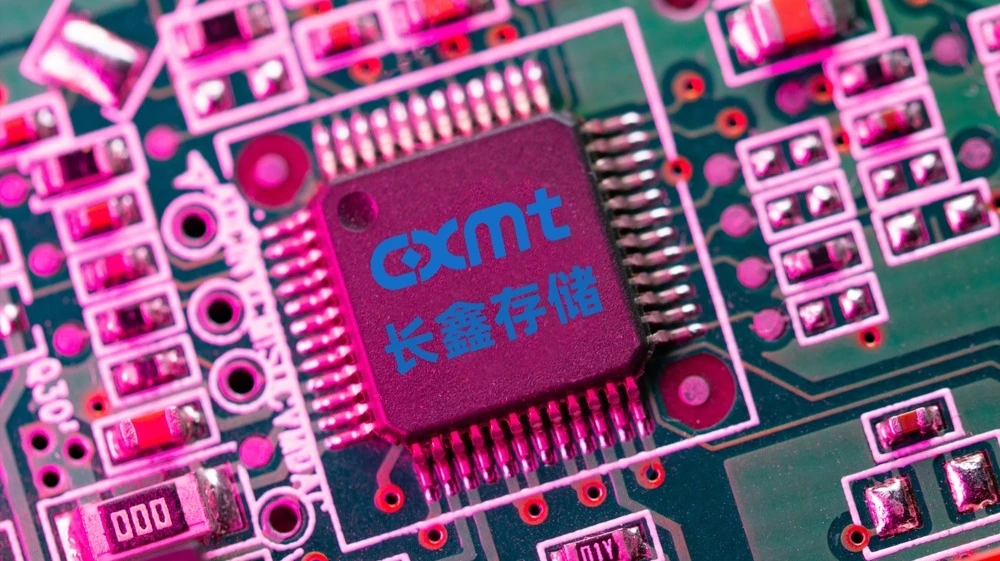
The success of China's CXMT is seen as a threat to the dominance of Samsung, SK Hynix, and Micron in the AI memory market / Photo: wutianzeri/Shutterstock.com
Shares of the three largest manufacturers of AI memory chips—U.S.-based Micron and its South Korean competitors SK Hynix and Samsung Electronics—fell on October 12 following news that their Chinese rival, ChangXin Memory Technologies (CXMT) had made progress in developing technology that would increase data storage density in chips. Micron and SK Hynix lost more than 2% in pre-market trading in New York. Samsung Electronics shares closed 4.4% lower in Seoul.
"Memory chip manufacturers have been rapidly raising prices this year, but the balance of power may be about to shift: a Chinese competitor is trying to encroach on their territory," writes Barron's.
At the same time, CXMT's own shares also fell in price: at the close of trading on October 12 in Shanghai, they lost 5.2%, dropping to 48.34 yuan.
New item with no details
CXMT President Cao Kangyu stated at an industry event in Shanghai over the weekend that the company plans to release server memory based on a new architecture by the end of the year, according to the Hong Kong-based South China Morning Post (SCMP). CXMT did not disclose detailed specifications or a launch date for the new product, but reported “key progress” in its development.
The new 4F² architecture makes it possible to reduce the size of memory cells and fit more of them onto a single chip. All leading RAM manufacturers are betting on 4F², notes the SCMP: in 2025, SK Hynix announced plans to transition to this architecture, and Samsung, according to some reports, expects to begin mass production of such memory by 2028.
How much does CXMT cost?
Even after Monday’s drop in share prices, CXMT remains the leader among Chinese companies in terms of market capitalization, ahead of Tencent, China Construction Bank, and Agricultural Bank of China, according to Barron’s. On the day of its debut on the Shanghai Stock Exchange in July, its shares surged 466%, and its market capitalization approached $500 billion.
CXMT shares fell the most since their listing on October 8—by 7.8%, according to Sina Finance. According to the publication’s assessment, the sell-off is primarily due to profit-taking, a reassessment of the stock’s high valuation, and a shift of funds between sectors, rather than a deterioration in business performance.
Analysts’ target prices vary by nearly a factor of eight. According to Phoenix, Goldman Sachs values CXMT shares at 129 yuan, Nomura at 116 yuan, and UBS and Mizuho at 70 yuan. The only analyst recommending a sell is a Morningstar analyst with a target price of 16.1 yuan. Such a wide divergence of opinions suggests that CXMT lacks a stable benchmark for valuation, Phoenix asserts.
On October 9, the CLSA Investment Group (a subsidiary of China’s CITIC Securities) initiated coverage of CXMT shares with an “Accumulate” rating (Accumulate, a recommendation to gradually build up a position) with a target price of 84.7 yuan, MarketScreener reported. According to S&P Global data cited by this portal, the consensus among 11 analysts covering CXMT shares is a “Better Than Market” and a target price of 79.53 yuan—65% higher than the closing price on October 12.
This article was AI-translated and verified by a human editor