Dow hits record high and Nasdaq posts its best day since March: Market rallies on US-Iran deal

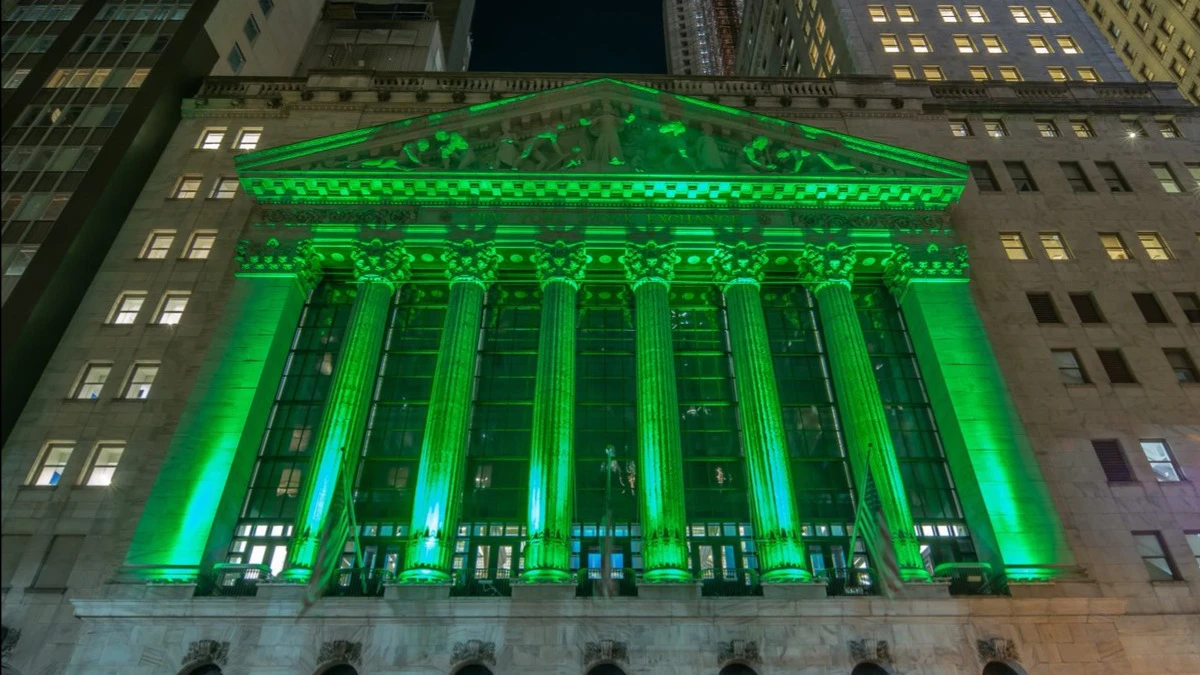
U.S. stocks, gold, and Bitcoin rose following the announcement of an agreement between the U.S. and Iran / Photo: X / NYSE
Major U.S. stock market indices surged at the close of trading on Monday, June 15; the fear index dropped by 9% in one go, and oil prices fell. U.S. President Donald Trump announced that a peace agreement between the U.S. and Iran “has already been signed,” and that shipping through the Strait of Hormuz, which had been suspended since late February, will resume on Friday, June 19.
Details
— The S&P 500 broad market index rose by nearly 1.7% on June 15.
— The Dow Jones Industrial Average rose 0.9% to reach a new all-time high of 51,671.83 points.
— The Nasdaq Composite technology index surged 3.1%, marking its biggest gain since March 31, according to MarketWatch.
— The Russell 2000 Small-Cap Index rose 0.85% and hit a new record high of 2,969.07 points.
— The VIX volatility index, also known as Wall Street’s “fear gauge,” dropped by 9% in one go to 16 points. Anything above 20 points is considered a period of heightened volatility.
— Oil prices fell by more than 4%. At the close of trading, futures for the benchmark Brent crude were trading at $83.70 per barrel. Futures contracts for North American WTI were trading at approximately $81.40 per barrel.
What influenced the market
Trump announced on Monday that the U.S. and Iran had already reached a peace agreement. As an unnamed White House official clarified while commenting on the situation to CNBC, the memorandum of understanding was signed electronically on Sunday, but the official ceremony will take place on Friday, June 19, in Switzerland. On that same day, Trump said, the Strait of Hormuz will be fully reopened. Vice President J.D. Vance expects that traffic through this corridor will be restored on a long-term basis and without tolls, he told CNBC.
Against the backdrop of falling oil prices, investors have effectively stopped pricing in a Fed rate hike this year: the probability of rates remaining unchanged is estimated at over 98%, according to the CME FedWatch tool. This is in stark contrast to just a short while ago, when the market was practically convinced that the central bank would tighten policy by year-end—amid a strong labor market and a spike in inflation driven by higher energy prices. The Federal Reserve is set to announce its next monetary policy decision on Wednesday, June 17. This will be the first meeting under the leadership of Kevin Warsh.
SpaceX shares surged 19.6% at the close of trading on Monday, following a 19% gain on its debut on the Nasdaq on Friday. As a result, the value of Elon Musk’s space company surpassed $2.5 trillion.
The combined market capitalization of the "Magnificent Seven" companies rose by more than $600 billion on Monday. Shares of the tech giants had their best day since March 31 and helped drive the broader market higher, MarketWatch notes.
The iShares Semiconductor ETF rose 5.4% over the course of the day.
What analysts are saying
“This time, it seems to be for real: both oil prices and market expectations for interest rates have crossed key thresholds,” Brian Mulberry, chief strategist at Zacks Investment Management, told CNBC regarding the signing of the peace agreement between the U.S. and Iran. In his view, this should ease pressure on the Fed. He called the drop in the price of U.S. oil to $80 per barrel a strong signal to the regulator: there is no need to raise rates, and price pressure should now ease relatively quickly. At the same time, Mulberry noted that it will likely take longer for prices of refined petroleum products, such as jet fuel, to decline.
Morgan Stanley believes that the deal could trigger a shift of capital toward cyclical, economically sensitive sectors that had lagged behind during the war in the Middle East.
“An agreement between the U.S. and Iran could trigger a broad surge in risk appetite in the stock market, supported by strong fundamentals,” Bloomberg quotes Andrew Tyler, head of global market strategy at JPMorgan, as saying. He upgraded his stock outlook to “tactically positive,” whereas a week ago he had revised his short-term outlook to “tactically cautious,” citing sell-offs in both the Nasdaq 100 technology index and the S&P 500. However, since that assessment, both indices have rebounded, Bloomberg notes.
The next phase of the bull market could be triggered by SpaceX’s IPO, according to Evercore ISI equity strategist Julian Emanuel, as reported by CNBC. In his optimistic scenario, the S&P 500 could reach 9,000 points by the end of the year, which is 19% higher than the close on June 15. In the base case scenario, the index could rise by 2.6%. The strategist compared the early hype surrounding SpaceX to Netscape’s 1995 IPO, which marked the beginning of a period of optimism around the internet before the dot-com bubble burst in 2000. Emanuel expects that SpaceX, as well as the upcoming major offerings from Anthropic and OpenAI, will similarly serve as a psychological turning point for the market.
Now that SpaceX’s IPO—the largest in history—has gone off without a hitch for the market, investors are once again actively buying the very same shares they were dumping back in early June, according to CNBC.
“Although the S&P 500 index rose by a modest 0.7% last week, the VIX volatility index fell much more sharply than expected. This is largely due to the unwinding of protective positions for the next 12 months and bets on a further deepening of the decline,” wrote Ed Tom, senior director of derivatives market analysis at Cboe.
This article was AI-translated and verified by a human editor