Flotek, Core Lab, Helix: which small-cap stocks benefited after the overthrow of the Venezuelan government


On January 3, 2026, the US conducted a military operation in Venezuela called "Absolute Resolve," during which the country's president, Nicolas Maduro, was captured. This move by Washington effectively ended months of escalation, accompanied by a naval blockade of Venezuelan oil tankers and accusations of the regime's involvement in drug trafficking.
The country is entering a transition phase under the leadership of Vice President Delcy Rodríguez, and investors are already factoring in expectations of a possible easing of US sanctions and a gradual normalization of the oil sector. According to Barclays estimates (the report is available at Oninvest), if restrictions are eased, oil production in Venezuela could increase by 200,000-300,000 barrels per day from the current level of around 1 million barrels.
Which small-cap sectors benefited from growth?
The news of Nicolas Maduro's overthrow triggered a rise in energy sector stock prices, including among small and mid-cap companies. On January 5, the first trading day after the operation, investors refocused on stocks that are most sensitive to geopolitical changes.
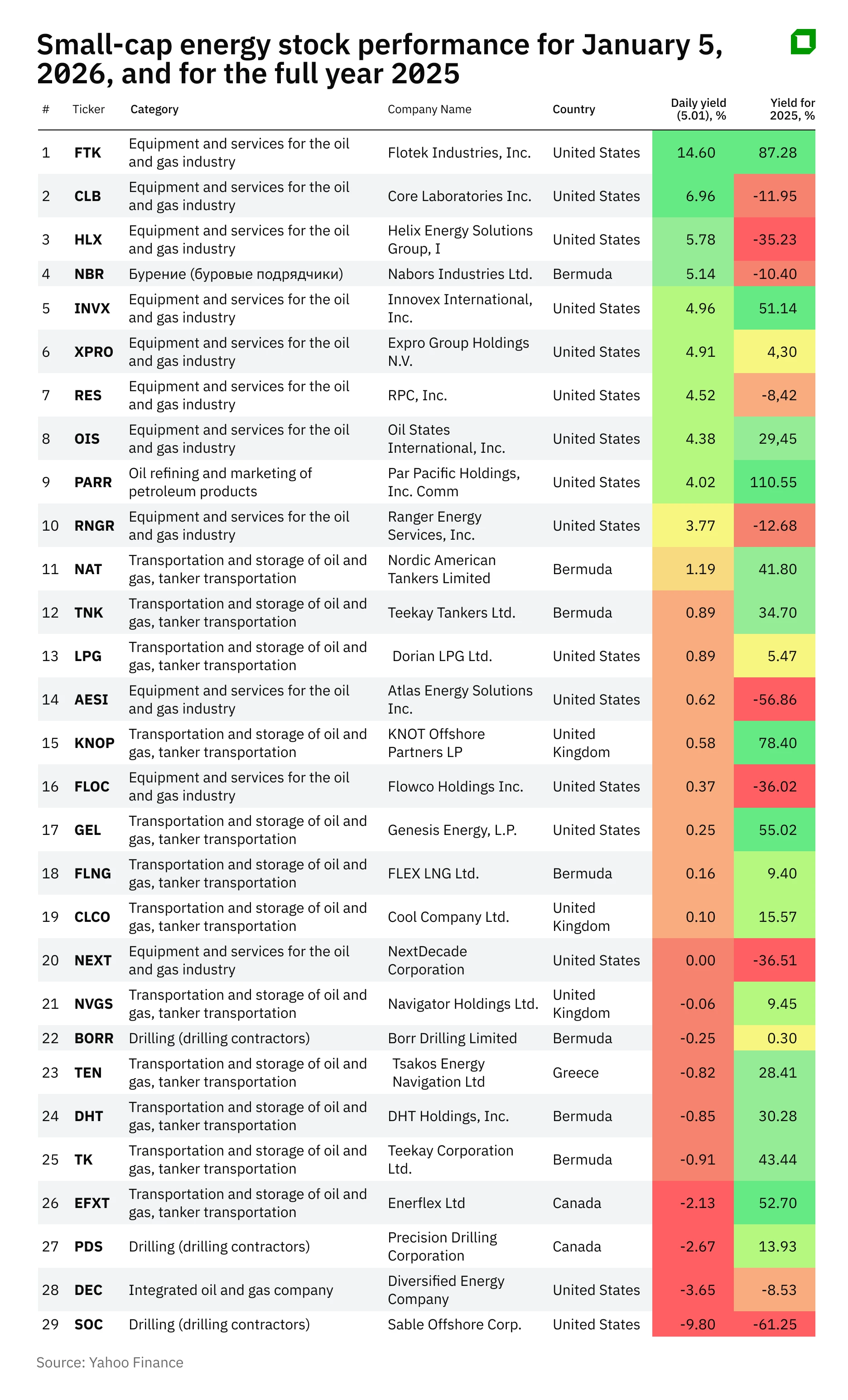
Oilfield service companies led the rally. Flotek Industries (ticker FTK) shares jumped about 14.5% at the close of trading on January 5, Core Laboratories (CLB) added 7%, and Helix Energy Solutions (HLX) rose nearly 6%. For Flotek, this surge was a continuation of strong growth in 2025 — as of January 5, the company's shares had risen by almost 88% over the year, while Core Lab and Helix, which fell by 12% and 35% respectively last year, only partially recovered their previous losses.
The oil transportation segment also showed significant growth: tanker fleet operators such as Nordic American Tankers, as well as midstream companies, gained 2–3% at the moment, factoring in a possible recovery in Venezuelan oil exports.
At the same time, the reaction of oil companies was less clear-cut: the market took into account that the potential influx of new raw materials could lead to a decline in oil prices and, accordingly, in producers' margins.
What is important for an investor?
The liberation of Venezuela from Maduro's regime has the potential to shift the balance of power in the oil market, and the reaction of different segments of the industry varies significantly. Refineries and service companies are the primary beneficiaries: the return of Venezuelan heavy oil expands supply in this segment, lowers prices for heavy grades, and increases the spread between light and heavy grades. Venezuelan heavy oil is significantly cheaper than light grades such as WTI, and it is precisely because of this price spread that complex refineries capable of efficiently processing heavy feedstock are able to achieve higher margins. According to Bloomberg Intelligence estimates, the resumption of production in Venezuela is particularly positive for US deep-processing refiners such as Valero and Marathon.
The main beneficiaries of a possible reboot of Venezuela's oil sector are service companies. If sanctions are eased, the country will need a large-scale upgrade of its infrastructure and technology to increase production. Morgan Stanley expects that, in a favorable scenario, well repairs and equipment upgrades could increase production by 300,000–400,000 barrels per day within 12–18 months. This means increased demand for the services of drilling contractors, oilfield service companies, equipment suppliers, and chemical reagent suppliers. Even small players in the industry have received a boost: the market assumes that the volume of work will be significant and long-term.
At the same time, analysts warn that the recovery in production will be a gradual process. According to OCBC Group Research estimates, Venezuela's return to the market will only exert moderate pressure on prices, and Brent could fall to around $59 per barrel by the end of the year. Barclays has maintained its medium-term forecast of $80 per barrel for Brent crude.
Small-cap growth leaders: Flotek, Core Lab, Helix, Par Pacific
Among the rapidly rising stocks, three small-cap oilfield service companies stand out: Flotek, Core Laboratories, and Helix Energy, as well as a small oil refiner, Par Pacific.
Flotek Industries
The American company Flotek Industries specializes in chemical reagents and digital solutions for oil production. Flotek has successfully transformed its business model by focusing on data analytics to improve drilling efficiency: in 2025, its stock price rose by 87%.
In the third quarter of 2025, Flotek reported a 232% year-on-year increase in revenue for its new Data Analytics segment, which helped boost the company's gross profit by 95% compared to the previous year. Net profit for the quarter was $20.4 million, compared to $2.5 million a year earlier.
Now, with new opportunities opening up for the industry in Latin America, Flotek has a chance to apply its technology in a new market. Wall Street analysts' consensus rating for the company's shares is "Buy," according to MarketWatch. The average target price is $20.5, almost 5% higher than the closing price on January 5.
Core Laboratories
Core Lab has been operating in the niche market of core analysis and enhanced oil recovery for many years. In the third quarter of 2025, the company's revenue amounted to approximately $134.5 million, an increase of 3% compared to the previous year. At the same time, Core Lab continues to generate profits and improve efficiency: operating profit grew by more than 14%, operating margin (ex-items) reached 12%, and free cash flow remains positive. In 2025, the company paid dividends and conducted a share buyback (approximately 1% of the total number of shares in circulation).
Core Lab continues to expand its international presence: in the fall, the company acquired Brazil's Solintec, strengthening its position in the South Atlantic shelf. If major oil companies return to projects in Venezuela's Orinoco, Core Lab's many years of expertise in working with heavy oil and complex reservoirs will be particularly in demand.
According to MarketWatch, Wall Street analysts' opinions on the company's shares are divided: one recommends buying the stock, one recommends holding, and two recommend selling. The average target price is 15% below the current share price.
Helix Energy Solutions
Helix Energy provides offshore energy services and operates in three segments: well services, robotics, and production equipment. In the third quarter of 2025, the company's revenue grew by almost 25% compared to the previous quarter, reaching $377 million. Third-quarter profit was $22 million, compared to a loss of $3 million in the previous quarter. Adjusted EBITDA for the period exceeded $100 million, the highest for Helix since 2014.
Helix's growth is supported by steady demand for subsea robotics services, as well as a revival in the well intervention market in the North Sea and Gulf of Mexico. The company has also secured a new four-year contract for subsea operations in the North Sea. Although Helix is unlikely to be directly involved in the restoration of production in Venezuela, the overall increase in activity expected against the backdrop of a global redistribution of oil flows could work in its favor.
Five Wall Street analysts recommend buying Helix shares, while two others recommend holding them. It is noteworthy that just a month ago, the company did not have a single rating. The consensus target price suggests a 47% increase from the current value.
Par Pacific
The American company Par Pacific Holdings ( PARR) is a striking example of how sharply the performance of a small oil refiner can soar in favorable market conditions. Par Pacific owns refineries in Hawaii and several states in the western United States. In the third quarter of 2025, the company reported net income of $262.6 million, compared to just $7.5 million a year earlier.
This financial breakthrough was made possible not only by high processing margins, but also by a one-time regulatory exemption: exempting refineries from some biofuel requirements (Small Refinery Exemption) brought in approximately $200 million in additional revenue.
Par Pacific may be among the indirect beneficiaries following the regime change in Venezuela. The return of cheap heavy oil to the market will improve the pricing environment for its refineries, and Bloomberg Intelligence analysts emphasize that all US integrated refiners will benefit. Par Pacific has already demonstrated its ability to take advantage of market imbalances: in addition to its traditional fuel business, the company is developing projects in the areas of decarbonization and natural gas, combining stable cash flow with long-term growth potential.
At the end of 2025, Par Pacific shares had risen by more than 110%. Five Wall Street analysts recommend buying the company's shares, while three recommend holding them. The growth potential is 27%.
This is not individual investment advice.