JPMorgan expects Tesla's stock to fall 60%. Why is it going against Wall Street's opinion?
Investment Bank advises investors to be cautious about the expectations of analysts predicting growth figures in Elon Musk's company's financial statements

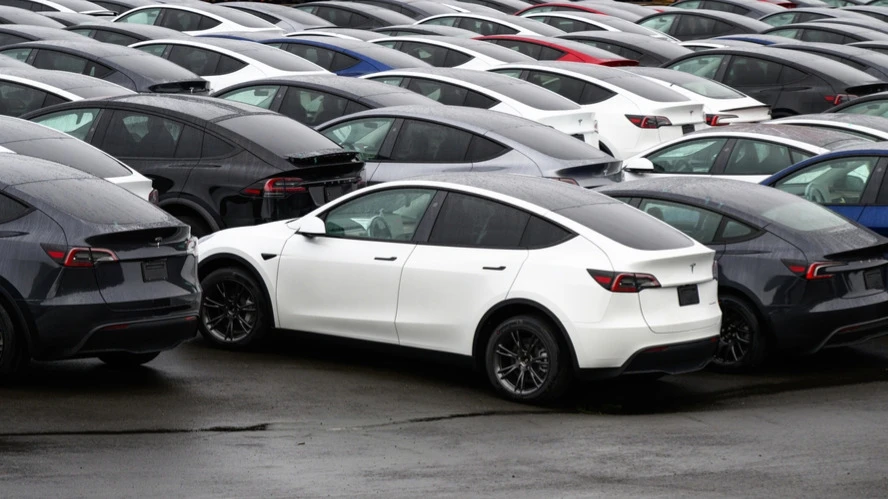
Tesla posted its weakest first quarter delivery result of the year / Photo: Ian Dewar Photography / Shutterstock.com
Tesla shares are unlikely to show growth in the near term, according to JPMorgan. The electric car maker has a record surge in unsold cars, and this is putting pressure on free cash flow, the investment bank explains. It reiterated a recommendation to sell Tesla securities and expects them to fall 60%. JPMorgan advised to approach the carmaker's securities with great caution. This goes against the consensus estimate of Wall Street.
Details
JPMorgan analyst Ryan Brinkman, following the release of Tesla's weak quarterly shipments data, worsened his forecast for the automaker's earnings this year from $2 to $1.8 per share, CNBC writes. That's below the Wall Street consensus forecast. JPMorgan also maintained a sell recommendation on Tesla shares and a $145 target price, one of the lowest on Wall Street. It assumes a drop in quotations by about 60% of their current value.
"With expectations for Tesla's results deteriorating sharply across all financial and operational metrics on the horizon through the end of the decade, the stock [is] up more than 50% over the past year and the target price is up 32%. This suggests that the market is betting on a sharp improvement in the company's results as early as the next decade," Brinkman wrote in a note cited by Yahoo Finance.
JPMorgan advises investors to be cautious about such expectations, given the risks of implementing Tesla's strategy and that the potential benefits may be too delayed in time.
Brinkman said that while technology and operational risks are now much lower than previously feared, entering more mass market segments with lower prices, as in the case of the cheaper Model 3, comes with increased challenges - both in terms of demand, execution and competition, the analyst said.
Tesla shares fell 2.2% in trading on Monday, April 6. Since the beginning of the year, they have lost 21.5%, showing the worst dynamics among the "Magnificent Seven" technology companies, notes Yahoo Finance.
What's with the supply
In the first quarter, Tesla delivered 358,023 cars, falling short of analysts' expectations, who expected at least 366 thousand, while there were also estimates of 370 thousand. The result of Elon Musk's company was 6.3% higher in annual terms, but the growth was provided by a low base, and compared to the record fourth quarter of last year, deliveries fell markedly , notes Yahoo Finance. This quarterly figure was the lowest in a year.
On the one hand, Tesla is facing the elimination of subsidies for electric car purchases in the U.S., and on the other hand, it is facing severe pricing pressure from Chinese competitors such as BYD, the publication explains.
"The record spike in unsold vehicles is exacerbating free cash flow problems," Brinkman warned. Inventories are "eating up" cash until electric cars are sold, Barron's points out, and reminds us that Tesla has traditionally generated stable free cash flow but is expected to be negative this year. Capital expenditures are rising as the company is aggressively investing in AI-related projects, including robotics.
What other analysts are saying
Analytical company Canaccord Genuity on this background confirmed a recommendation to buy Tesla shares with a $420 target, Investing.com reports. This estimate implies growth of 17% relative to the closing level of Monday's trading. Analysts were not spooked by the weak supply report, pointing to rising fuel prices that make electric cars more attractive, as well as the recent jump in the price of used Tesla cars in the domestic market. That could support demand in the future, Canaccord notes.
In total, according to MarketWatch, of the 56 analysts tracking Tesla securities, 26 advise buying them, 21 advise holding them in a portfolio, and nine advise selling them. The consensus rating is Hold, but over the past month the share of bullish recommendations has increased from 42% to 46%.
The average target is about $408 per share, up 14% from the closing price on April 6.
This article was AI-translated and verified by a human editor