Microsoft could deploy over a million of its own AI chips in 2027, challenging Nvidia
The Azure Maia 300 chip is supposed to become the backbone of Microsoft’s services, reducing the tech giant's need for third-party processors

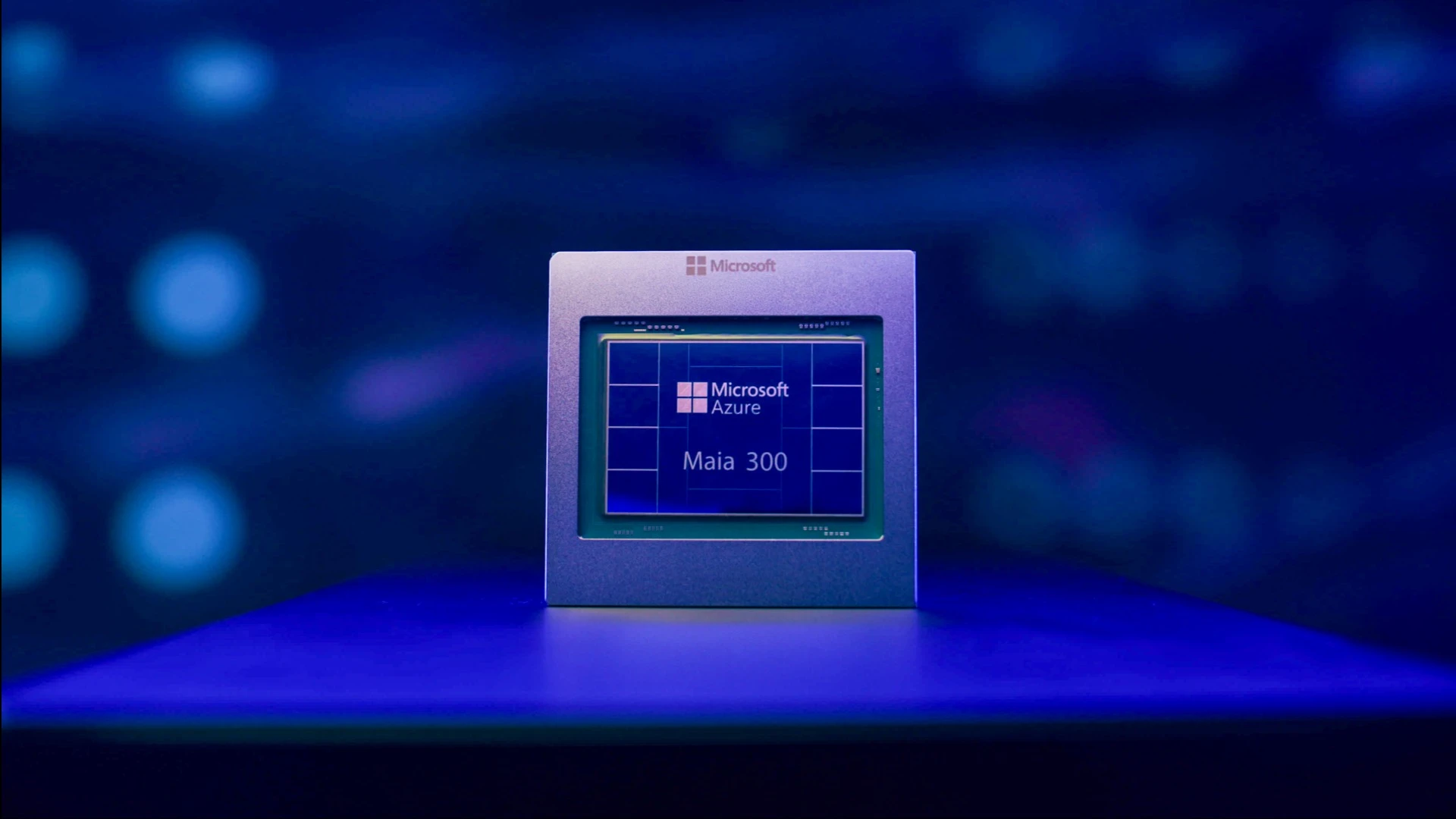
Microsoft has announced the next generation of its custom AI chip / Photo: Microsoft
Microsoft has unveiled its new Azure Maia 300 AI processor. The company plans to deploy potentially more than 1 million of the chips in 2027 to support its internal AI services, Reuters reports. The move reduces its dependence on third-party processors, primarily those from Nvidia and AMD. Other major cloud providers, including Google and Amazon, are also developing their own chips. What does this mean for Nvidia’s business?
Details
Microsoft plans to make its custom Maia chips the “primary inference system for Microsoft products and services,” referring to the process of generating AI responses. Microsoft expects Maia 300 to deliver 40% more tokens per megawatt than “leading GPU-based systems.” This is a direct swipe at Nvidia, Yahoo Finance writes.
A token is a basic unit of measurement in AI systems that can represent parts of words, images, and videos. The more tokens per megawatt, the more efficient an AI rack. A full rack configuration containing 96 Maia 300 chips delivers up to seven times the rack-scale token throughput of Maia 200, Microsoft stated.
Microsoft stock closed 1.1% higher on Monday. The company’s market capitalization thus climbed back above $4 trillion for the first time in almost a year, having last exceeded that threshold on October 29, 2025, after reaching an all-time high of $4.029 trillion the day before, MarketWatch noted. Microsoft is the fourth-largest company in the U.S. by market value, behind only Nvidia, Apple, and Amazon.
Implications for Nvidia
Microsoft is one of several companies developing or already using their own AI chips. They include cloud giants Amazon, Google, and Meta, as well as AI labs OpenAI and Anthropic. Custom processors allow them to reduce their dependence on Nvidia and AMD and tailor their hardware to specific workloads.
That is a potential problem for Nvidia, which regularly generates more than 50% of its quarterly revenue from hyperscalers, Yahoo Finance reckons. Moreover, Amazon and Google already rent out their chips to third-party customers, directly threatening the business of the world’s most valuable company. Amazon is also considering selling chips for customers to install in their own data centers, rather than only renting out access through its own facilities.
That does not mean cloud companies will stop buying Nvidia chips entirely, however, Yahoo Finance added. Customers still need different types of chips for different workloads, meaning Amazon, Microsoft, and other hyperscalers will likely continue buying the most in-demand processors, it concluded.
Context
Microsoft introduced its second-generation chip, Maia 200, in January, calling it the “most performant, first-party silicon from any hyperscaler.” The company compared it with Amazon’s third-generation Trainium chips and Google’s seventh-generation TPUs.
As The Information reported in August, Microsoft was in talks with TSMC to reserve manufacturing capacity for more than 300,000 Maia 300 chips for delivery in 2027, with the eventual goal of securing capacity for more than 1 million processors. Bloomberg thinks Microsoft trails rivals such as Alphabet and Amazon, whose custom chips are already widely used to power AI services.