Meta launches Muse Wonder AI model, says it has caught up with industry leaders
Meta shares closed 3.4% higher on Monday

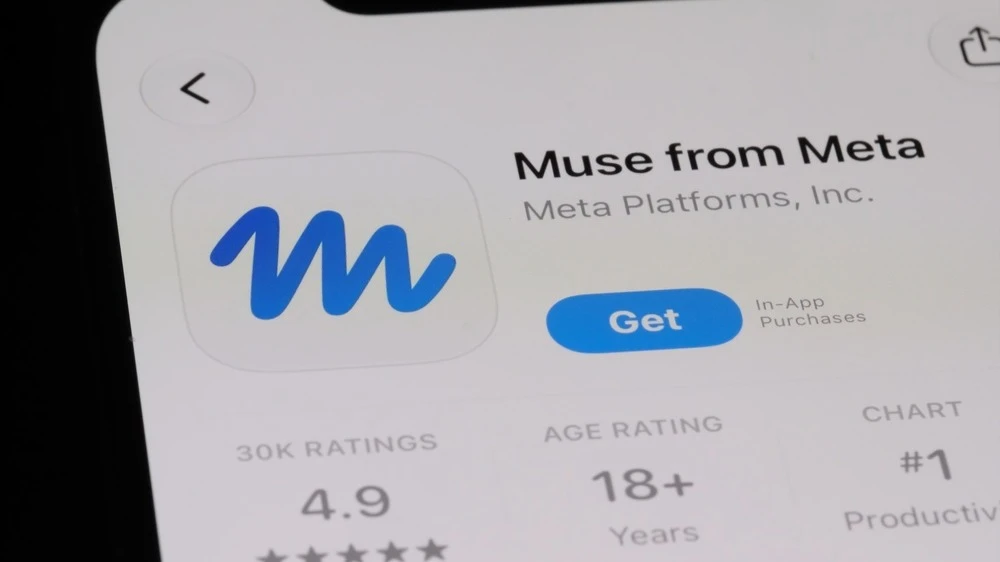
Meta has released a long-awaited AI model / Photo: Shutterstock.com / Robert Way
Meta Platforms has unveiled a new AI model, Muse Wonder, which the company believes can compete with leading models from OpenAI and Anthropic in coding and complex professional tasks. The release marks a milestone in Mark Zuckerberg’s multibillion-dollar strategy to strengthen Meta’s position in the AI race after its previous models fell short of expectations, Bloomberg reports.
About the new model
Meta stated in a blog post that Muse Wonder outperforms some competing models on technical benchmarks. Specifically, the company compared it with Anthropic’s Claude Opus 5.5 and Fable 5.1, as well as OpenAI’s GPT-6 Astra. However, benchmark results do not always reflect real-world performance, and comparisons are complicated by different systems’ strengths across different tasks, as Bloomberg notes.
Muse Wonder is designed to handle complex tasks, including coding and analyzing financial information and legal documents. The new model is also better at remembering relevant information from previous conversations with users. Meta plans to integrate it into Muse, its personal AI assistant introduced in September. Muse can carry out everyday tasks, such as ordering groceries and booking travel. Muse Wonder will soon power the subscription version of the app.
Meta has moved away from its previous strategy of prioritizing open models: Muse Wonder will be closed. The company intends to sell access to its most powerful versions to business customers, competing with OpenAI and Anthropic for corporate contracts. Muse Wonder API access costs $4 per million input tokens and $20 per million output tokens, with a discounted rate of $0.20 per million cached input tokens. Muse Wonder Full is available through Muse Code subscriptions, with the premium offering costing $200 a month.
The model’s release follows a sweeping overhaul of Meta’s AI division. After Llama 4 fell short of expectations in April 2025, Meta stepped up investment in infrastructure and recruiting. In particular, Scale AI founder Alexandr Wang was hired to lead a new AI development unit. Meta introduced Muse Spark in April this year, but that model still lagged competing offerings, the Financial Times reports.
Zuckerberg interview
In an interview with the FT on Monday, Zuckerberg said that Meta had rejoined the leaders in the AI race and intends to continue investing heavily to compete with OpenAI and Anthropic.
Muse Wonder is “going to allow much more sophisticated behaviors that are at the frontier of what is being done in the AI field,” Zuckerberg told the FT. He also emphasized that developing the model required substantial computing power, investment, and rigorous scientific work over an extended period.
Meta is already developing its next generation of models, and technological progress could accelerate, according to Zuckerberg. In addition, he rejected calls to slow AI development, arguing that these systems can be made safe through standard guardrails and responsible development.
The Meta CEO also gave his opinion on how the company’s strategy differs from those of OpenAI and Anthropic: its competitors are primarily focused on automating knowledge work, while Meta aims to build personal superintelligence that empowers individual users. At the same time, Zuckerberg acknowledged that current models still lack enough common sense to be ideal personal assistants. The industry has yet to make AI reliable in practical applications such as handling customer support inquiries, he said.
Risks to Meta’s strategy
Although the Muse app is helping popularize AI assistants that can independently carry out tasks in the U.S., obstacles to widespread adoption remain, the FT notes. Shortly after its launch, Amazon blocked Muse AI agents from shopping on its site. That limited the system’s functionality and showed that tech companies could use their market power to restrict competing AI products.
Data privacy raises additional concerns. Users have accused Muse of accessing or sharing private information without permission. In response, Zuckerberg pointed to plans to release Muse Confidential VM, a version of the service in which the company would be unable to access users’ data or their conversations with the AI agent.
Meta’s heavy investment in AI has also been accompanied by internal changes. In April, the company announced plans to cut around 8,000 employees, or 10% of its workforce, with the layoffs taking effect on May 20. According to employees, the layoffs and plans to install software that tracks employees’ mouse movements and keystrokes to train AI models have hurt morale, the FT reports.