Oninvest Index: Drone Manufacturers Lagged Behind the Market. Who Defied the Correction and Posted Gains?

In the first half of 2026, Oninvest’s equally weighted UAV EW Index rose by 15.2%, while the Russell 2000 gained 21.9% over the same period / Photo: Shutterstock.com
Following strong performance in 2025, the drone manufacturing sector took a breather. At the end of the first half of 2026, the UAV EW Index —an equally weighted index calculated by Oninvest*—rose by 15.2%, while the market-cap-weighted index— the UAV CapW Index —rose by only 0.3%. By comparison, the Russell 2000 rose 21.9% over the same period, and the S&P 500 rose 9.6%.
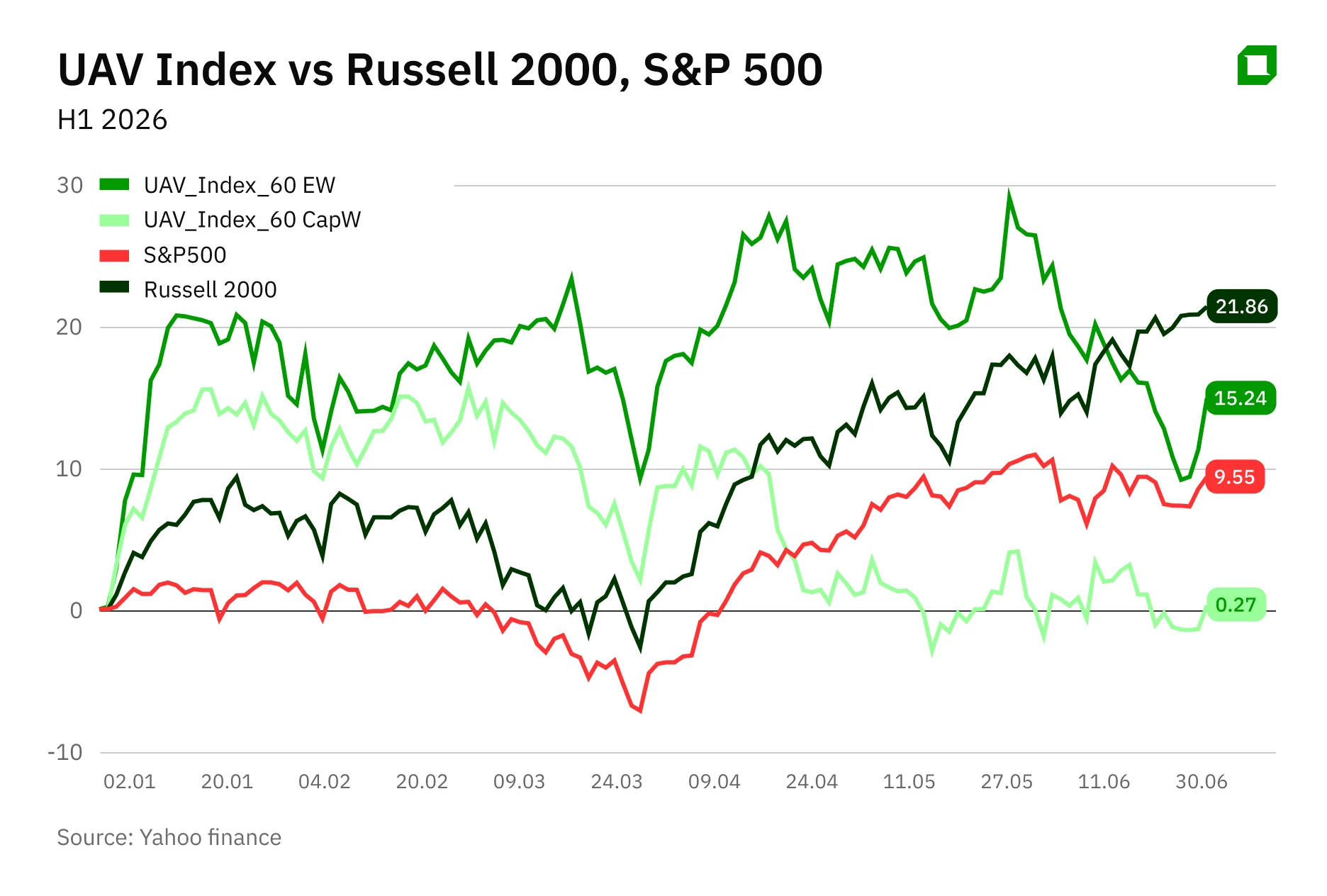
The contrast with the 2025 results—when the UAV EW Index rose 88.7% and significantly outperformed the benchmarks—can be attributed to a correction among last year’s leaders: over the first half of the year, Kratos fell 34.3%, AeroVironment fell 31.8%, and ZenaTech dropped 53.1%. At the same time, demand has not weakened: at the end of the first quarter, Kratos’s order backlog exceeded $2 billion, with an order-to-revenue ratio of 1.6, while AeroVironment’s funded backlog reached $1.2 billion at the end of the fiscal year, compared to $726.6 million a year earlier. In other words, the market primarily adjusted its valuation of the companies, rather than their operating results. In mid-July, the conflict in the Middle East escalated again, which is a potential catalyst for companies in the sector.
We have selected the top performers from the UAV EW Index among micro-cap companies, as well as several of the most interesting issuers with a market capitalization above $500 million that have demonstrated strong performance and stand out for the quality of their investment case:
Aerodrome Group (TASE: ARDM)
One of the top performers in the sample was Israel’s Aerodrome Group, a provider of unmanned solutions with a market capitalization of approximately $62 million (+359% over the first half of the year). The company handles the entire drone operations cycle: equipment integration, operator training, mission planning, maintenance, and data processing.
The company's solutions are used for reconnaissance and surveillance, facility security, and monitoring of energy infrastructure. Aerodrome Group is currently expanding its presence in the defense sector.
By mid-March, the stock had risen 830% from its all-time low. The key catalysts were a strategic investment by EagleNXT, which included the right to establish a joint venture in the U.S., and the announced plan for a group of investors led by Elad Holdings to acquire a stake in the company, which included former Mossad chief Yossi Cohen and Israel Canada owners Barak Rosen and Assi Tochmayer.
For now, the rise in the stock price reflects expectations of a change in control, an influx of capital, and the expansion of sales channels rather than an improvement in the business. In 2025, Aerodrome’s revenue fell by 32.6% to 9.74 million shekels ($3.2 million), and its net loss amounted to 21.61 million shekels ($7.1 million).
Majestic Dragon AeroTech (0918.HK)
Majestic Dragon AeroTech, with a market capitalization of about $240 million—a newcomer to the sample—has seen its stock rise 133% since the start of the year. Until August 2024, the company was engaged in the wholesale trade of watches and clothing, but after rebranding, it began developing a line of civilian drones for firefighting, logistics, and agriculture.
While the traditional wholesale business still accounts for about 65% of revenue, the structure is gradually changing: At the end of fiscal year 2026, revenue from the drone division grew by 27%, while revenue from the wholesale division declined by 26%. Judging by the stock’s performance, the market is already pricing in the company’s future transformation, although this is only gradually becoming apparent in its financial results.
Park Aerospace (PKE)
Park Aerospace posted the best performance among companies with a market capitalization of over $500 million: its stock rose 80.7% over the first half of the year. The company manufactures composite materials for the LEAP-1A engine nacelles used in the Airbus A320neo family and remains the sole qualified supplier of ablative materials for PAC-3 Patriot missiles. In the unmanned aerial vehicle (UAV) segment, it supplies composites for the Kratos XQ-58 Valkyrie, according to data from the Citizens JMP report. It also participates in programs related to Israel’s Arrow missile defense system.
At the end of fiscal year 2026, revenue increased by 18.2% to $73.3 million, and adjusted EBITDA rose by 35.3% to $15.8 million. A sharp increase in production of PAC-3 MSE missiles could serve as an additional driver: in the U.S. budget request for fiscal year 2027, procurement of these missiles is set to increase more than 14-fold compared to 2025, and Lockheed Martin plans to expand production of the interceptors. To meet this demand, Park Aerospace is building a new plant that will more than double its composite materials production capacity. The main risk is the high concentration of the business: about 40% of the company’s revenue is tied to GE Aerospace programs through a single customer.
On June 9, Citizens JMP initiated coverage of the stock with a “Market Outperform” rating and a price target of $42, estimating the company’s potential addressable market at $2.18 billion for 2026–2030. According to MarketWatch, the company has only two Buy ratings. The $42.50 price target is 23.9% higher than the closing price on June 23.
Parrot (PARRO)
Shares of Parrot, a French microdrone manufacturer, rose 32.7% over the first half of the year and 40.6% year-to-date. In the first quarter of 2026, the company’s revenue increased by 52% to €27.9 million, and sales of professional microdrones doubled to €21.3 million, thanks to shipments of the ANAFI UKR reconnaissance drone.
An additional driver was the inclusion of this drone in a European armored vehicle program: the customer has already received 250 systems, with another 175 to be delivered under a long-term agreement. According to Cantor Fitzgerald’s estimates, these 175 units alone will generate approximately €2.6 million in revenue in the second quarter (the company’s earnings report is expected on July 31). The main risk is dependence on the schedule of government tenders and the delivery times for components.
Parrot has only one rating—from Cantor Fitzgerald. On May 21, the firm’s analyst reaffirmed the “Overweight” rating (a recommendation to buy the stock) and raised the price target from €11 to €12, which is 14.3% above the closing price on June 23. The main risk is the company’s dependence on the schedule of government tenders and the delivery times for components.
Palladyne AI (PDYN)
Shares of Palladyne AI, a software developer for autonomous and swarm drones, rose 42.7% over the first half of the year. Preliminary second-quarter results exceeded expectations: revenue increased by approximately 480% year-over-year to $5.8 million, and the order backlog grew to $24 million from $17.3 million in the previous quarter.
Another catalyst was a strategic partnership with Israel Aerospace Industries (IAI). Under the agreement, Palladyne received exclusive rights to manufacture and market loitering munitions in the United States. Analysts at Lake Street and A.G.P., in reports dated July 8 and June 30, respectively, maintained their “Buy” ratings with target prices of $11 and $12. The main risk is high cash burn: with quarterly expenses of $8–9 million and a cash balance of $44 million as of the end of June, the company has enough funding to last approximately five to six quarters without raising additional capital.
According to MarketWatch, Palladyne AI has a total of three “Buy” ratings and one “Hold” rating. The target price of $11.25 is more than twice the closing price on June 23.
Red Cat (RCAT)
By the end of June, Red Cat (RCAT) had gained 34.3% year-to-date; however, by mid-July, the stock had lost all of its gains and was trading in negative territory (-2.5%). This was due to a $225 million secondary offering at a discount to the market price, after which the stock lost about 14% in a single day, followed by a broad sell-off of risky assets amid a new round of tensions surrounding Iran.
That said, the investment thesis remains the same. In May, the company began full-scale production of the Variant 7 unmanned surface vessel, designed for reconnaissance, coastal security, and strike missions. In the aviation segment, Teal’s drones have advanced to the finals of the Pentagon’s Drone Dominance Gauntlet II competition, with the winners set to receive a chance at production contracts in August. On July 2, Northland analysts reaffirmed their “Outperform” rating with a price target of $22.
According to MarketWatch, all eight analysts covering Red Cat stock recommend buying it. The target price of $21.60 is 168% higher than the closing price on June 23.
What Does the Escalation Between the U.S. and Iran Change?
The latest round of escalation surrounding Iran is driving interest in several areas at once: reconnaissance microdrones, autonomous maritime platforms, and missile defense systems. The most obvious beneficiary in our sample is Park Aerospace, as the increased use of PAC-3 Patriot missiles requires higher production volumes of key components. For Palladyne AI, the potential driver remains the localization of IAI’s loitering munitions production in the U.S.; for Aerodrome Group, it is new investments and a possible joint venture in the U.S.; while Parrot could benefit from accelerated procurement of reconnaissance microdrones by European countries. For Red Cat, the investment thesis remains tied to the launch of mass production of the Variant 7 and participation in a Pentagon program, whereas the recent combat use of U.S. naval drones only confirms the demand for this class of equipment but does not necessarily translate into orders for the company itself.
At the same time, geopolitics alone does not guarantee revenue growth. The first half of the year showed that the market is reacting less and less to high-profile issues and more and more to actual contracts, access to government procurement, and companies’ ability to scale up production. It is these factors—not news from the Middle East—that will ultimately determine the sector’s future trajectory.
This is not intended as individual investment advice.
* In the first half of 2026, Oninvest updated its small-cap index of drone manufacturers: the new version includes 60 companies—19 more than before. The index now accurately reflects the entire small-cap segment, including micro-caps: drone and component manufacturers, software developers, sensor suppliers, and service companies from the U.S., Europe, Israel, and Asia.