Oninvest Index: Small-cap gold miners have outperformed gold. Which ones should you bet on?

In August, UBS left its gold forecast unchanged: the bank expects the price to reach $4,600 per ounce by the end of 2026 / Photo: Shutterstock.com
Since the beginning of 2026, gold has seen two sharp reversals in direction: at the start of the year, it soared to a historic high of nearly $5,600 per ounce, then lost about a third of its value, and by the end of August, it had risen to approximately $4,600. Gold mining companies’ costs do not change as quickly as the price of gold, which can sharply increase their profits. This drove their stock prices higher in August: gold miners’ shares rose significantly faster than gold itself and outperformed the broader market.
Roller Coaster
On January 29, the price of gold hit a new all-time high of $5,597.23 per ounce, but by the end of June, it had fallen below $4,000. In August, the trend reversed again: by the end of the month, the price had risen to approximately $4,600. Along with gold, mining company stocks also rebounded in August: the MSCI Global Gold Miners Index gained 43% over the month.
Demand from central banks also remains high: in the second quarter, they purchased 289 metric tons of gold—62% more than a year earlier. In August, UBS maintained its positive outlook on gold: by the end of 2026, the bank still expects a price of about $4,600 per ounce, but by September 2027, it expects the price to reach $5,400.
For gold miners, however, it is not only the price of the metal itself that matters, but also how much of that price remains after production costs. One of the key metrics in the sector is AISC, or all-in sustaining costs. For example, in the second quarter of 2026, gold miner Orezone sold gold at an average price of $4,401 per ounce, with an AISC of $2,449.
How the Oninvest Index Grew
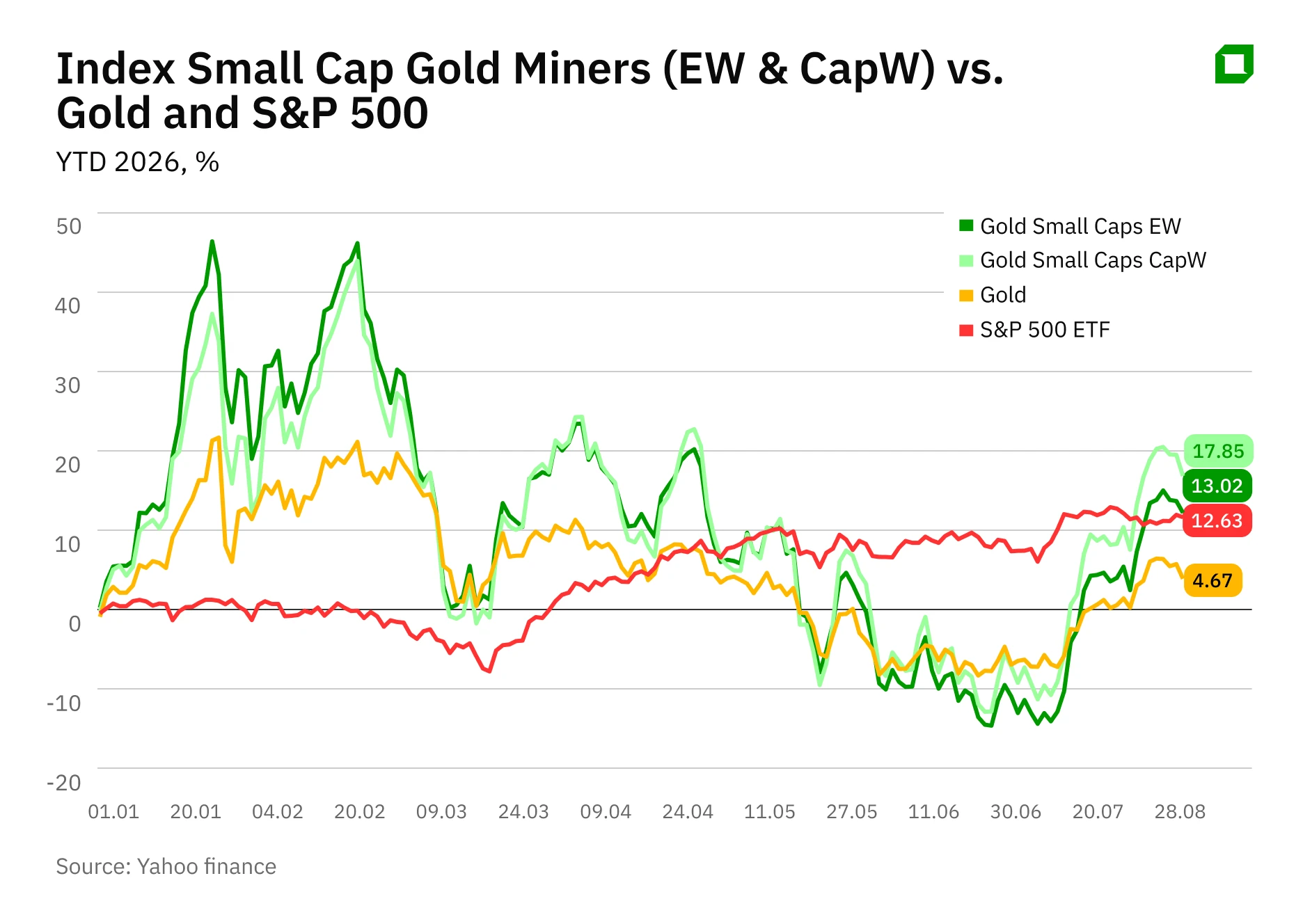
In 2025, the Oninvest Index posted impressive results: its equally weighted version rose by 202.5%, while gold itself gained 64.5%. The first half of 2026 was not as successful for small-cap gold miners: the equally weighted Oninvest Small Caps Gold Miners EW* index lost 9.5%, and the market-cap-weighted Oninvest Small Caps Gold Miners CapW index fell by 7.3%. During the same period, gold fell 7% in price, while the S&P 500 rose 9.6%.
But in August, the picture changed dramatically: from June 30 to August 28, the equally weighted index rose 24.9%, while the weighted index rose 27.1%. During this period, gold rose 12.6%, while the S&P 500 rose only 2.8%. Year-to-date, small-cap gold miners are also in the black: the Oninvest Small Caps Gold Miners EW rose 13%, and the Oninvest Small Caps Gold Miners CapW by 17.8%. Meanwhile, gold gained 4.7%, and the S&P 500 rose 12.6%.
If gold prices continue to rise, low-cost gold miners could increase their profits much faster than the price of the metal itself. We’ve selected four companies from the Oninvest index that are of the greatest interest to investors:
Montage Gold (TSX ticker: MAU)
A 97% increase since the beginning of 2026
A Canadian company is building the Koné mine in Côte d’Ivoire—its first production asset. According to the updated feasibility study, the mine is expected to operate for 16 years and produce more than 300,000 ounces of gold per year during the first eight years.
In its second-quarter report, Montage confirmed its plans to produce its first gold in the fourth quarter of 2026. Construction is on schedule: of the $885 million budget, the company has already contracted $714.4 million, or about 81%, up from 63% in January. Cash on hand of $309 million is sufficient to cover the remaining capital expenditures.
At the same time, the company is ramping up its exploration efforts: in the first half of the year, the volume of drilling rose to 105,454 m, compared with 83,280 m a year earlier.
The second asset is Didievi, a project currently in the resource estimation phase. Montage acquired it following its purchase of the Australian company African Gold in April 2026. The deposit’s resources are estimated at 989,000 ounces of gold. In August, the company increased its stake in the project from 80% to 95.5% by paying $57.7 million.
Montage’s main risk is that it essentially has only one production asset under construction, and both of its potential projects are located in the same country. So far, judging by safety metrics, construction has proceeded without any major setbacks.
On August 12, ATB Capital Markets raised its price target from 19 to 22 Canadian dollars and maintained its “Outperform” rating (the report is available at Oninvest). ATB Capital Markets assumes a 19-year mine life for Koné, annual gold production of more than 300,000 ounces in the first 11 years, and an AISC below $1,400 per ounce. This will make Koné one of the largest and lowest-cost gold mines in West Africa.
Mako Mining (Nasdaq: MAKO)
A 73.5% increase since the beginning of 2026
The company mines gold at the San Albino mine in Nicaragua—which it describes as one of the highest-grade open-pit mines in the world—and at the Moss mine in Arizona. In addition, Mako is preparing to build the fully permitted Mt. Hamilton heap leach project in Nevada and owns the Eagle Mountain project in Guyana, which is currently in the preliminary economic assessment stage.
In the second quarter of 2026, Mako’s revenue rose 61.8% year-over-year to $62.6 million, while net income increased from $8.8 million to $13.9 million. At the same time, AISC—that is, all-in sustaining costs—rose from $1,668 to $2,286 per ounce.
Mako's main risk is its geographic exposure. A significant portion of its existing business is tied to Nicaragua, while its new projects are located in other jurisdictions with their own political and regulatory risks, including Guyana.
Mako shares began trading there on March 30, 2026. On August 14, Ryan Walker of Stifel reaffirmed his "Speculative Buy" rating and a price target of 20 Canadian dollars (the report is on file with the editorial office).
Orezone Gold (TSX, ASX: ORE)
A 52% increase since the beginning of 2026
The Canadian company has two operating gold mines, one of which it acquired as recently as March 2026. The first is Bomboré in Burkina Faso, in which Orezone holds a 90% stake. Commercial production of oxide ore has been underway there since December 2022, and in December 2025, the company launched the first phase of its solid ore processing facility. This is expected to increase total gold output by 45%.
The second asset is Casa Berardi in Quebec, an operating mine with both underground and open-pit mining operations. The transaction to acquire it was completed on March 25, 2026.
The deal had a significant impact: in the second quarter, gold production rose to a record 58,566 ounces, compared with 27,548 ounces a year earlier. Revenue more than doubled—from $94.5 million to a record $271.6 million—and adjusted EBITDA nearly tripled to $134.5 million; net income totaled $45.2 million, or $0.07 per share. Meanwhile, the AISC rose to $2,449 from $1,830 per ounce.
Orezone Gold also faces country-specific risks: further increases in production in Burkina Faso depend not only on the project’s economics but also on decisions by local authorities, who are increasing the government’s stake in mining projects.
Analysts believe that growth potential remains. On August 13, National Bank Financial raised its price target for Orezone shares from 3.25 to 3.5 Canadian dollars and maintained its “Outperform” rating (buy recommendation). It also raised its 2027 EBITDA forecast by 5% to $665 million. In total, the company’s stock has three “Buy” ratings from analysts and one “Hold” rating. The average target price is 4.28 Canadian dollars, with a growth potential of 58.5%.
i-80 Gold (TSX: IAU, NYSE: IAUX)
A 24% increase since the beginning of 2026
The company mines gold in Nevada and is simultaneously building its own regional mining and processing system there—to process ore from three underground mines at the Lone Tree plant, a central processing hub. The system includes the existing Granite Creek mine, the Archimedes mine—which is scheduled to begin operations in late 2026—and the Cove project.
i-80 Gold is one of only two gold mining companies in Nevada with its own autoclave, which allows it to process refractory sulfide ore and extract gold from it—gold that is difficult to recover through conventional leaching. The second such facility is owned by Nevada Gold Mines, a joint venture between Barrick and Newmont.
For now, this infrastructure is not operating at full capacity, and the company is facing a shortage of processing capacity. In the second quarter of 2026, i-80 Gold produced 11,098 ounces of gold, compared with 4,178 ounces a year earlier, but sold only 5,335 ounces; more than 5,300 ounces remained in work-in-progress. The ore is processed at a third-party mill under contract, and its capacity was insufficient. As a result, quarterly revenue fell to $24.3 million from $27.8 million a year earlier. Nevertheless, for the first half of the year, revenue rose 83% to $76.7 million.
The quarterly loss, on the other hand, increased to $52.5 million from $30.2 million a year earlier, primarily due to non-cash revaluations of financial instruments. At the end of the second quarter, the company had $464.6 million in cash. By 2028, i-80 Gold expects to reach 150,000–200,000 ounces per year, when in-house processing will allow it to remove the current capacity constraint.
i-80 Gold has not yet reported reserves at any of its properties in accordance with SEC rules; therefore, the company’s production guidance is based on resources rather than proven reserves. The company plans to present its first feasibility studies for Granite Creek and Cove in the third quarter of 2026.
On August 11, Don DeMarco of National Bank Financial reaffirmed his “Outperform” rating and a price target of 3.75 Canadian dollars, and on August 12, Richard Gray of ATB Capital Markets reaffirmed his “Outperform” rating with a price target of 3.5 Canadian dollars (reports are available at the Oninvest editorial office). This suggests a potential for a 40–50% increase in the stock price from its current level.
All six analysts covering the company recommend buying its stock. The average price target is $3.11, representing an upside potential of nearly 75% from the closing price on August 31.
*Oninvest expanded the index’s constituent list from 45 to 54 companies listed in the U.S., Canada, Australia, London, and Istanbul, and recalculated the returns in dollars. The index is calculated in two versions: an equally weighted version, where each company accounts for 1.82%, and a market-capitalization-weighted version.
This is not intended as individual investment advice.