The AI market is "almost certainly" in a bubble — billionaire Ken Griffin
The founder of Citadel believes that the effectiveness of investments in artificial intelligence has yet to be proven

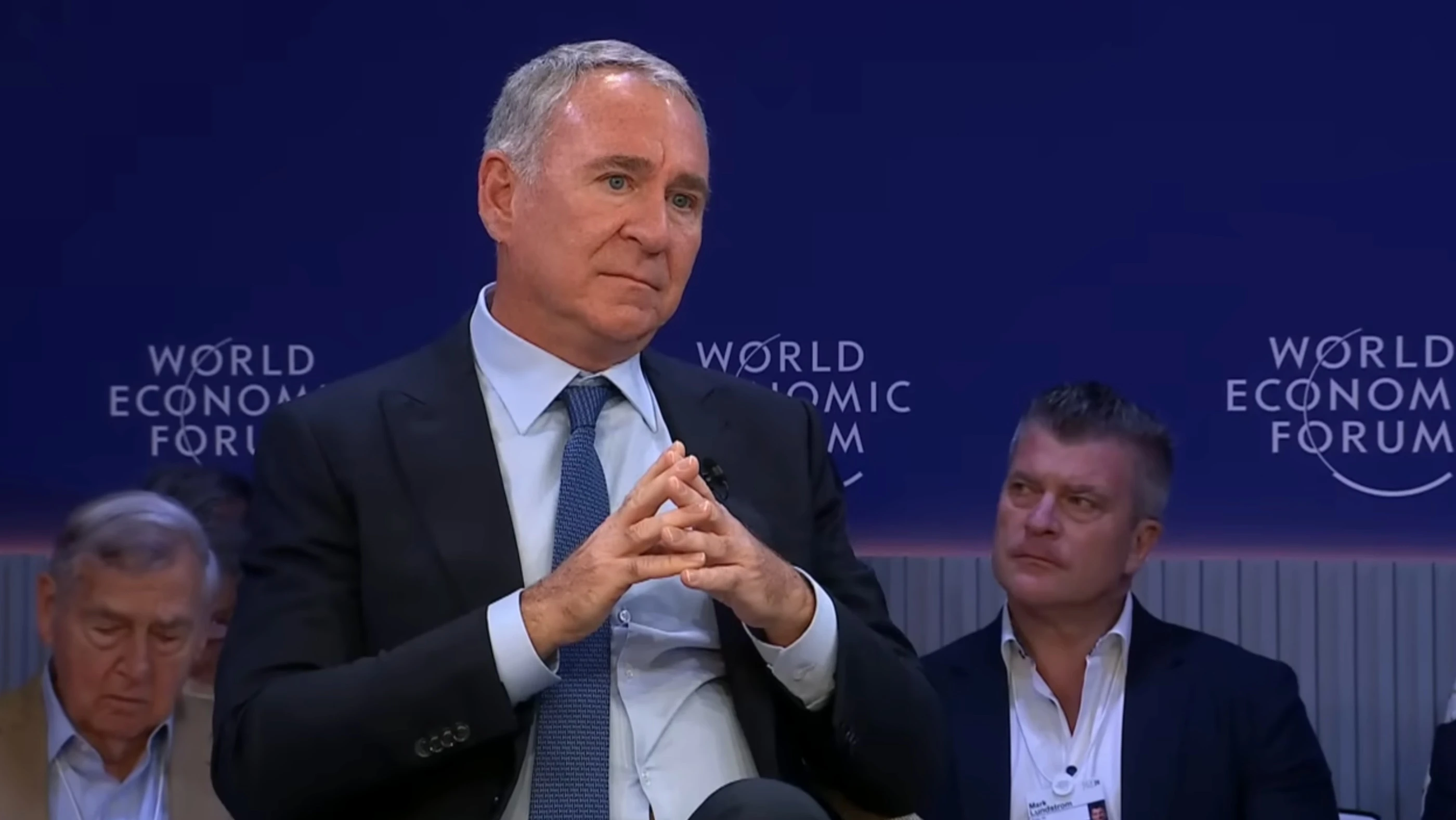
Griffin linked his concerns to Anthropic's upcoming IPO / Photo: A still from Ken Griffin's speech at the 2026 WEF session
Investors are “almost certainly” in the midst of a bubble in the artificial intelligence market, said Citadel founder Ken Griffin, whose net worth Forbes estimates at $56.6 billion. Griffin noted that many companies are still trying to figure out how much they will spend on the technology and how it will transform the economy.
“Corporate America has a very uneven ability to derive value from its AI models. “I think the entire corporate world is looking at its bills from Anthropic and OpenAI and thinking: Okay, we need to figure out how to get real productivity out of this,” he said at the Future of Global Markets conference in New York (as quoted by Bloomberg).
Griffin linked his concerns to the upcoming IPO of Anthropic, one of the leading AI developers. The company is expected to file for an IPO in the coming weeks and could carry out one of the largest offerings in history. On October 20, The Wall Street Journal reported that Anthropic could spend $750 billion on additional computing power in the coming years. Griffin believes that the company’s success will ultimately depend on whether it can prove to investors that its models are essential in every industry.

The Citadel CEO’s stance on AI has shifted significantly over the past year: at the beginning of the year in Davos, he called the technology “garbage,” but in May, during a speech at Stanford Business School, he admitted that he was “overwhelmed” by the scale of what AI is capable of. Now his tone has become much more optimistic: as Bloomberg notes, Griffin stated that the technology will spark a wave of new business creation in the U.S.
“You see the threat to white-collar workers unfolding; as a business owner, you see bulldozers filling in the moats that separate you from your competitors. And at the same time, you realize that this will be a golden age for entrepreneurs,” he said.
Comparing the current situation to the era leading up to the dot-com crash and the “bizarre” business models of that time, Griffin noted that any radical transformation of the economy is usually intertwined with a market bubble, and such bubbles often coincide precisely with massive technological shifts.
“The companies that end up on the other side of this bubble will become market leaders for decades to come,” he said. “It’s just a shame I didn’t hold on to my Amazon shares back then.”
Context
Other well-known investors have also expressed concerns in recent months that the AI market is overheating. Ray Dalio, founder of Bridgewater Associates, said in June that the AI market is showing signs of a bubble that will eventually burst. Michael Burry, known as the inspiration for one of the characters in “The Big Short,” said this week that the market reminds him of a maturing supervolcano: on the surface, the situation appears stable, but imbalances are building up beneath the surface. According to Burry, the conditions for a correction have already taken shape in the market, and the AI industry’s financial problems will only intensify the pressure.
Griffin himself also warned in April about the risk of a global recession, linking it to the energy crisis in the Middle East and growing concerns about the impact of AI on the labor market.
______________________
In the “Guru Portfolios” section on Oninvest, you can track the composition and changes in the portfolios of the world’s largest investors and funds. The service allows you to analyze the largest holdings, new ideas, and changes in asset allocations based on 13F filings, as well as compare portfolio performance over time.
This article was AI-translated and verified by a human editor