The New Energy Boom: How to Profit from the Growth of the Battery Market

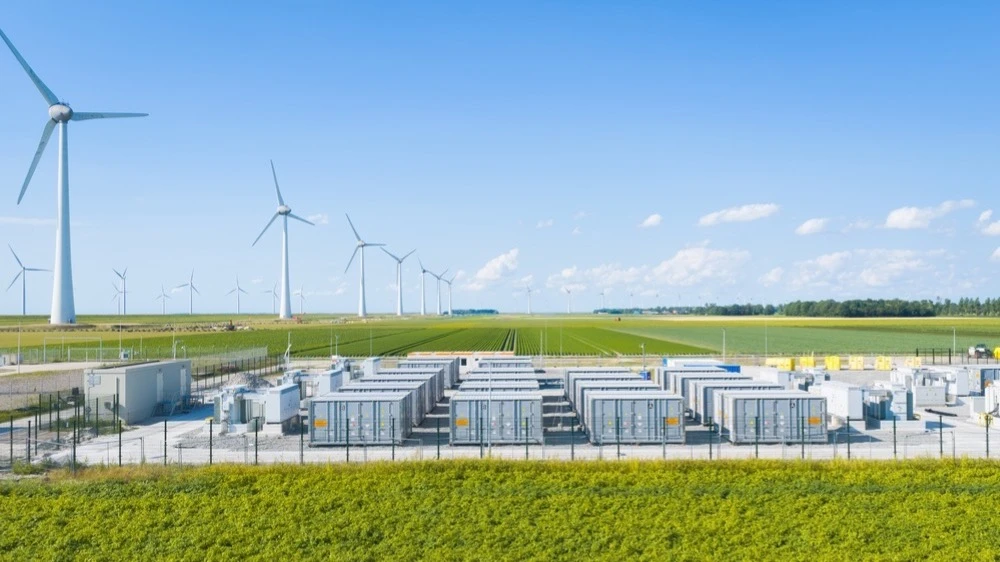
The growth of the solar and wind power sectors is driving demand for energy storage systems. Photo: biletskiyevgeniy.com / Shutterstock.com
The more electricity solar panels and wind turbines generate, the higher the demand for energy storage systems. In Europe, this market grew sharply in 2025, and the coming winter may create additional opportunities for companies in the sector. Which of them should investors pay attention to?
Recurring Records
In April 2026, solar and wind power surpassed natural gas for the first time in the world in terms of their share of electricity generation—22% versus 20%. Over the previous five years, the share of natural gas remained virtually unchanged, while solar and wind power generation more than doubled.
Solar power generation is growing the fastest—largely thanks to the mass production of inexpensive solar panels in China. According to BloombergNEF, while it took the world 10 years to deploy the first 1 terawatt of capacity in this sector, it took less than three years to reach the second 1 terawatt and less than two years to reach the third. The 3-terawatt milestone was reached in March 2026—just as the war in the Middle East began.
The war has highlighted the risks of dependence on fossil fuel imports and forced many countries to build their energy security by relying on their own resources. Renewable energy sources (RES) can help in this regard. The pace of their deployment will accelerate, and by the end of the year, global solar capacity will reach 3.43 TW, according to BloombergNEF’s forecast: 1.1 TW in developed countries, 1.73 TW in China, and 0.6 TW in developing countries.
However, the higher the share of solar and wind power generation, the greater the need for energy storage systems. Electricity generation from these sources depends on weather conditions and is unstable. And without rapid development of the energy storage sector, the revolution in this field is unlikely to continue, warns Lara Haim, director of solar energy research at BloombergNEF.
As a result, the battery market is growing rapidly—especially in countries and regions that have been actively expanding their renewable energy capacity in recent years, including Pakistan, the Philippines, Australia, and Europe.
The Battery Boom
In Europe, solar power capacity installation received a major boost in 2022, when the region lost access to gas from Russia following its invasion of Ukraine.
The battery boom, however, didn’t truly begin until 2025: newly installed capacity totaled 6.95 GW—2.6 times more than the previous year and nearly 25 times more than in 2021, according to BloombergNEF.
Europe has been developing renewable energy for so long that many accessible sites that can be easily connected to the grid have already been utilized, says Jorge León, head of geopolitical analysis at Rystad Energy: Therefore, to ensure stable operation, it is necessary to develop not only renewable energy but also energy storage systems.
In June 2026, the EU set a goal of nearly quadrupling storage capacity—from 55 GW at the start of 2026 to 200 GW by 2030.
Everyone—from large energy and utility companies to infrastructure funds—is actively investing in this sector.
Among the largest manufacturers of battery cells and energy storage systems, as well as providers of technological and digital solutions, are China’s CATL and BYD, the U.S.’s Tesla, Fluence (a joint venture between AES and Siemens) and GE Vernova; South Korea’s LG Energy Solution and Samsung SDI; Japan’s Panasonic and Hitachi Energy; the Swedish-Swiss company ABB; and others.
In Europe, this winter is creating excellent opportunities for companies in the sector, according to Bloomberg. Due to the mini-crisis triggered by the war in the Middle East, the spread between intraday electricity prices and gas prices (Dutch TTF futures) has returned to 2022 levels.
“Colder weather and unpredictable winds are already leading to more significant fluctuations in daily electricity prices, which creates much more favorable conditions for the use of batteries,” says Paul Sheffield, commercial director of the British energy company Drax Group, which is increasing its investments in this sector.
Batteries can help offset fluctuations in electricity generation from renewable energy sources and in electricity prices. This, in turn, will ultimately help lower costs for consumers.
In the United Kingdom, Europe's largest battery market, the average difference between the highest and lowest prices per megawatt-hour of electricity over a 24-hour period rose by 80% in September compared with last year.
As a result, Harmony Energy—which operates 10 battery storage facilities across the country—posted a record monthly profit of 4 million pounds ($5.3 million), according to its founder, Peter Kavan. This is 62% higher than the average from January through August.
According to BloombergNEF estimates, the capacity of industrial-scale battery storage systems will increase more than fivefold this year in the United Kingdom compared to 2022 levels (to 10.4 GW), in Germany—by about 3.8 times (to 4.6 GW), and in France—by 4 times (to 1.2 GW).
In the U.S., where Donald Trump is waging a campaign against solar and wind energy, the government has not eliminated tax breaks for energy storage systems. This is one of the reasons why companies have begun to take a different approach to developing renewable energy projects, incorporating such systems into them from the outset.
BloombergNEF estimates that 124 GW of new "solar generation + energy storage" projects are set to come online over the next three years.
And in June, Sunrun, Renew Home, and Tesla announced plans to create the largest energy distribution center in the U.S. (16 GW), redirecting electricity from hundreds of thousands of home battery systems (including electric vehicles) and more than 8 million thermostats back into the grid during peak demand hours.
Nighttime Energy
In the first half of 2026, solar power’s share of global electricity generation reached a record 10 percent; at midday, it can reach as high as 25 percent, while at night it drops to nearly zero. At such times, traditional power generators—from coal-fired power plants in India to gas-fired plants in the EU—step in to support the power grid, notes the Ember think tank.
By 2025, energy storage systems had become significantly more efficient and affordable. Already, solar panels combined with batteries cover about a quarter of evening electricity demand (during peak hours from 7 p.m. to 9 p.m.) in California and Bulgaria. In Bulgaria, incidentally, there were virtually no energy storage systems installed at all in 2024. “The example of Bulgaria shows how quickly the deployment of battery storage can be scaled up,” writes Ember.
The standard lifespan of modern batteries is already 20–25 years (based on 10–12 charge-discharge cycles per year, assuming one charge per day and an annual decrease in the battery’s maximum capacity of 2% or less). At the same time, operating costs for industrial systems are low—just 2% per year.
Ember forecasts that the energy storage capacity set to come online worldwide in 2026 could enable 34% of new solar generation to be shifted to nighttime hours.
However, this is the maximum potential figure, since not all batteries will be used in such operations. Nevertheless, it is nearly double the figure recorded in 2025 (18%).
This article was AI-translated and verified by a human editor