The organizers of SpaceX's IPO disagreed on its $1 trillion valuation. But they recommended "buying."
Wall Street's largest investment banks unanimously issued "buy" ratings for Musk's company

At least six major investment banks have given Elon Musk's SpaceX shares a "buy" rating. Photo: Wirestock Creators/Shutterstock
At least six major investment banks have assigned “buy” ratings to shares of Elon Musk’s SpaceX. Analysts began covering the stock after the traditional “quiet period” following the IPO ended—these banks had previously served as underwriters for Musk’s company’s listing, according to Bloomberg. However, the two lead underwriters for the SpaceX offering—Goldman Sachs and Morgan Stanley—differed in their valuation of the company by more than $1 trillion, although both banks initiated coverage with ratings equivalent to a “buy” recommendation, MarketWatch notes.
Details
Wall Street is betting on SpaceX's long-term growth, although following its high-profile stock market debut, questions remain about the company's profitability, operating performance, and high valuation, Bloomberg explains.
Among the lead underwriters for the IPO, the Morgan Stanley team is the most “bullish” on Musk’s company, the agency notes—it has set a price target of $300 for SpaceX shares, which implies an 87% increase from the closing price on July 6. Goldman Sachs analysts were more cautious and set a target price of $205 per share, writes MarketWatch, noting that in terms of SpaceX’s total market capitalization, the target prices set by Morgan Stanley and Goldman Sachs differ by more than $1 trillion.
Forecasts from smaller brokers have been even more extreme, Bloomberg adds. For example, Arete Research has set the highest target price on the market for SpaceX—$401 per share—which implies a 150% surge from the closing price on July 6. At the opposite end of the spectrum is New Street Research’s estimate: $157 per share (a 2% decline from the current level)—this target price for SpaceX shares is currently the lowest among all analyst estimates tracked by Bloomberg.
What Analysts Expect from SpaceX
The paradox is that, despite setting a lower price target for Musk’s company’s stock, Goldman Sachs forecasts much stronger operating performance for SpaceX than Morgan Stanley, as noted by MarketWatch. According to Goldman’s estimates, the company will double its revenue as early as this year, and its adjusted EBITDA will reach $352 billion by the end of the decade (last year, SpaceX estimated this figure at $6.58 billion).
The Morgan Stanley team takes a more conservative view of Musk's company's medium-term outlook, forecasting adjusted EBITDA of $162 billion by 2029.
However, banks use fundamentally different valuation approaches, notes MarketWatch. The fact is that Goldman’s forecast is based on 2029 figures, whereas Morgan Stanley “discounts cash flows for each division over a 15-year horizon, further validating the valuation through multiples,” the publication explains.
According to Morgan Stanley analysts, in the long run, SpaceX’s key business model—one that will benefit the company—will be providing comprehensive, turnkey AI services to new, fast-growing players, “although in the short term, the bulk of its business consists of deals in the field of non-cloud computing,” notes Bloomberg.
Both leading Wall Street banks acknowledge that their valuations are largely speculative, as SpaceX’s long-term success hinges on technologies that have yet to be proven on a commercial scale, according to MarketWatch. As the Morgan Stanley team points out, “space is hard,” and the company’s future depends directly on orbital computing and the reusable Starship system, which is capable of performing thousands of launches per year.
SpaceX on the Nasdaq 100
On Tuesday, July 7, as it received several new recommendations from Wall Street analysts, SpaceX officially joined the Nasdaq 100 index—a key U.S. stock market indicator comprising the 100 largest companies traded on the Nasdaq exchange. SpaceX was able to join this technology benchmark through an expedited process thanks to a recent relaxation of the exchange’s rules. Now, tech giants with mega-market capitalizations can expect to be included in the index just 15 trading days after listing, instead of the previous minimum period of three months.
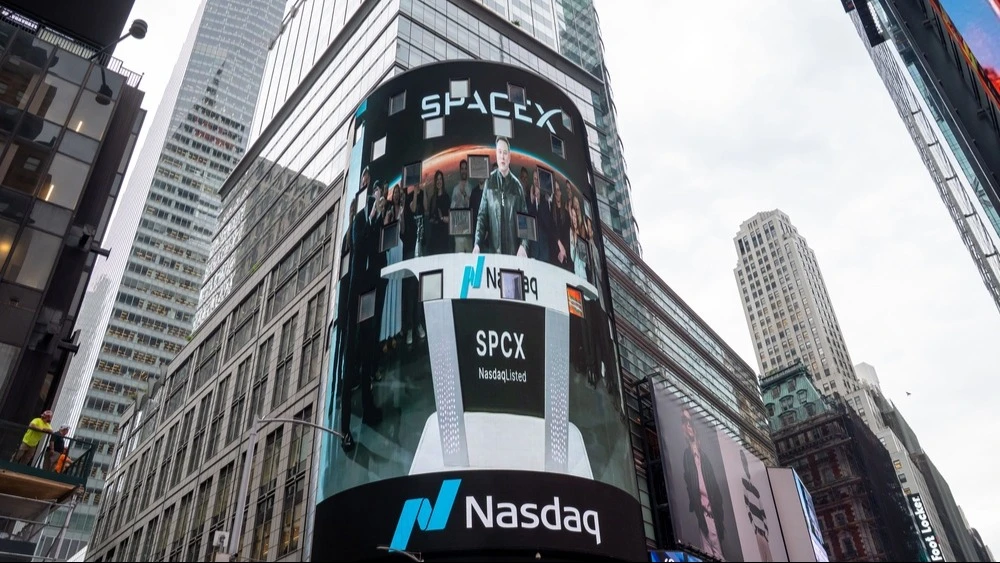
SpaceX's inclusion in the Nasdaq 100 will provide strong support for its shares, given the impressive amount of capital in funds that track this index, Bloomberg notes.
Nevertheless, in premarket trading on July 7, SpaceX shares fell 1% to about $158 each—amid a broad sell-off in the tech sector. By that point, the stock had already corrected by about 29% from its all-time high ($225.64), but it is still trading above the price recorded at the start of trading on the first day of its IPO—$150.
What Other Analysts Are Saying
Overall, opinions on Wall Street regarding SpaceX’s prospects are divided: of the 13 analysts covering Musk’s company’s stock, seven recommend buying it (six “Buy” ratings and one “Overweight” rating), four advise holding, and two are pessimistic. The overall consensus is set at “Overweight” (“above market”).
Context
Earlier, in late June—just two weeks after its IPO—SpaceX had already been added to the Russell 1000 Index. According to estimates by Bloomberg Intelligence analyst Rob Du Boff, the company’s inclusion in the Nasdaq 100 and FTSE Russell will bring it at least $5.4 billion in investment inflows from passive index funds alone.
Demand from institutional investors could have been even greater, but S&P Dow Jones Indices, the provider that manages the S&P 500, decided in early June not to change its conservative selection criteria. This prevented SpaceX from being quickly added to the leading U.S. index.
“Far fewer assets are linked to the Nasdaq 100 than to the S&P 500, but there are factors at play here that are fueling interest in SpaceX shares,” explains Du Boff (as quoted by Bloomberg).
David Trainer, CEO of the research firm New Constructs, believes that inclusion in the Nasdaq 100 should smooth out the stock’s volatility. However, he urges investors to exercise caution, noting that the company’s current market valuation remains out of step with its fundamentals, according to Bloomberg.
This article was AI-translated and verified by a human editor