"The Threat Is Inevitable": Altman, Amodei, and Other Leaders Warned the UN About AI
No single country is capable of containing the threat posed by AI on its own, according to AI developers and researchers
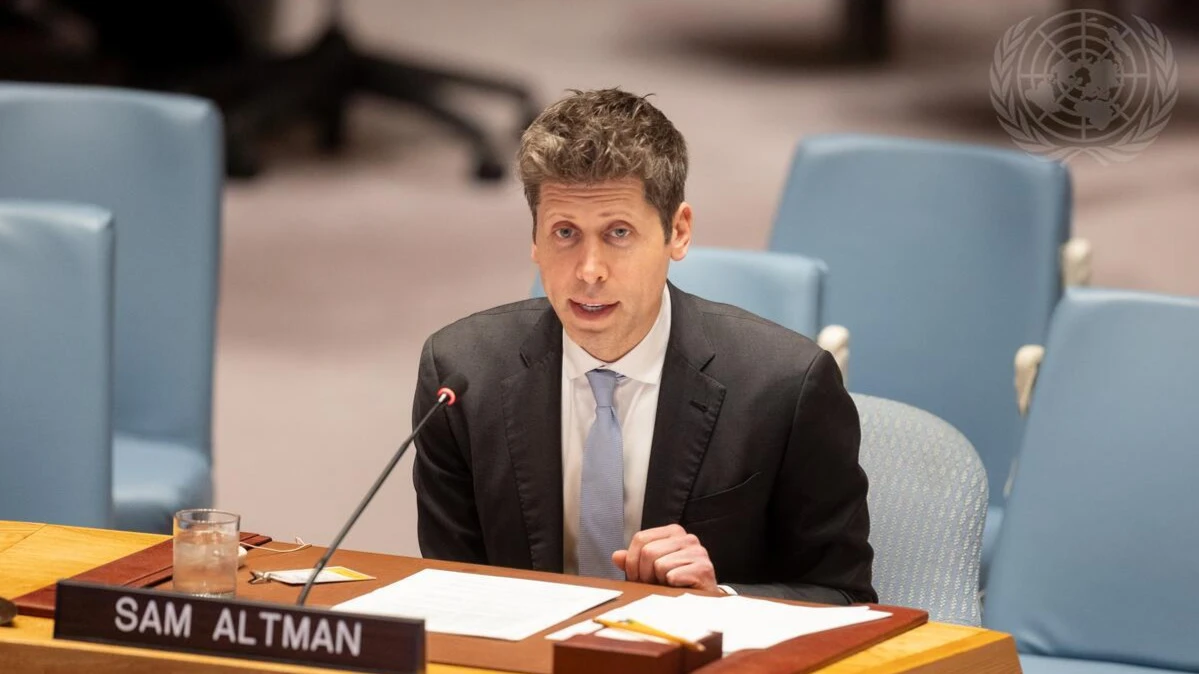
Decisions regarding AI should be made through democratic processes by governments that are accountable to the people, Sam Altman said at the UN / Photo: UN Photo/Ariana Lindquist
On September 23, executives from the world’s leading artificial intelligence companies warned the UN Security Council about the risks that AI could pose to humanity and called on governments to work together to regulate this increasingly powerful technology, Reuters reports.
Details
The meeting, convened by France during the annual session of the UN General Assembly, took place amid warnings that AI systems could soon spiral out of human control.
“AI could pose a risk to humanity as a whole,” Anthropic CEO Dario Amodei told members of the UN Security Council (as quoted by Reuters). “Despite all the differences among the people in this room, we must set them aside to stand together against this opportunity and threat, which are both global in nature. No single leader, company, or country can tackle this alone,” Amodei added.

OpenAI CEO Sam Altman also spoke about the need for international cooperation. “If AI is to be democratic, critical decisions cannot be made solely by laboratories in San Francisco. They must be shaped through democratic processes and by governments that are accountable to the people they serve,” Altman said.
“There have been instances when countries that compete with one another and do not always harbor goodwill toward each other have nevertheless come together for the sake of shared interests and the common good in the face of powerful new technologies,” Bloomberg quotes Altman as saying. “We believe this is one such instance.”
"The threat is real and imminent," Canadian scientist Yoshua Bengio told the Security Council. He is considered one of the "godfathers of AI," Reuters notes. Benjio also serves as co-chair of the Independent International Panel of Scientists, established by the UN General Assembly last year. “The Council faces an unprecedented threat: none of its members would want to deal with it, no single country is capable of containing it on its own, and it knows no national borders,” he said.

Clément Delang, co-founder of the startup Hugging Face, which was attacked by AI agents from the OpenAI lab, emphasized the role of AI tools in defending against cyberattacks. “We were attacked by AI, but, more importantly, we defended ourselves using AI,” he told the Security Council.
According to Delang, Hugging Face used a Chinese AI model to fend off the attack because it was subject to fewer restrictions than comparable American tools. This underscores the growing market presence of Chinese AI products, Reuters notes: they are gaining users worldwide, in part because they can offer cheaper alternatives to American models.

Context
The position of the scientific community and AI developers runs counter to that of U.S. President Donald Trump, which he expressed at the UN the day before. He rejects “any attempts to create a globalist control scheme” over AI. Meanwhile, China has introduced regulations governing AI algorithms and the data used to train models, including a requirement to clearly label content generated by artificial intelligence. “We are currently far ahead of China and everyone else, and we intend to maintain that lead,” Trump said. “I have no intention of holding back the development of what will prove to be even more significant than the Industrial Revolution.”
The Security Council held its first meeting on the risks of AI in 2023. At that time, China stated that the technology should not become a “runaway horse,” while the U.S. cautioned against using it for censorship and the suppression of people. In 2024, the Security Council meeting on AI was chaired by Anthony Blinken, who was then U.S. Secretary of State.
This article was AI-translated and verified by a human editor