Why do investors see Walmart stock as both a sign of a recession and a safe-haven asset?

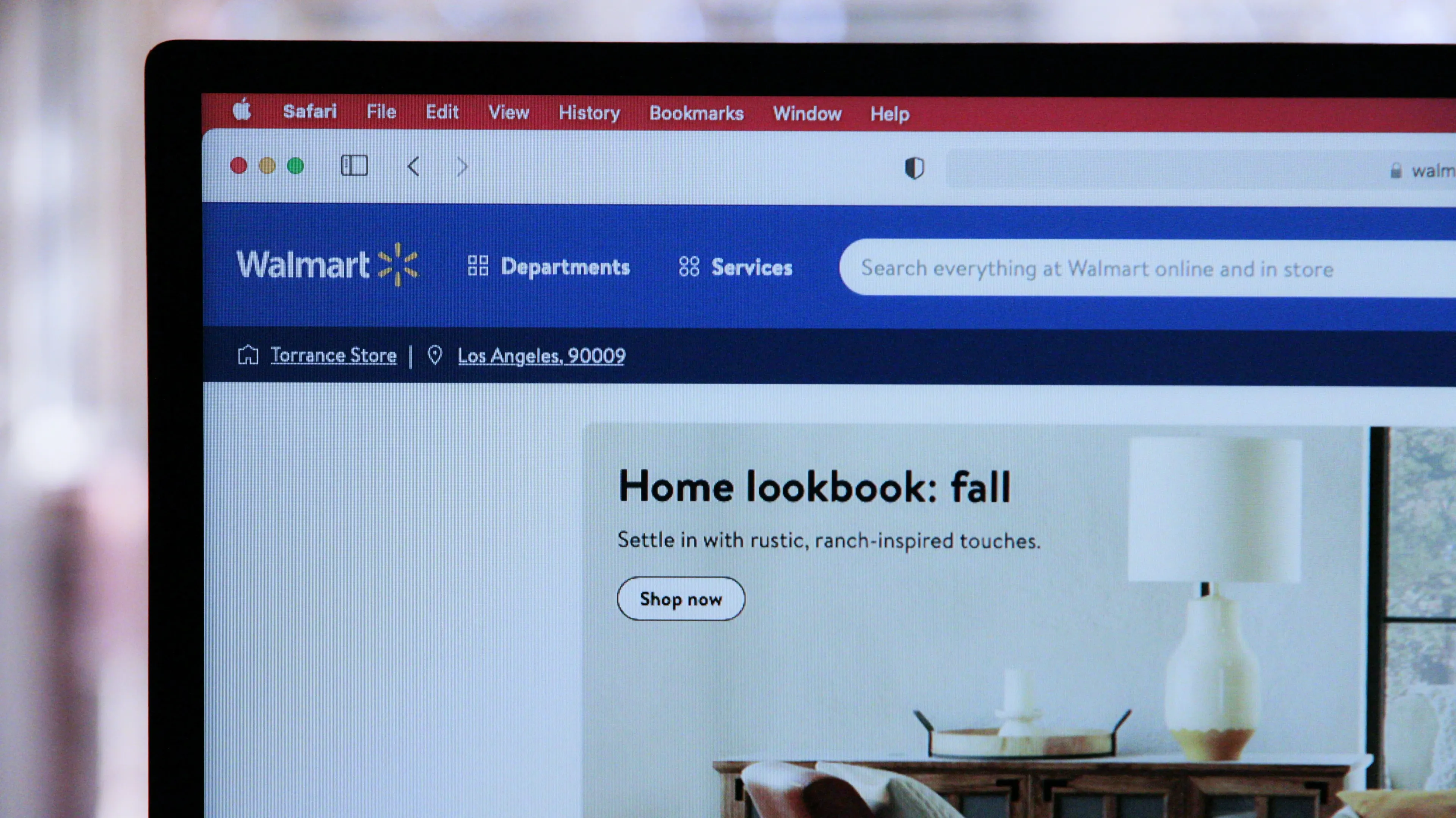
Walmart has benefited from two trends at once: consumers are trying to save money and looking for good deals in stores, while investors are seeking safe-haven stocks amid waning interest in AI. Photo: Marques Thomas / Unsplash.com
For the market, Walmart stock has become both a safe-haven asset and a tool for gauging the likelihood of an impending recession. Investor Jim Paulsen, who uses the stock price movements of the largest U.S. retailer as an indicator of an impending crisis, has spotted some warning signs. Walmart’s own earnings report, released on November 19, shows that Americans continue to spend, but are increasingly looking for bargains and choosing cheaper goods.
Consumers are spending money…
Walmart, the largest U.S. retailer, reported better-than-expected results for the third quarter of fiscal year 2027, which ended in October. According to the company’s report, published on Thursday, November 19, its total revenue rose 5.2% to $188.8 billion. Comparable sales in the U.S., including brick-and-mortar supermarkets and online channels, rose 2.9%, slightly exceeding the forecasts of analysts surveyed by Bloomberg, while growth in the previous quarter was the lowest in six years at 2.6%.
The company also raised its forecast for the current fiscal year, which ends on January 31: net sales are expected to grow by 4.9% to 5.2%, and operating profit by 8% to 8.6% (the August forecast was 4–5% and 7–8.5%, respectively).
Walmart shares closed down 1% for the day, while the S&P 500 index fell 2%.
Walmart’s figures add to a string of solid sales results reported by other retail chains over the past few days, notes The Wall Street Journal: This suggests that American consumers continue to spend money despite high inflation, sharply rising fuel prices, and complaints about financial difficulties. Target’s comparable sales rose 5.6% in the last quarter, TJX’s (owner of the TJ Maxx chain, among others) rose 4%, and home improvement retailers Home Depot and Lowe’s saw increases of 2.2% and 1.8%, respectively, despite a sluggish housing market.
"Customers are telling us that they continue to face challenges, likely due primarily to fuel prices. But the fact remains: [their] expenses remain significant," said Walmart CFO John David Rainey.
…but more and more people are saving money
Analysts point out that beneath the surface stability lie trends that are not particularly favorable for the consumer sector, which accounts for two-thirds of U.S. GDP.
But these trends could benefit Walmart and investors in its stock.
Consumers, while continuing to spend money, are increasingly turning to more affordable products, the Bank of America Institute noted in its November report. According to BofA data on spending from checking accounts, credit cards, and debit cards, the share of such shoppers has reached its highest level since 2021.
This trend is particularly noticeable in the apparel and food service sectors. In the travel sector, some households are giving up on trips altogether rather than switching to cheaper options.
Month-over-month retail sales growth in October was just 0.2%, according to the U.S. Department of Commerce; in September, the figure was 0.8%.
In recent years, the U.S. economy has followed a K-shaped trajectory. Its growth has been driven, in part, by spending from affluent consumers, who have grown increasingly wealthy thanks to the boom in the capital markets. Meanwhile, the poor and those living on wages—whose earnings are failing to keep pace with inflation—are having to scrimp and save more and more.
Lately, even the upper part of the “K” has begun to look “somewhat sagging,” although evidence of this has so far come mainly from the private sector and is not reflected in statistics such as the unemployment rate, the WSJ notes. Even parts of the middle class are having to cut back on spending or switch to cheaper goods and services.
People with low incomes always suffer the most and are the first to be affected, but now the negative effects seem to be “spreading to wealthier segments of the population than in the past,” Jim Paulsen, who has been an investor for over 40 years and has observed numerous economic cycles, told the newspaper.
In his investment newsletter, he publishes an early warning indicator he calls the “Walmart Recession Signal” (WRS). Over time, the investor has refined this indicator. Previously, it was calculated as the ratio of Walmart’s stock price performance to a basket of retail stocks (the S&P 500 Retail Stock Price Index), but since 2025, it has been calculated relative to a basket of luxury sector stocks (the S&P Global Luxury Index).
As economic activity slows and the risk of a recession rises, consumer preferences in the retail sector typically shift toward discounters such as Walmart, at the expense of general merchandise retailers or luxury brand retailers. Accordingly, an increase in the WRS can serve as a signal of a possible recession or, at the very least, a significant slowdown in economic growth.

This year, the WRS has exceeded the level reached during the brief recession of 2020—amid the COVID-19 pandemic—by more than one and a half times, and has nearly reached the peak levels seen during the 2008–2009 crisis. It then corrected, but has resumed its upward trend in recent months.
Walmart reported that it increased its market share in the grocery sector last quarter. This is due to lower prices, “which remain Walmart’s main weapon in its arsenal,” according to a report by Neil Saunders, managing director of GlobalData, as quoted by Bloomberg.
"Even some members of the middle and upper-middle classes have 'recently been behaving like low-income shoppers,'" Chuck Grom, an analyst at Gordon Haskett, told the WSJ. He pointed to the rise in the number of shoppers at Dollar General stores, which cater to customers with even lower incomes than Walmart. Dollar General’s small store format and convenient locations attract people who are trying to drive less to large shopping centers.
Factors like these are still far from indicating a recession, but the strength of the consumer sector and the economy largely depends on the well-being of the middle class, which for many is underpinned by rising real estate prices and much more significant growth in investment portfolios, Grom notes.
Walmart Is in a Strong Position
In recent months, investors concerned about the outlook for AI-related technology companies have begun selling off such stocks and investing in safe-haven assets.
Retailers have traditionally been like this, and Walmart is at the forefront here.
Its stock has risen 22% since early October, when tech stock indices began a significant decline. The Nasdaq Composite and the S&P 500 have fallen more than 8% from their October 6 peak, while the Nasdaq-100 index of the largest tech companies has dropped nearly 15%.
“As 2026 draws to a close, the AI sector—which has been the main driver of the U.S. stock market’s exceptional growth over the past four years—is facing the most serious challenge in its history,” — says Venu Krishna, director of U.S. equity strategy at Barclays (asquoted by the Financial Times).
According to him, financing for AI-related companies has become “more complex, more reliant on debt, and more sensitive to market fluctuations.”
“The technology sector has lost its appeal,” agrees Guy Miller, chief market strategist at Zurich. “Investors are seeking to diversify their portfolios, and this is driving a shift in funds toward companies associated with essential goods and other market segments.”
In October, the MSCI Global Consumer Staples Index, which tracks the performance of consumer staples stocks, rose 10.6%. This marks a record high since 1998. Meanwhile, the healthcare sector index gained 9.8%. This was the second-highest gain of the current century, surpassed only by the surge in the index during the COVID-19 pandemic.
Pictet Asset Management is shifting its focus toward more defensive investments and “less cyclical” sectors due to concerns about funding challenges for AI and rising interest rates aimed at combating inflation, the company’s chief strategist, Luca Paolini, told the FT.
The trend of investors shifting away from AI toward more stable sectors appears to be far from over, given the plans by Democrats who won seats in Congress to restrict the construction of data centers and the fallout from the scandal surrounding Nvidia, the WSJ notes.
As a result, Walmart can “make lemonade out of lemons,” the newspaper concludes . On the one hand, consumers are trying to save money and are looking for good deals in stores; on the other hand, investors’ interest in AI is cooling off. All of this works in Walmart’s favor.
This article was AI-translated and verified by a human editor