10 robotics stocks with big returns so far in 2026


Canada's MDA Space participates in the development of the next-generation lunar rover together with Lockheed Martin and General Motors / Photo: X / MDA Space
The robotics market is expanding at an accelerated pace and has the potential for multiple-fold growth in the coming decades, Morgan Stanley noted in its "Robot Almanac" report published at the end of 2025. The bank’s strategists estimate that the industry’s total addressable market could reach $500 billion by 2030. By 2040, it could amount to about $9 trillion, and by 2050 to $25 trillion, and that covers only the segment of robotics device sales.
According to Morgan Stanley, the number of robots in operation will increase to 6.5 billion by 2050 versus roughly 340 million in 2030. This implies not just quantitative growth but a deep transformation of entire industries, from manufacturing to services and logistics. Analysts also single out China as a key beneficiary of this trend: robotics and “physical AI” are already strategic priorities for Beijing, and the technological gap with other countries continues to widen.
Robotics stocks performance in 2025
Analyst Aldiyar Anuarbekov has put together a robotics stock index specially for Oninvest, the equal-weight version of which gained 27.6% in 2025, while its cap-weight version surged 149%. The index includes 52 small caps from the robotics industry. For comparison, the S&P 500 rose 16.4% last year, while the Russell 2000 gained 11.3%.
The divergence between the two indexes reflects a high concentration of gains in a narrow group of leaders. Only about half of the companies in the robotics index ended the year in positive territory, but they accounted for the bulk of overall performance.
Sizing up the opportunity
The rapid rise in robotics stocks in 2025 and early 2026 has significantly increased valuations, although as of end-March, the market had partially corrected amid a broader decline in risk appetite. According to our calculations, the average price-to-earnings ratio for the equal-weight index stands at around 21.5 – meaning the market is, on average, valuing companies in the sector at nearly 21 years of earnings. This is comparable to multiples of the largest IT companies and directly reflects high expectations already priced in. At the same time, many small caps in the robotics sector remain at an early stage of development, meaning such valuations require a cautious approach and imply elevated risks if growth slows.
The industry still faces bottlenecks: shortages of rare earth metals – largely controlled by China – limited production capacity, a lack of high-quality training data for complex AI models (particularly in humanoid robotics), as well as issues related to safety, regulation, and public acceptance of new technologies.
Investors should look not only at end manufacturers of robots but also at the supply chain. A potential robotics boom is driving demand for components: motors, drives, bearings, sensors, optics, cameras, AI compute modules, and batteries. These segments could become “quiet beneficiaries” of the growth.
Market leaders in 2026 and picks
In 2026, the robotics sector continues to outperform the broader market. As of end-March, the cap-weight index had gained 8.6% year to date, while the equal-weight index has declined 2.3%. The former had risen as much as 60% year to date before the onset of the conflict in Iran. For comparison, the S&P 500 has declined 7.1% year to date, while the Russell 2000 is down 3.7%.
Investors are gravitating toward companies that have already demonstrated the ability to scale their businesses. Interest in component suppliers also remains strong – including IPG Photonics and Cognex – as well as developers of specialized autonomous systems, including Exail Technologies and Rainbow Robotics.
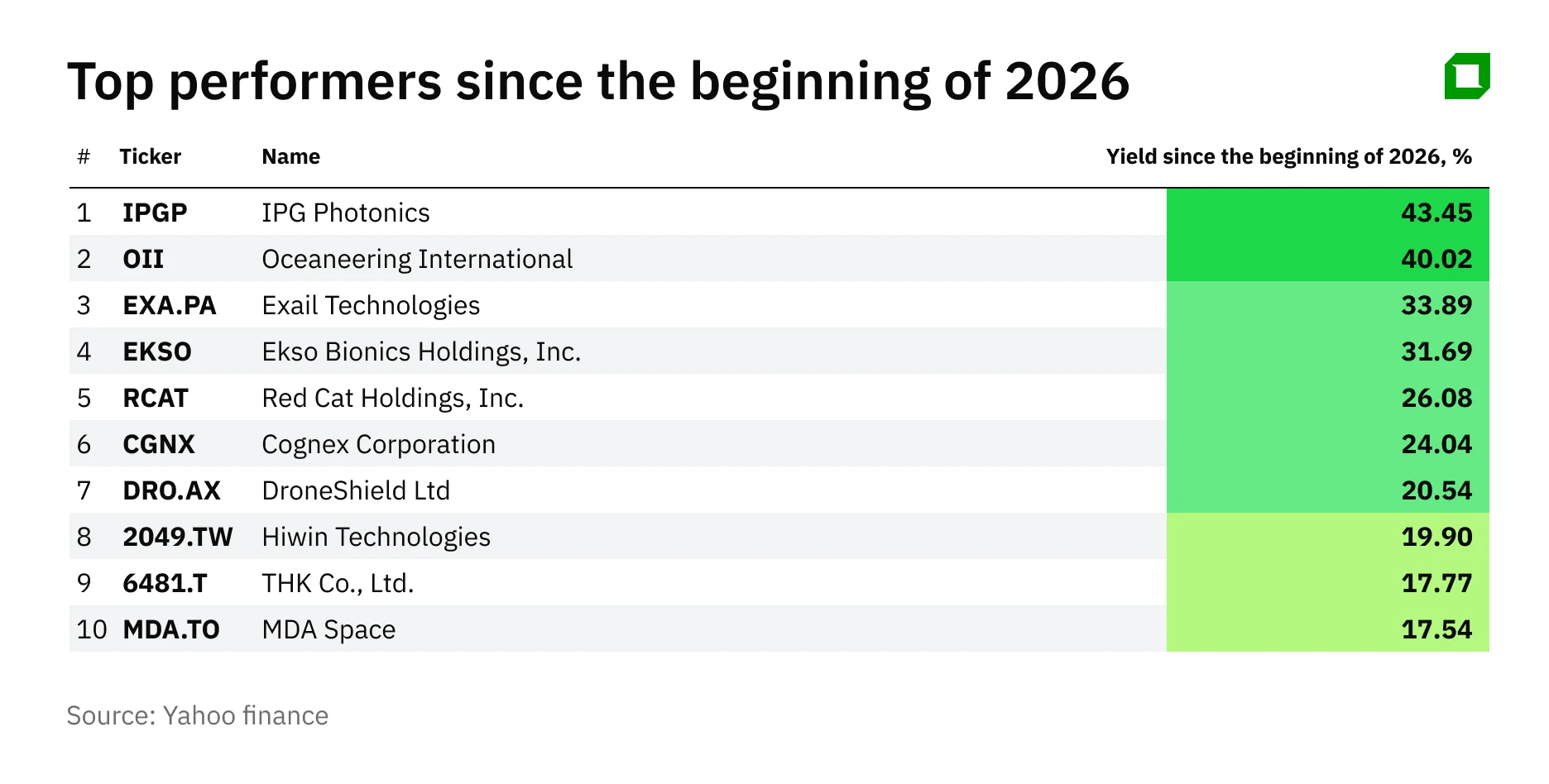
The sector remains highly differentiated, with a wide dispersion of performance across companies, increasing risks for investors. At the same time, the overall trend remains structurally positive – investment in “physical AI,” including robotics, continues to accelerate and attract growing attention from both strategic players and financial investors.
Below we offer three stocks from the index that investors should watch.
Exail Technologies
French high-tech group Exail Technologies, which specializes in maritime robotics and inertial navigation, has been one of the standout beneficiaries of the sector rally. By the end of 2025, its market capitalization had increased more than fivefold.
The sharp rise in the stock was supported by strong operating performance: in 2025, the company’s revenue grew 28% year over year to over EUR479 million, while order intake rose 87% to EUR844 million.
Analysts at Kepler Cheuvreux, in a report dated February 18, 2026, reiterated a “buy” rating on the stock, citing strong competitive advantages and robust demand for Exail’s solutions. The stock has six “buy” ratings and two “hold,” according to Market Screener data. The average target price is $155 per share, implying 30% upside to the Tuesday closing price.
MDA Space
Canada’s MDA Space is a manufacturer of satellite systems and space robotics. The company is benefiting from several key trends: an increasing share of local contractors in defense procurement, rising Canadian defense spending, and the rapid development of commercial space programs, where MDA acts as a contractor.
Financial performance also remains strong. In the third quarter, revenue grew 45% year over year to CAD409.8 million ($296.2 million), while the order backlog increased to CAD4.4 billion ($3.2 billion). Net income rose 33% to CAD46 million.
According to Morgan Stanley, rising defense spending and the convergence of space and military technologies are creating a sustainable long-term growth driver for MDA Space. The stock has eight “buy” ratings, according to MarketWatch data. The average target price is $53.60 per share, implying the stock could more than double from its current level on the New York Stock Exchange.
Ekso Bionics
U.S.-based Ekso Bionics develops exoskeletons for medical and industrial use. In December, the company secured exclusive distribution rights in the U.S. for the BalanceTutor rehabilitation system and is simultaneously exploring strategic options, including a potential deal with Applied Digital to develop the ChronoScale GPU platform, as well as the possible sale of part of its exoskeleton business.
In the third quarter, revenue grew 2% year over year to $4.2 million, while the net loss narrowed 31% year over year to about $1.4 million. In January, the company raised an additional $5.9 million, strengthening liquidity and providing additional resources for business development.
At the same time, analysts at SADIF Investment Analytics assess Ekso Bionics’ financial profile as carrying elevated operating risks, meaning investment in the stock requires a cautious approach and position sizing discipline. According to MarketWatch data, the company has one “hold” rating, with a target price of $90 per share. This implies the stock could rise nearly ninefold from its current level.
This material does not constitute individualized investment advice.