Betting on the hype: can the mania around Swatch become an investment strategy

The sale of the Royal Pop watch, produced by Swatch and Audemars Piguet, has provoked chaos due to the decision to sell the novelty strictly offline. Thousands of shoppers brawled and mobbed boutiques in Paris, London and New York. Police fired tear gas, and stores were shut down in an emergency. Galina Kravchenko-Manyukova, FOUNDER&CEO of K&PA agency, an expert in fashion and luxury management, believes that this collaboration is one of the most revealing cases of 2026 not only for the watch market, but also for the entire fashion and luxury industry. What should investors do in this situation?
Royal Pop is no longer just a watch. It is an example of how brands sell scarcity, emotion and participation in a cultural event. This is why Royal Pop watches have been surrounded by queues, fights, resales and excitement at the level of sneaker drops or Labubu.
But for an investor, another question is more important here: is this HYIP able to help fix Swatch Group's financial performance or are we witnessing another short Ma that will end faster than the first print run is sold out?
Product uniqueness
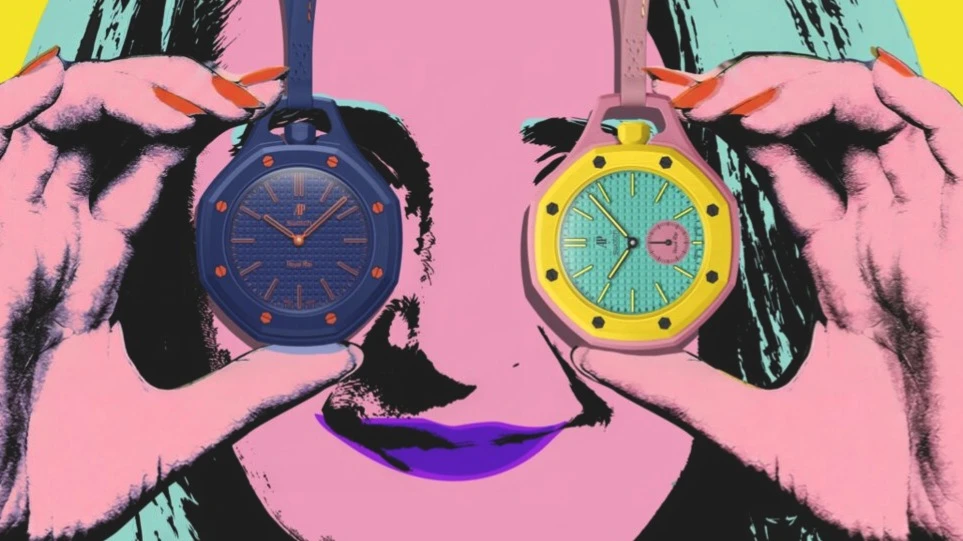
The product itself looks very unusual for the luxury market. Instead of the expected more affordable Royal Oak version (the legendary luxury watch collection by Audemars Piguet priced from $20,000 for the basic models), the companies released a series of bright pocket watches in the aesthetics of Pop Art and the iconic Swatch POP line of the 1980s for $400-420.
The case is made of bioceramic, Swatch's signature material. Instead of a classic bracelet there is a leather cord, thanks to which the watch can be worn around the neck as a pendant, attached to a bag as a pendant or key chain, used as an accessory or even as a table clock. In terms of fashion trends, the relevance of the model is at its peak!
The collection consists of eight models in rich colors: blue, green, orange, pink, black and white. Visually, they are immediately read as Royal Oak: octagonal bezel, decorative screws, the signature Petite Tapisserie pattern on the dial. But at the same time, everything is deliberately "non-luxurious" - bright, ironic and even a bit toy-like.
And this is a very important point. Royal Pop is not about watchmaking as such. Swatch has very accurately grasped the main trend of recent years: people buy not just the item, but the opportunity to become part of a "viral" story.
The MoonSwatch collection in 2022 already showed the power of these mechanics. Back then, Swatch effectively democratized the iconic Omega Speedmaster mechanical sports chronograph model. Most buyers will never be able to afford a real Omega, but are willing to buy the "Omega feeling" for $300.
The logic is similar with the Royal Pop. Audemars Piguet is one of the most closed and prestigious Swiss watch brands in the world, founded in 1875. The company is known for its complex movements, limited editions and extremely high level of handcraftsmanship. The idea of getting a "slice of AP" for relatively affordable money automatically creates a huge demand.
How the market reacts
The launch caused a global excitement: queues, temporary store closures, conflicts of buyers in Milan, New York, Dubai, Paris and other cities. The price of watches - about $ 400-420, while on the secondary market individual offers and complete sets quickly began to sell with a large markup. Reuters writes that complete sets of eight watch models went for as much as $25,000 on the online platform StockX. Swatch shares rose nearly 18% in the week after the first hints of a partnership, but have fallen more than 7% since peaking on Ma. 8 after the market realized it was only talking about the pocket watch format - without releasing a wristwatch.
Times of limited growth
Royal Pop is not just a collaboration. It is an attempt by Swatch Group to solve several tasks at once: to quickly return attention to the brand and the group as a whole, to rejuvenate the audience, to increase traffic in stores and to support sales at a time when the classic watch market is going through a very difficult period. However, it is too early to be sure of sustainable growth.
The Swatch Group's financial performance is now in far from good shape. By the end of 2025, the group's net profit has fallen by almost 90%, the operating margin has dropped to 2.1%, and the key market of China has ceased to be a growth driver. For the luxury industry as a whole, these are times of limited growth in financial performance.
The Swatch Group is one of the largest watch conglomerates in the world, owning a pool of 16 watch brands in various price ranges - from High Luxury fine watchmaking to Mass Market. According to Morgan Stanley estimates, in 2025 the top 6 brands of the group by revenue were: Omega, Longines, Tissot, Swatch, Blancpain, Rado. Swatch Group is unique in its vertical integration: the company not only assembles watches, but also independently produces movements (ETA), batteries, cases, dials and hands. This allows it to control quality and cost at all stages of production.
What should an investor pay attention to?
Today, the luxury market is increasingly living according to the laws of drop collections, artificial scarcity and social networks. The queue to the boutique itself becomes a marketing tool that further fuels the frenzy. But here comes the main risk for the investor.
The problem with collaborations is that they work great as a short-term attention driver, but much worse as a long-term business strategy. We have seen similar stories with their ups and downs before:
Labubu from the Chinese company Pop Mart turned into a global mania: toys were resold for many times the price, people stood in queues, and social networks were filled with unboxing videos. But as soon as the hype starts to subside, the market quickly asks the question: what's left after the hype? Pop Mart surged on the Labubu wave, but then the market began to question the sustainability of that demand. In March 2026, Pop Mart shares fell more than 20% after reporting despite strong annual results: investors became cautious about future growth.
Adidas' collaboration with Yeezy (the clothing and footwear brand of American rapper Kanye West) has long been a full-fledged growth driver for Adidas. After breaking up with Ye, Adidas wrote off €500 million of unsold Yeezy inventory in 2023. This is a good example of how dangerous a business's reliance on one kind of collaboration can become.
Swatch is making a very clear bet: to turn an elitist watch model into a pop culture object at an understandable price. Short-term, this could actually support the company's stock. The market loves stories about excitement, queues and viral demand. In addition, such projects give a quick cachet, increase sell-through and help sell other models.
But over the long term, the hype alone is not enough. For the Swatch Group's share price to grow sustainably, structural problems must be addressed: dependence on the Chinese market, declining profitability, currency pressure and complex production economics.
That's why I would separate the prospects of investing in the product itself and investing in the company's stock.
Buying Royal Pop as a speculative object in the first weeks after the release may be justified - on the wave of scarcity and excitement. But buying Swatch shares just because there were queues outside the stores is a much riskier strategy.
Is it worth buying shares
Arguments FOR.
The effect of collaborations: MoonSwatch (with Omega) sold about 2 million copies. "Royal Pop" could be just as viral.
Management forecast: The company expects "significant growth" in 2026 due to capacity utilization and a return to profitability. Q4 2025 sales were up 7.2%.
Strong balance sheet: the group has low debt, high liquidity (1.2 billion francs) and an equity of 87%.
PROTECT arguments (Risks):
The company's profitability is extremely low: A net profit of €25 million is paltry for such a corporation.
Dependence on China: Management recognizes that the sales situation there will not improve dramatically. Growth of 2-4% instead of the previous 20%.
Currency factor: The Swiss franc has strengthened extremely, making production within Switzerland incredibly expensive. The group's core philosophy is "Swiss Made". The 150 factories inside Switzerland remain the heart of the business.
Negative performance of Omega's main brand: The Swatch Group's main brand is estimated by Morgan Stanley to have seen an 8% decline in sales to rank fifth in 2025, behind Rolex and Cartier.
The short-term hype around Swatch's more mainstream watch brand product will help patch up operational problems, but may not be the foundation that fixes the group as a whole.
The key question for the investor is: Is Swatch capable of turning one brand's one-off cultural explosion into long-term demand? What else will other brands do to restore sales and financial performance? Because the hype almost always ends. And a sustainable business is not built on queues, but on margins, demand, and the company's ability to re-strategize the brand pool for long-term growth.
This article was AI-translated and verified by a human editor