"Catastrophic Vulnerability": What Risk Did Burry Find in Anthropic's IPO Prospectus?

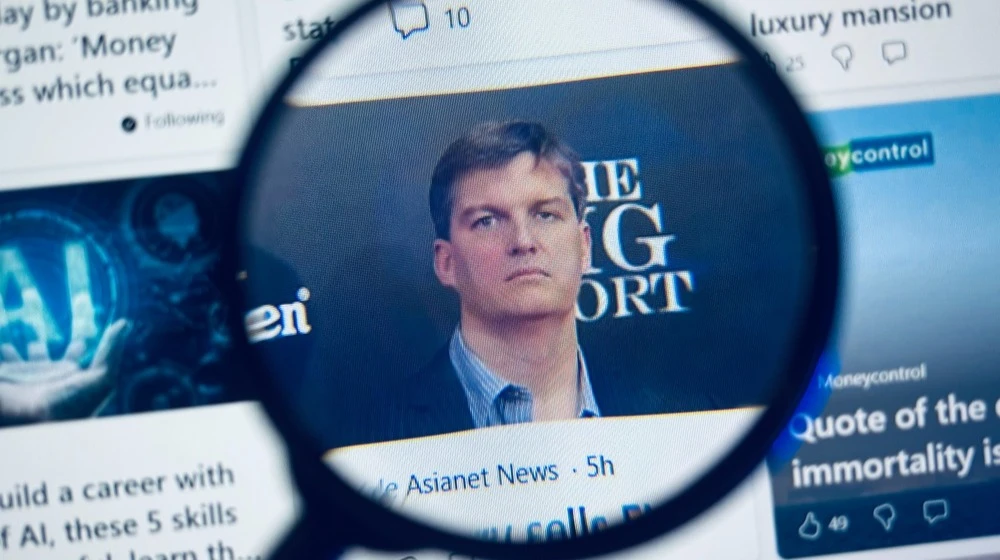
Anthropic's complex relationships with power suppliers make the entire system vulnerable to even the slightest market shift, warns Burry / Photo: favoritesphoto / Shutterstock.com
The closed-loop mutual funding system, which Anthropic detailed in its IPO prospectus, may be effective given the current growth of the artificial intelligence market, but it increases vulnerability should that growth come to a halt, warns investor Michael Burry, known as the real-life inspiration for the character in “The Big Short.” In his blog, Cassandra Unchained, he calls this a risk that affects not only Anthropic itself but extends much further. Burry compares the startup’s relationships with suppliers to the schemes of the late 1990s, when the expansion of the internet and the construction of telecommunications infrastructure were financed by equipment manufacturers.
"With every new technological revolution, people repeat the same mistakes."
Take it or pay for it
For Burry, the most important aspect of Anthropic’s more than 300-page IPO prospectus was the disclosure of information regarding the company’s financial burden. According to the document, the total value of agreements for the purchase of computing power and equipment leases amounts to $537 billion. Taking into account the deal with Google—which has not yet been finalized—and separate agreements with SpaceXAI, the total could increase by nearly $270 billion.
If that happens, liabilities will exceed revenue for the past 12 months by more than 20 times, and revenue on an annual run-rate basis by approximately 12 times, the investor writes.
At the same time, Anthropic’s revenue growth is slowing, Burry notes. While revenue grew by 132–144% quarter-over-quarter in the first and second quarters, growth slowed to 45% ($16.8–16.9 billion) in the third quarter—as reported by Bloomberg and the Financial Times, Anthropic informed investors shortly before the prospectus was published. In August and September, according to Burry’s calculations based on data from the consulting firms Syz and SemiAnalysis, revenue grew by 3–7% per month.
At the same time, Anthropic’s infrastructure expenses are growing faster than its revenue: in the third quarter, they rose by 78%—from $5.6 billion to $9.9 billion, according to Burry’s calculations based on data from the prospectus.
In such a situation, it might be possible to reduce capacity purchases, but that’s not an option for Anthropic—the company’s contracts with hyperscalers are on “take-or-pay” terms, Burry points out. This means that Anthropic is obligated to pay for the agreed-upon amounts of computing capacity regardless of actual usage, and if consumption falls short of the plan, it must make up the difference in cash. The take-or-pay principle was included in the contracts because Anthropic requested more capacity from suppliers than they were willing to provide. According to the prospectus, the agreement with Microsoft binds the company to these obligations through May 2033, with Google through July of that year, and with Amazon through April 2036.
Chained Together
The situation is complicated by a circular financing model in which major technology companies serve as Anthropic’s sources of funding, providers of computing power, and sales channels all at once.
The most striking example is Anthropic’s relationship with Amazon and Google. Together, the hyperscalers have invested approximately $41 billion in the AI developer and, at the same time, have signed contracts with it for computing power worth $110 billion and $114.5 billion, respectively. These same companies sell Claude to customers on their cloud marketplaces, charging Anthropic a commission. As a result, the hyperscalers account for nearly half of Anthropic’s revenue (48% in the first half of the year) and also represent 58% of its accounts receivable, writes Burry.
“Just remember: this whole scheme is so complicated simply because the industry requires too much borrowed capital, and that capital needs to be removed from the balance sheets of the direct participants. When the ‘bulls’ go to great lengths to prove that this time is different thanks to the cash flows of hyperscalers, don’t forget: that cash flow is nowhere near enough. And the Byzantine complexity of this deal—as well as all of Anthropic’s relationships with its partners—confirms this.”
Anthropic has complex relationships not only with hyperscalers—for example, Broadcom leases equipment with TPU processors to the startup and brings in third-party investors to finance it. In exchange, they receive rights to a portion of Anthropic’s future lease payments. Smaller suppliers, including Lambda and Nscale, also use their contracts with Anthropic to secure bank loans for purchasing equipment.
Anthropic states in its prospectus that a breach of certain commercial agreements could trigger a cross-default under the credit agreement and certain convertible loans, according to Burry. In that case, creditors would be able to demand early repayment of virtually all of Anthropic’s debt.
“This is precisely where the risk lies. Some may view this entire closed system of interconnections and interdependencies as a guarantee of stability during the growth phase, and to some extent that is indeed true. However, such a structure makes the entire system catastrophically vulnerable at the slightest slowdown in growth or a market downturn,” concluded Burry.
This article was AI-translated and verified by a human editor