Emerging markets are investors' favorites this year. Trump is contributing to that

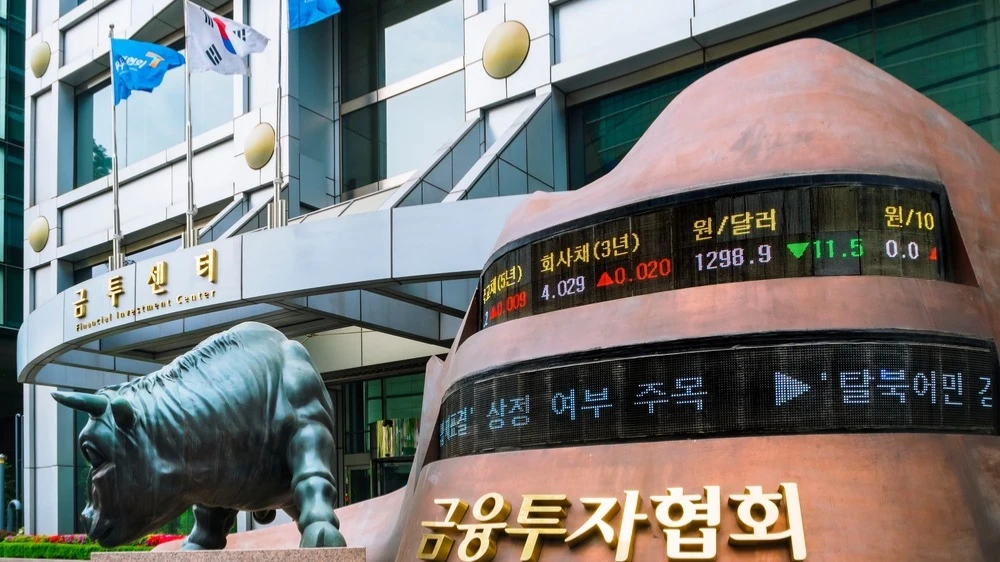
Emerging markets are growing stronger than developed markets this year. South Korea is one of Goldman Sachs' favorite markets / Photo: VTT Studio/Shutterstock.com
The U.S. Supreme Court's ruling that most of the import duties imposed by U.S. President Donald Trump are illegal and his response - imposing an additional global levy of 15% - is playing into the hands of emerging markets. They have been on the periphery of international investors' attention for many years, but now their indices are strongly outperforming developed markets.
Who's gonna get in the way?
Inflows into emerging market equity funds totaled $24.9 billion in January, which boosted the MSCI Emerging Market Index by 8.8%, its best January since 2012, Bloomberg notes.
The largest exchange-traded fund, iShares Core MSCI Emerging Markets, with $139 billion in assets from BlackRock, attracted $8.9 billion, a record since its inception that same year, 2012. Previous performance hasn't even come close to that amount, with three monthly peak inflows of $4.6 billion in 2025, $4.2 billion in 2019 and $3.6 billion in 2023.
In February, MSCI Emerging Markets continued to grow. Since the beginning of the year, it has already grown by 13.6%. By comparison, the US S&P 500 and pan-European Stoxx 600 rose by 0.94% and 5.8% respectively.
On Friday, February 20, emerging markets were supported by the U.S. Supreme Court's ruling that found more than half of the import duties already imposed by Donald Trump illegal. Although the US president immediately announced first new 10 percent and then 15 percent levies, the situation is generally positive for emerging markets. It "underscores the uncertainty of U.S. policy" and gives an additional "boost to the diversification theme," says Alvaro Vivanco, emerging markets macro strategist at Wells Fargo.
The diversification of international funds that began last year with the U.S. exit is one important positive for emerging markets and should ensure continued inflows and quote gains this year, Ulrike Hoffmann-Burchardi, chief investment officer for the Americas and global director of equities at UBS Global Wealth Management, told Bloomberg.
Many clients have excess free funds in their portfolios, and with inflation continuing to rise, it is very costly not to invest. Our main advice to clients is to enter market areas that allow for further diversification of the portfolio and can bring higher returns.
Such investor action has allowed the MSCI Emerging Markets to soar 39% over the past 12 months, while the S&P 500 and Stoxx 600 are up only 12.95% and 13.9%, respectively.
Emerging economies boast strong fundamentals. They are growing faster than developed economies, have prudent monetary and debt policies, and some of their leaders are acting more responsibly than the current U.S. leadership, says Alessandra Alecci, manager of the Emerging Markets Bond Fund at Carmignac.
In addition, she points out, many developing countries are mining metals, which play a key role in the AI revolution and the green transition. Added to this is a weakening dollar, making investing in assets in other currencies more attractive. "Put together the capital inflows coming back for diversification purposes with very strong fundamentals - who would want to get in the way [of the growth generated by these factors]?" says Alecci.
Emerging markets have been an unpopular asset class for so long that even the record capital inflows since the start of the year are just a bid to catch up with the train leaving on a diversification path that will help markets from Asia to Latin America, says Alejo Chervonko, chief investment officer for emerging markets in the Americas at UBS Global Wealth Management. "Seeing what's happening, a lot of people are asking the question, 'Do I have enough geographic diversification?"' - he notes. - And the answer for many is, 'Not yet.'"
Asia and Latin America: big themes
The Asian market began to pull away from the U.S. and European markets around the middle of last year. Over the past 12 months, the MSCI Asia Pacific index has gained 36.8%, including a 12% gain since the beginning of this year.
"The weakening dollar is both a cause and a symptom of the accelerated Asian market rally," said Kyle Rodda, senior financial markets analyst at Capital.com(quoted by Bloomberg). - "The dollar would be higher were it not for the political risk premium due to 'sell America' operations."
But Asian markets also have their own strengths. The region's leading technology companies are becoming indispensable in the supply chain associated with AI development. Investors are attracted by the stable economic situation: according to the IMF forecast, this year (as well as last year ) Asia will provide about 60% of global GDP growth.
Many countries in the region are undertaking corporate reforms designed to protect shareholder rights and increase shareholder returns. South Korea (MSCI holds it in its emerging market indices) and Japan are at the forefront of this movement. The latter's market is also optimistic after Prime Minister Sanae Takaichi's party achieved its biggest election victory in the post-war period.
"Asia is at the crossroads of three big themes," Aidan Yao, senior Asia investment strategist at Amundi Investment Institute, told Bloomberg. - The first is AI, the second is corporate reforms in many markets, and the third is improving fundamentals."
Asia is becoming increasingly popular with investors as the global technology race spreads from AI pioneers to those driving large-scale adoption. Regional companies - Korean, Taiwanese, as well as Japanese - control critical areas, supplying most of the equipment for AI development.
Timothy Ma, chief Asia-Pacific equity strategist at Goldman Sachs, called South Korea one of the bank's favorite markets.
Latin America is trying to keep up with Asia, with the MSCI EM Latin America index soaring to an 11-year high of more than 20% YTD, its best start to a year since 1991.
Such attention to the region has not been observed for 10-15 years, said Bloomberg Chervonko from UBS Global Wealth Management. Emerging markets have generally been a small part of international investors' portfolios, but this is especially true for Latin America, and now funds are rushing to catch up, he explained.
Moreover, foreigners are more active than local investors, who fear political instability and market reversal as a result of elections, if the results are disappointing. This year's presidential elections are to be held in Brazil and Colombia.
However, political uncertainty in the same US, especially after the Supreme Court's decision on duties, will continue to provoke a weaker dollar and a flow of funds into Latin American assets, says Malcolm Dorson, senior portfolio manager at GlobalX Management.
"Whether it is the expected interest rate cuts in a number of countries, favorable political developments or favorable commodity markets, we remain positive on the region," says Ola El-Shawarbi, VanEck portfolio managers.
This article was AI-translated and verified by a human editor