Iran has set up a shadowy crossing point for ships through the Strait of Hormuz and is forcing payment
The fee is as high as $2 million, Iranian parliament says

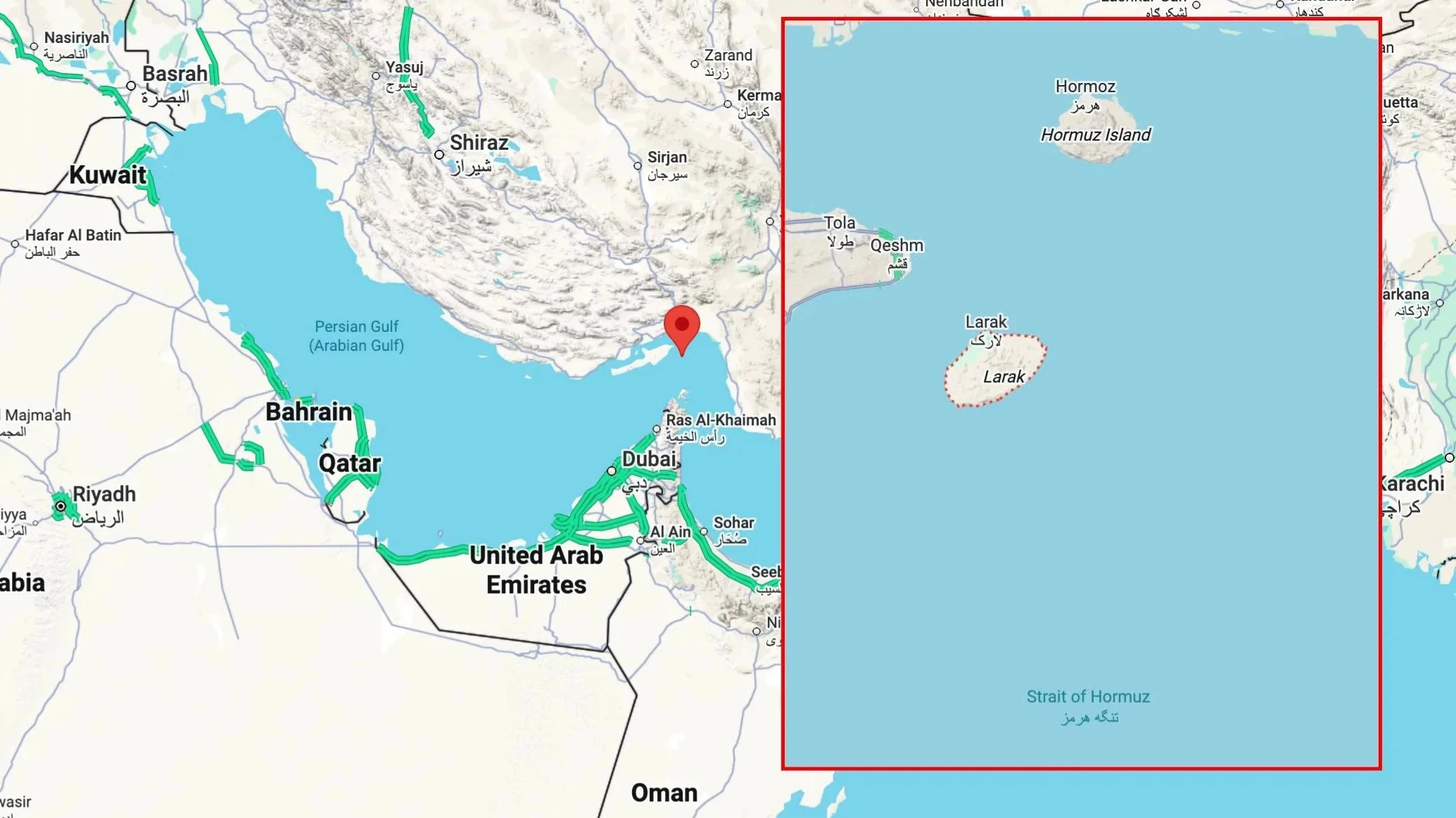
All ships wishing to leave the Persian Gulf now follow an IRGC-controlled corridor through Iranian territorial waters north of Larak Island / Photo: Google Maps
By blocking the Strait of Hormuz, Iran has tacitly organized a toll-free exit from the Persian Gulf for commercial ships through its territorial waters, CNBC has pointed out. Monetizing control over the world's most important oil artery allows Tehran to offset the costs of the war.
Details
On March 31, the Iranian parliamentary committee on national security and foreign policy approved a bill that would charge a fee for ships passing through the Strait of Hormuz, the world's largest energy transit route, the Korean newspaper The Chosun Daily reported, citing Iranian state media. The document has not yet become a law: for that it must pass a vote in parliament, be vetted by the Council of Guardians of the Constitution and receive the signature of the country's president, the newspaper said.
However, the established practice of ships passing through the strait indicates that an informal payment point already exists there, one of the oldest industry publications Lloyd's List wrote in late March. The entire fleet now follows the Islamic Revolutionary Guard Corps (IRGC)-controlled corridor exclusively through Iranian territorial waters north of Larak Island, and transit fees are paid in yuan, Lloyd's List wrote.
The local administration is prioritizing bulk carriers carrying agro-products for Iran, as well as tankers carrying export oil and liquefied gas, maritime analytics provider Windward said in its latest weekly review on March 30. The capacity of that system began to expand last week, from five to seven to about 12 ships per day. "At the same time, there was a build-up of vessels waiting for authorization north of Larak Island, confirming once again: transit is under active control, not recovering," Windward noted.
Iran has begun charging $2 million each to some merchant ships for passing through the Strait of Hormuz, Alaeddin Boroujerdi, a member of Iran's parliamentary committee on national security, said in late March. He said the authorities have already put the measure into practice after decades of free transit. The parliamentarian attributed the introduction of the fees to the costs of war. "War requires expenses, so we are forced to take transit fees from passing ships," the MP was quoted as saying by Iran International TV channel, which is in opposition to the Iranian government.
Does Iran have the right to charge a fee?
Article 19 of the UN Convention on the Law of the Sea states that states are obliged to allow "innocent passage" of civilian vessels in their territorial waters. The Secretary General of the Cooperation Council for the Arab States of the Persian Gulf, Jassem Mohamed al-Budaywi, regarded Iran's charging as "aggression and a violation of the UN agreement on the Law of the Sea," according to the Associated Press.
The head of the United Arab Emirates' largest oil company, Abu Dhabi National Oil, Sultan al-Jaber, called the Iranian authorities' actions "economic terrorism." "When Iran holds Hormuz hostage, everyone pays a ransom - at the gas station, the grocery store and the pharmacy," al-Jaber said at an event in Washington. The UAE is the first Gulf country preparing to help the United States forcefully unblock the Strait of Hormuz, The Wall Street Journal has learned.
On April 1, it became known that the UAE asked the UN to authorize a number of measures, including the use of force, to reopen the Strait of Hormuz. The seventh chapter of the UN Constitution, to which the UAE Ambassador to the UN Mohamed Abushahab referred in his letter, allows the UN Security Council to respond to "threats to the peace or acts of aggression" by authorizing the use of force or other measures, including an economic blockade and the severance of diplomatic relations with the aggressor, Bloomberg writes.
Any comparison of the Strait of Hormuz with the Suez and Panama Canals is incorrect, CNBC says. The Suez and Panama Canals are man-made structures: their construction and maintenance are not free, which gives operators the right to collect transit fees. The Strait of Hormuz was formed naturally, so Iran has no legal grounds for collecting fees, the material says.
How the Strait of Hormuz has changed in a month of war
The transformation of the shipping regime in the Strait of Hormuz was the most significant change over the past month in global maritime logistics, according to Windward's March survey.
In the first week of March, commercial traffic actually collapsed. The daily number of passages through the strait fell from typical levels of 70-80 vessels to single-digit values. By the second week the situation in the Strait still remained close to complete paralysis: only 10 vessel passages were recorded for five days. At the same time, the activity of the "shadow" fleet was recorded inside the strait: satellite images confirmed the presence of large vessels with disabled transponders.
By the third week, the picture started to change. Transit of ships with transponders on remained extremely low, while the number of "shadow" ships increased. In addition, the selective nature of transit became evident, with vessels taking routes through Iranian territorial waters instead of standard shipping corridors, often after preliminary calls at Iranian ports. By the fourth week of March, this pattern had taken hold and become more pronounced, Windward said.
Context
British Foreign Secretary Yvette Cooper will hold an online meeting with counterparts from France, Canada, the UAE and other countries on April 2 to discuss a plan to unblock the strait, Bloomberg reports. U.S. Asian partners, including Japan, South Korea and Australia, are also planning to join the discussion. U.S. participation in the meeting is not expected.
This article was AI-translated and verified by a human editor