Nvidia claimed that its new Vera processor outperforms AMD's competing product
Nvidia held a presentation on the capabilities of the Vera processor on the eve of AMD's Advancing AI conference, at which the company will unveil its competing server CPU, the Epyc Venice

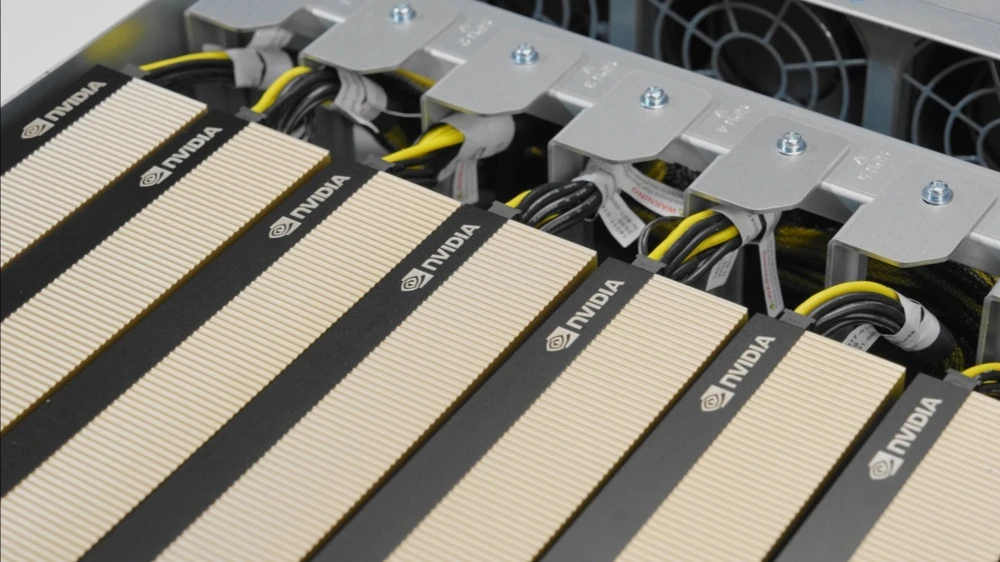
The Vera Rubin server delivers 10 times more tokens per watt of power consumption when running the DeepSeek R1 model than the previous-generation Grace Blackwell server / Photo: harhar38 / Shutterstock.com
Nvidia took a step that is rare for the company and released the results of benchmark tests comparing its new Vera server processor with AMD’s competing solution, the Epyc Turin, according to Bloomberg. The rollout of the new Vera Rubin servers is under close scrutiny by investors and analysts concerned about potential delays and manufacturing issues, the agency explains.
Vera Rubin’s presentation took place on the eve of the AMD Advancing AI conference, which kicks off Wednesday in San Francisco: At the event, AMD will unveil its first AI server rack, Helios, which competes with Nvidia’s NVL72 Rackscale platform, according to Yahoo Finance.
Nvidia shares rose nearly 2% during trading on July 21, while AMD shares jumped 8% right away amid a broad rally in semiconductor stocks.
What Nvidia Says
During its presentations on Tuesday, Nvidia took an unusual step for the company and showed direct comparisons with competitors’ solutions, according to Bloomberg. According to the company, its new server CPU, Vera, runs Python code up to 1.8 times faster than AMD’s Turin processor.
Nvidia also stated that its next-generation Vera Rubin platform delivers a significant performance boost compared to the previous-generation Nvidia Grace Blackwell system. According to the company, AI cloud operator CoreWeave achieves 10 times more tokens per watt of power consumption when running the DeepSeek R1 model on the new platform, Yahoo Finance reports. Tokens are units of information that AI models use to represent parts of words and phrases when processing queries and generating responses.
OpenAI, the developer of ChatGPT, plans to begin large-scale deployment of Vera Rubin in the third quarter, Nvidia also reported. According to the company, Vera Rubin systems are used by CoreWeave, Alphabet’s Google Cloud division, Microsoft’s Azure, Meta Platforms, Dell Technologies, and other companies.
What else do you need to know about this?
“AMD’s new processor would have performed significantly better in the comparison,” an AMD spokesperson told Bloomberg, commenting on the comparison between the Vera processor and AMD’s Turin. Later this week, the company will hold an event in San Francisco to unveil a new server platform featuring the Venice processor and to promote Helios, its first rack designed for AI-focused data centers.
For Nvidia, the server processor market is a new venture. AMD currently controls about 33% of this market, while Intel holds a 66.8% share. However, AMD continues to grow its market share and has strong partnerships with the largest cloud infrastructure providers, according to CNBC.
What Is Nvidia Worried About?
Nvidia needs to prove that its latest products are on schedule and outperform those of its competitors. During presentations at the company’s headquarters in Santa Clara, Nvidia emphasized that the new hardware will be more powerful and easier to implement, according to Bloomberg. The rollout of Vera Rubin is under close scrutiny by investors and analysts concerned about potential delays and manufacturing issues, the agency explains. Although Nvidia CEO Jensen Huang has already dismissed these concerns, some investors still believe that Nvidia could lose its competitive edge.
This year, the semiconductor sector’s benchmark index rose 70%, while Nvidia’s stock gained 11%. Meanwhile, the stock prices of Intel, Arm Holdings, and Advanced Micro Devices more than doubled.
Nvidia remains the leading supplier of AI accelerators—chips used in data centers to run artificial intelligence-based software. However, competitors, including AMD and Broadcom, are seeking to increase their market share. Data center customers, such as Amazon, are also developing their own chips, which could reduce their dependence on Nvidia.
What the Market Expects from AMD
AMD is expected to unveil its new Helios server platform at a conference on Wednesday and Thursday—the first solution of its kind for AI data centers and a direct competitor to Nvidia’s NVL72 server rack. Helios includes 72 Instinct MI455X GPUs, Epyc Venice processors, Pensando data processing processors, and the ROCm software platform, Yahoo Finance has learned.
The Nvidia NVL72 consists of 72 Blackwell or Rubin GPUs, Grace or Vera processors, the NVLink interconnect system, and the CUDA software platform. Analysts believe that AMD’s solution will likely be more expensive, but it will still find buyers due to the long waiting list for Nvidia servers.
Context
Despite the lack of excitement surrounding Nvidia’s stock this year, its sales growth is expected to accelerate, according to Bloomberg. Revenue is projected to rise 82% to $393.4 billion in the current fiscal year, compared with 65% growth a year earlier, and total revenue is expected to exceed $500 billion next year.
Most analysts tracking Nvidia and AMD stocks recommend buying shares of both companies: Nvidia has 62 out of 65 buy ratings, according to MarketWatch, while AMD has 48 out of 58. The Wall Street consensus price implies a 51% increase in Nvidia’s stock price from its July 21 closing price, while AMD’s consensus price is slightly below its last close (by 0.2%).
This article was AI-translated and verified by a human editor