"Sex, Lies, and Nvidia," Show Business on the Stock Market, "Dove" Lands at the ECB
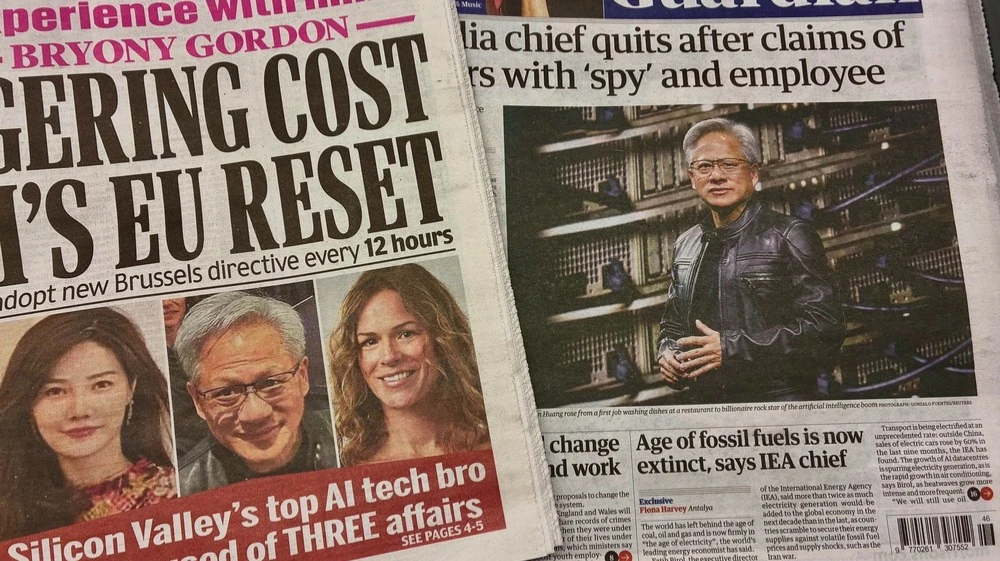
The scandal surrounding Jensen Huang suddenly put stock market reports on par with the "celebrity gossip" section. Photo: Steve Travelguide / Shutterstock
It's very tempting to call Jensen Huang's triumphant return as Nvidia's CEO the event of the week—but there's a suspicion that this development could turn out to be the event of the year, or even of a much longer period.
The company's stock initially soared by 31%, but later fell by 6%—such blatant interference by Donald Trump (the country’s president and, as it happens, a shareholder in Nvidia) in the company’s internal affairs did not sit well with either Democrats or Republicans.
The sex-and-espionage scandal surrounding Jensen Huang—which has had a happy (for now) ending—was one of those rare instances where stock market reports took center stage alongside the “celebrity gossip” section, and buying (or selling) stocks became something akin to “stocking up on popcorn.”
The plot turned out to be exceptionally cinematic (incidentally, the recent American series *Friends and Neighbors* begins precisely at the moment when a major financier is fired from his company for having sex with a subordinate). Huang’s case has been described countless times and from a wide variety of perspectives—ranging from speculation about the form of state capitalism that Donald Trump is building, by pressuring Nvidia’s board of directors to reinstate Huang, to reflections on how the culture of corporate governance itself is changing.
It’s also worth keeping an eye on how these developments will affect the rivalry between Nvidia and Anthropic— the return of the open-source model advocate is expected to make the creators of Claude a bit nervous.
Among the interesting reactions was that of the famous short seller Michael Burry,who had been activelycommenting on Huang’s downfall at ; following Huang’s unexpected return at (coincidence?), Burry changed his investment strategy—the very one that had made him famous—at . There are, however, some unquestionable beneficiaries—for example, the Nvidia call options purchased at the end of last week brought a Reddit user a 1,984% profit (the number itself seems to allude to the very totalitarian capitalism that Trump is accused of espousing).
Be that as it may, this saga is clearly far from over, and one can only speculate how many seasons lie ahead—another soap opera is unfolding within Nvidia, this time involving the head of sales. Huang himself will testify at a public hearing of the U.S. Senate Banking Committee on December 3.
It's AI's fault again
Monday’s magical story involving Huang, however, did not prevent Asian tech stocks from plummeting on Wednesday. Shares of Japan’s Advantest and Tokyo Electron lost about 13%, SoftBank Group fell 15%, South Korea’s Samsung Electronics and SK Hynix dropped more than 8%, and Taiwan’s TSMC fell 7%. South Korea’s Kospi fell 4.5%, and Japan’s Nikkei 225 dropped 1.4%. As has often been the case recently, the blame was placed on AI—doubts about its reliability and the necessity of the enormous costs associated with its implementation seem to be growing in proportion to fears for the future of humanity, fears that are themselves caused by artificial intelligence.
However, by the end of the week, Asian markets were feeling better: South Korea’s Kospi, following a recent decline, gained 0.3% on November 26; Japan’s Nikkei 225 rose 0.9%; and Hong Kong’s Hang Seng rose 1.2%. Some analysts attributed this to the positive sentiment surrounding Thanksgiving, which remained undampened even by the new U.S. tariff package.
The Benefits of Psychotherapy
Huang will address the Senate, while the newly elected (but not yet officially confirmed) president of the European Central Bank will address the European Parliament.
For the first time in the regulator’s history, the position was filled by a Spaniard—Pablo Hernández de Cos, who had previously served as governor of the Bank of Spain. Described as a moderate “dove” and a pragmatic centrist, he is the successor to Christine Lagarde, who stepped down early in February; his nomination was supported by the majority of eurozone countries.
Meanwhile, early elections will be held in Spain this Sunday—and, as in many European countries, analysts are predicting a strengthening of the right-wing electoral trend, based on the pre-election successes of the conservative People’s Party and the far-right Vox. Despite solid economic indicators in 2026 (the Spanish IBEX 35 stock index ranks among Europe’s leaders in terms of growth rates, and private investors are pouring billions into data centers and renewable energy), and expectations of 2.4% GDP growth, voters are dissatisfied with accelerating inflation, corruption scandals, and the housing crisis—not to mention that the summer migration crisis in Ceuta is still fresh in their minds.
While Huang is undergoing (at least according to his recent confessions to Nvidia employees) daily one-and-a-half-hour psychotherapy sessions (when does he even find time to run the company?), our regular correspondent and editorial therapist Mikhail Tegin has written another psychological column—take a look. This Sunday, he explains why unattainable life goals push people toward investment risk— or, to put it simply, why do we continue to invest, relying on the dubious saying, “Nothing ventured, nothing gained”?
This article was AI-translated and verified by a human editor