Truce effect: S&P 500 has its best week since November, Nasdaq out of correction zone

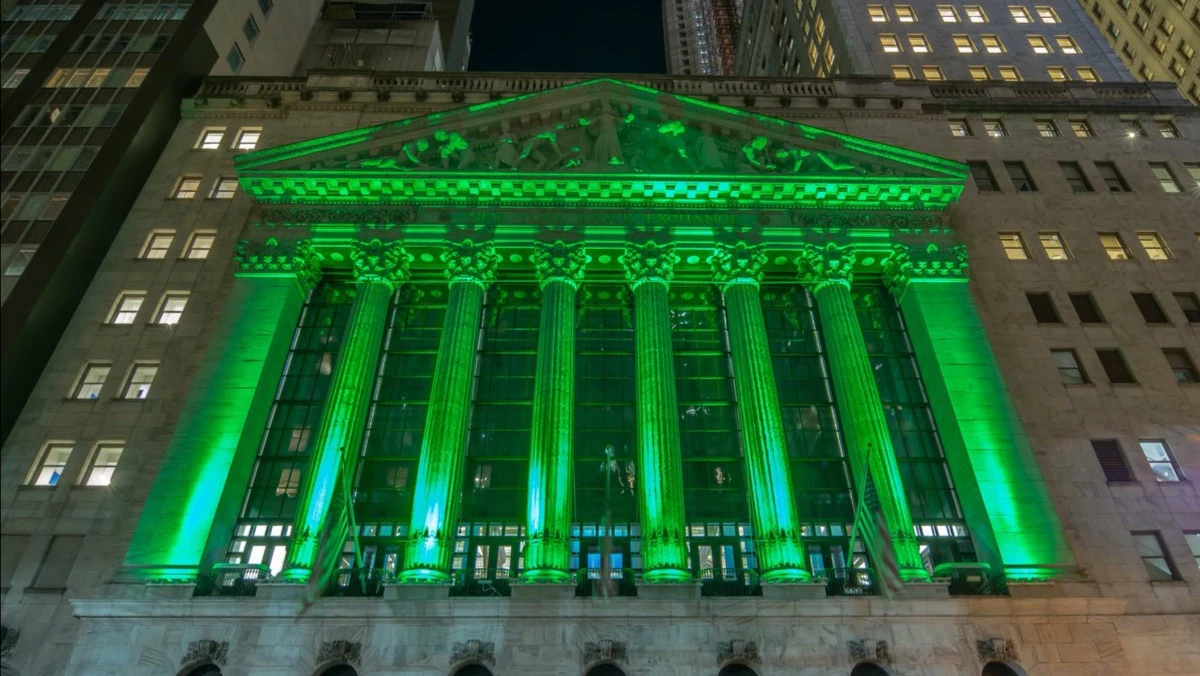
The market expects de-escalation of the conflict in the Persian Gulf / Photo: X / NYSE
The S&P 500 index declined on Friday, but at the end of the week still showed the best growth since November, as well as the Nasdaq Composite. Traders rejoiced at the truce between the U.S., Israel and Iran, but are still cautious about its prospects. For instance, it was supposed to, but never did, unblock shipping in the Strait of Hormuz. Oil futures were cheaper, but real commodity prices in Europe were at record levels. In the US, important macro data was released on Friday: the Consumer Price Index report for March showed that inflation was in line with expectations, however, the war still led to increased inflationary concerns of consumers.
Details
- The broad market index S&P 500 declined by 0.11% on April 10 and closed at 6816.89 points. At the end of the week, the index rose more than 3%, which was the best result since November.
- The Nasdaq Composite Technology Sector Index rose 0.35% to 22,902.9 points on Friday. At the end of the week, it added more than 4% - this is also the best weekly result since November, writes CNBC. The index has officially exited the correction zone - that's what they call a drop of more than 10% from the recent peak.
- The blue-chip index Dow Jones Industrial Average fell 0.56% to 47,916.57 points. Since the beginning of the week it has grown by 3%.
- The CBOE Volatility Index (VIX), which is called the "Wall Street fear index", closed trading at 19.3 points. The psychologically important mark indicating high volatility is considered to be 20.
- Brent crude futures were down 1.5% to $94.5 a barrel and WTI crude futures were down 2% to $95.9 a barrel.
What influenced the market
Oil prices sharply accelerated their decline as stock markets closed in the US. Brent oil, which during the day at moments exceeded $98 per barrel, was below $95. The occasion may have been the announcement by the Lebanese President's office that talks have been agreed with Israel to discuss a US-brokered ceasefire. In addition, Iran's semi-official Tasnim news agency reported the arrival of a delegation from Tehran to Islamabad, Pakistan, for talks with a U.S. delegation led by Vice President J.D. Vance, Bloomberg reported. Iran insists that the talks will only take place if its preliminary demands are met, the agency added. Ending Israeli attacks on Lebanon was one of the reasons Tehran accused the U.S. of violating the truce.
US President Donald Trump on Friday accused Iran of "short-term extortion of the world through the use of international waterways," hinting at closing the Strait of Hormuz. Trump wrote on the social media network Truth Social, Iranian leaders "don't seem to realize that they have no trump cards" and that "the only reason they are alive today is to negotiate!" Trump's post came after the US president said Iran should not charge oil tankers passing through the Strait of Hormuz.
Meanwhile, North Sea physical crude prices - a measure of the real rather than futures value of crude - rose to a record high amid Iran's continued control of the Strait of Hormuz. Forties Blend, a benchmark for immediate-shipment crude, rose to nearly $147 a barrel on Thursday, April 9, surpassing record levels before the 2008 financial crisis, LSEG data showed.
Inflation was also the focus of investors' attention this week, with a number of important reports released over two days amid concerns that rising energy prices caused by the conflict in the Middle East will spread throughout the US economy. The Consumer Price Index for March on Friday showed that inflation in the first month of the war matched expectations and amounted to 0.9% in monthly and 3.3% in annual terms. At the same time, it was the highest result in three years. Included in these figures was a 10.9% jump in energy costs due to the conflict. However, if energy prices are excluded, inflation remained moderate in March, with core CPI rising just 0.2% month-over-month and 2.6% from the same period a year ago, below expectations. Before the war with Iran, which has been going on for almost six weeks now, inflation had been stubbornly stuck at 3%.
Nevertheless, the war did increase inflationary concerns. According to a University of Michigan survey released Friday, consumers expect inflation to accelerate to 4.8 percent in the coming year. That's up a full percentage point from the March figure.
Just as the market eased fears over the escalating conflict in the Middle East, fears of a "software apocalypse" returned to investors due to a new model by AI startup Anthropic. It hasn't been publicly unveiled yet, but Anthropic claims it could potentially threaten the cybersecurity of large companies. This led to a drop in shares of cybersecurity solution providers, with Palo Alto Networks falling 6.7% on Friday and the iShares Expanded Tech-Software Sector ETF, which tracks stocks of software developers, down 2.6%.
What the analysts are saying
- "In the short term, the focus will continue to be on what's going on in Iran," Louis Navellier, founder and chief investment officer of Navellier & Associates, told Bloomberg. - If the situation escalates again and missiles fly again, we will certainly see the market decline again and volatility rise."
- "There are no signs yet that high energy prices are starting to trickle down into core inflation," Bloomberg quoted Brian Jacobsen, chief economist at Annex Wealth Management, as saying. - That may be a process that will unfold over time as companies, at least initially, take the brunt of the hit."
- Given the global situation and strong corporate earnings growth, some investors may view the inflation data as acceptable and expect energy price pressures to ease, David Russell, senior global market strategist at TradeStation, said in a conversation with Bloomberg. "But resolution of the crisis over the Strait of Hormuz will be key to the improvement," he added.
- "The Fed will do its best not to place too much weight on the macro data it gets for March and April," Orion Chief Investment Officer Tim Holland told CNBC. That's possible, he said, provided "there is a path to de-escalation between the U.S., Israel and Iran." Holland believes the war with Iran will eventually subside and oil prices will correct following that. But he cautioned that investors should worry more about the inflationary implications if WTI crude is still trading around $100 a barrel by early or mid-June. "You get a potentially toxic cocktail of already depressed consumer sentiment and a real upward reassessment of inflation expectations," he said. - It would be a dire situation for the economy, and the Fed would be in a very difficult position."
This article was AI-translated and verified by a human editor