WHO reports hantavirus and a dangerous Ebola outbreak. Will this set off a new vaccine race?
Only a few companies have a chance of winning it

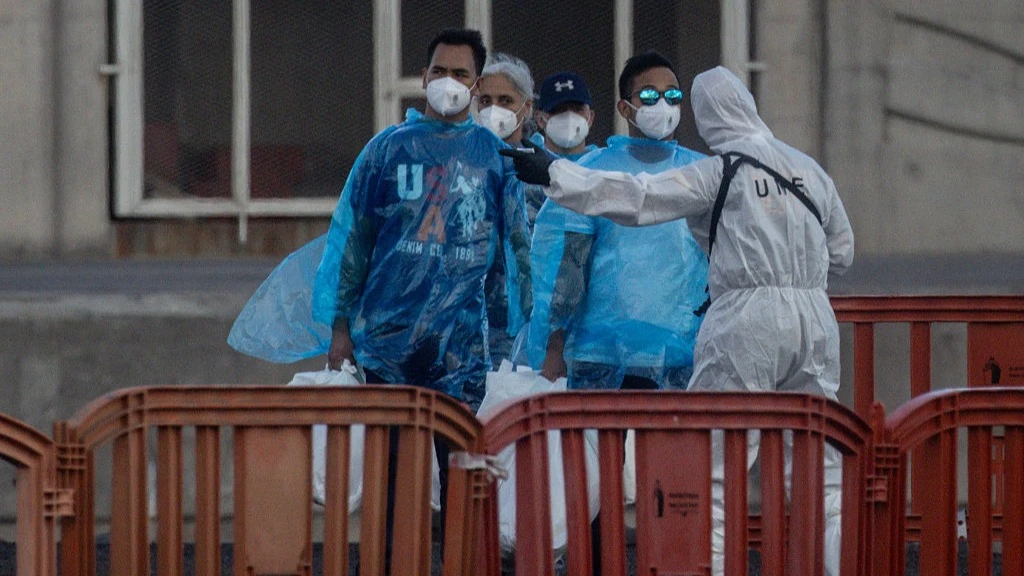
An outbreak of a dangerous hantavirus infection occurred on the cruise liner MV Hondius. Passengers were evacuated and the liner arrived at the port of Rotterdam on May 18. Photo: Chris McGrath/Getty Images
In May, the whole world was tensely following the fate of the passengers of the cruise liner Hondius, on which an outbreak of the deadly hantavirus broke out. The virus has been known for more than 30 years, but there is no cure or vaccine for it. And this week, the WHO declared an international emergency because of the Ebola outbreak in Africa. Which companies could be affected by the epidemic threat?
Death at sea
On April 1, the MV Hondius, a Dutch cruise ship of Oceanwide Expeditions with about 150 passengers and crew members from two dozen countries, left Ushuaia, Argentina, bound for the island nation of Cape Verde. Five days later, one of the passengers fell ill, and another five days later, he died on board.
What happened next was a classic epidemic thriller. The body was taken off the ship on the island of St. Helena on April 24. Several dozen passengers and the wife of the deceased also got off there. She had left St. Helena on a commercial flight to South Africa, and collapsed right at the airport while trying to board a flight home to Holland. The woman died two days later in a Johannesburg hospital. A third passenger, a German national, fell ill on April 28 and died May 2 aboard the same ship, AP reported.
It was not until Ma 2, a month after the first case, that South African authorities tested positive for Andes hantavirus in one of the ship's patients. There is no licensed vaccine or specific treatment against this strain.
Initial symptoms usually include fever, headache, muscle aches, abdominal pain, nausea or vomiting. The disease can progress rapidly, causing coughing, shortness of breath, fluid accumulation in the lungs, and shock. The incubation period is up to 42 days. Lethality can be as high as 50%; by comparison, COVID-19 gave a mortality rate of up to 3% at its peak.
On Ma. 4, WHO reported seven hantavirus cases aboard the ship - two confirmed and five suspected - as well as three deaths.
Cape Verde refused to accept the MV Hondius and it headed for the Canary Islands. Despite the objections of local authorities, Spain agreed to accept the ship, and it anchored off Tenerife, the passengers began to be evacuated by special flights. On Ma. 10, Great Britain landed parachute medics on the remote island of Tristan da Cunha to help one of the liner's passengers who had gone ashore there.
Two days later, 12 staff members at the Dutch Radboudumc hospital went into quarantine because urine and blood from a patient with hantavirus were handled without following proper safety protocols, Reuters wrote.
The Hondius itself arrived in the port of Rotterdam on May 18.
The most recent WHO report, dated Ma. 13, related to the hantavirus outbreak on the airliner, says 11 cases (eight confirmed) and three deaths.
At the moment there are no signs of a larger outbreak beginning, but of course this could change, and given the long incubation period of the virus, we may see more cases in the coming weeks.

A virological detective
The number of people who have fallen ill and died from hantavirus infection is still relatively small - for comparison, the same COVID-19 killed 517 people last month, according to the WHO. What's all the fuss about then?
The Kepler Cheuvreux report (available from Oninvest) cites one reason for the global upheaval: "There have been several outbreaks of Andes with high mortality over the past decade, but they have received almost no global media attention. The only difference now is that Europeans and Americans have been affected, which probably says more about the Euro-American centricity of the markets than about the significance of the event itself."
Hantaviruses are widespread throughout the world, with 10,000 to 100,000 people becoming ill each year, mainly in Asia. The carriers of the disease are rodents: humans can be infected by contact with urine, feces or saliva of sick animals, and rarely by a bite.
However, the South American Andes-type hantavirus is the only one of its fifty species that can be transmitted from person to person. In addition, it is characterized by increased lethality - up to 50% of those who fall ill die, compared to 1-15% of those who fall ill with other strains of this virus in Asia and Europe.
A separate intrigue is where the Dutch couple who apparently started the outbreak aboard MV Hondius contracted the virus.
One version - at a dump on the outskirts of Ushuaia, where tourists often come to watch birds and where waste attracts rats and mice. However, the authorities of the Argentine province of Tierra del Fuego strongly reject this version, writes BBC. You bet, Ushuaia is critically dependent on tourism, and the city does not need such a "fame".
The couple had been in Argentina since Nov. 27, 2025, making numerous trips by car, including to Chile and Uruguay, before boarding a ship in the port of Ushuaia on April 1. The investigation is ongoing.
If the dangerous virus has long been known, why is there still no cure?
A glow that went out
Maria Ines Barria, now a researcher at the University of San Sebastian in Puerto Montt, Chile, grew up in a neighborhood where people were infrequently but severely ill with hantavirus infection.
In 2014, she assembled an international consortium that included experts from the University of Concepción (Chile), Rocky Mountain Laboratories (NIH, USA), Germany's Robert Koch Institute and New York-based Ichor Biologics.
They took the blood of hantavirus survivors and isolated antibodies that neutralize Andes hantavirus. The "Eureka!" moment came when Barria saw in the microscope how the antibodies extinguished the green fluorescent glow that had marked the virus, she told Bloomberg. That happened 10 years ago.
After successful animal trials, in 2021 the new drug was granted the status of an orphan drug by the US regulator FDA, which is an accelerated track for registering therapies for rare diseases. It remained to invest about $7 million in human clinical trials, but these funds could not be found.
The key factor hindering progress is funding and resources. We have achieved significant results, but we have reached a stage that is much more expensive and requires a completely different level of investment, as well as specific infrastructure, which we do not have at the moment.

The search for a cure for hantavirus is particularly urgent in Chile, where, as Bloomberg wrote on Ma. 13, citing the country's health ministry, 39 cases, including 13 deaths, have already been reported in 2026. In southern Argentina, 42 cases of infection have already been diagnosed since the beginning of the year through Ma. 7, according to government data.
While the world was watching MV Hondius, on May 17, WHO declared an international emergency, one of the highest threat levels - only a pandemic is higher. This was due to the outbreak of Ebola (Bundibugio strain) in Congo and Uganda - already 81 dead there. By the way, there is no cure for this strain of Ebola either. The reason is the same - the disease is rare and localized mainly in Africa, so it is of little interest to international pharmaceutical companies, and governments are cutting funding.
In mid-M Ma, the Global Preparedness Monitoring Board (GPMB) - a group of experts set up by the World Bank and WHO after the first major Ebola outbreak, just before COVID-19 - published a report entitled "A World on the Brink: Priorities for a Pandemic Resilient Future". In their assessment, infectious disease outbreaks are becoming more frequent and more devastating. They cited climate change, armed conflict and geopolitical fragmentation among the causes.
Who can create a vaccine faster
The COVID-19 pandemic has become a gold mine for pharmaceutical companies - according to Reuters estimates, thanks to vaccines and other means of antiviral therapy they earned billions of dollars in 2022. The leaders (Pfizer and Moderna) - more than $75 billion. Thanks to vaccines from COVID-19, various estimates prevented from 2.5 million to 14 million deaths.
This time around, Moderna's stock has jumped nearly 20% in four days since May 4 - after WHO reported the hantavirus on the airliner.
Evercore ISI analyst Corey Kasimov wrote in a Ma. 7 report (available from Oninvest) that he does not see, in terms of the current news agenda, a "meaningful earnings opportunity" for the pharma market: hantavirus remains a rare disease with a limited market, so possible sharp swings in company stocks are more likely to reflect market sentiment than a change in fundamentals.
But in the same report, he notes Moderna and the flexibility of its mRNA platform to create vaccines and drugs - "a quality that has already become evident since the COVID-19 pandemic."
Hantavirus, for now at least, does not have the potential to cause a pandemic, first of all because it is not very contagious - transmission requires prolonged close contact between people (that's why the ideal conditions arose on a cruise ship). And secondly, it does not have a period of "asymptomatic carrier", which was with coronavirus - when a person is already infectious, but he himself feels nothing or almost nothing, so he goes to public places and travels, spreading the disease, reassures Newsweek.
If we are unlucky and the hantavirus mutates into a more infectious form, perhaps it is Moderna that is in the best position to quickly create a vaccine.
The company has already confirmed preclinical studies of the hantavirus mRNA vaccine with the U.S. Army Medical Research Institute for Infectious Diseases (USAMRIID) and Korea University Medical College (VIC-K), CNBC reported on May 11, citing a statement from the pharma company.
True, as Morgan Stanley (available from Oninvest) wrote in its May 12 report, this collaborative program "remains preclinical, and a finished vaccine is not expected in the near future."
Small biotech Traws Pharma is working on a therapy against an Asian variant of hantavirus.
As for Ebola, Noble Capital Markets analysts look to GeoVax, which is "one of the few" developing vaccines against monkeypox, Ebola and other infectious diseases, according to the report.
All in all, not much for the whole world. The question is not whether there will be another pandemic, but whether we will be ready for it.
This article was AI-translated and verified by a human editor