Worse Than the Dot-Com Crash: How the Burst AI Bubble Threatens the U.S. Economy

Over the past two years, the U.S. economy has become heavily dependent on spending on AI. Photo: Matt Fowler KC/Shutterstock
Over the past two years, the U.S. economy has become heavily dependent on spending on AI: according to Barclays, such spending accounted for 25% of U.S. economic growth over the past year, The Wall Street Journal (WSJ) reports. Trillion-dollar swings in the stock market, rising borrowing for data centers, and calls to limit their construction are raising concerns that this engine of growth could falter. Many economists and business leaders believe that even without a collapse, a significant reduction in AI investment could deal a severe blow to the economy. But there is debate over the scale of the consequences for the industry: some fear a recession worse than the one that followed the dot-com crash, while others are more optimistic. The WSJ identifies three main threats through which a downturn in the AI sector could impact the economy.
The Wealth Effect
Since the beginning of 2025, U.S. stocks have risen by about 20%, largely thanks to AI: stocks in this sector have outperformed the market again this year (the S&P 500 has risen 5% since the start of 2026), and they account for nearly half of the broad U.S. stock index. “This is a strong boost for the economy,” said Jonathan Millar, senior U.S. economist at Barclays.
Market growth has been supported by consumer spending—the main driver of the U.S. economy: as households become wealthier, they spend more. In the third quarter, spending rose 3.8% year-over-year and helped push GDP growth to 3.4%, notes the WSJ. The last time a stock market crash led to a recession in the U.S. was during the dot-com crash in the early 2000s. But that downturn proved to be relatively short-lived, partly because unemployment rose less than in other recessions.
A downturn in AI—for example, due to disappointing profits from chatbots or overbuilding of data centers—could prove to be more painful: the share of stocks in U.S. households’ net worth has risen to 35%, up from 26% at the peak of the dot-com bubble. According to Federal Reserve (Fed) data for the second quarter, more than half of all stocks and mutual fund shares held by individuals belong to the top 1% of Americans, and it is precisely this group that has recently been driving consumption growth. Risky strategies such as margin trading are also widespread. If the markets crash, millions of Americans will likely start saving, which, in theory, would slow the economy, the WSJ writes.
Data Center Expenses
Spending on data center construction and other AI investments this year will account for a much larger share of GDP than investments in Internet infrastructure at the turn of the 1990s and 2000s, and will continue to grow in the coming years, the WSJ notes. The boom is creating jobs in construction and at supplier manufacturers: Caterpillar (generators), GE Vernova (turbines), and Eaton (electrical equipment) are reporting sharp revenue growth thanks to demand from data centers.
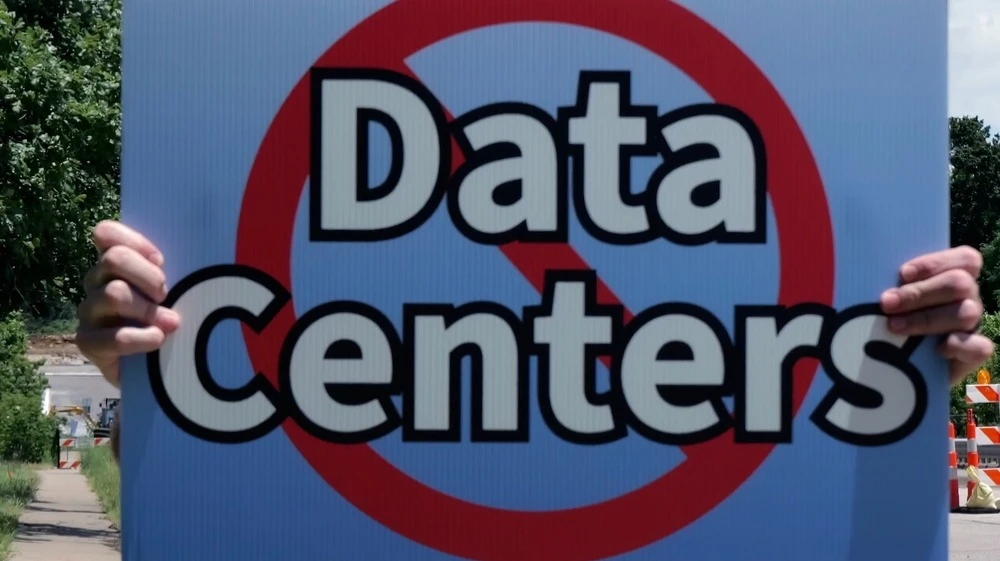
However, many Democrats were elected to Congress in the November elections, in part thanks to promises to limit the construction of data centers. If they keep their word, or if investors lose faith in future AI profits and the largest cloud companies sharply cut back on construction, the U.S. economy will lose a key driver, the WSJ writes. However, the blow may be less severe than many fear. Most of the spending goes toward imported chips, which contribute little to U.S. GDP. With that in mind, according to an estimate by Millar of Barclays, data center construction has added about 0.5 percentage points to GDP growth over the past year. A complete halt to this activity could trigger a recession in Taiwan, the largest chip manufacturer, but not necessarily in the U.S.
Credit Risks
The severity of the downturn may depend on the financial sector. The mortgage crisis of the 2000s escalated into the worst recession in 70 years precisely because the problems spread to financial institutions, causing them to stop lending to the economy. Some economists are already comparing the growth in AI-related loans to the mortgage boom of the mid-2000s. As was the case then, the risks are difficult to track, writes the WSJ: many loans do not appear on balance sheets; they are issued by nonbank lenders such as private equity firms, which are subject to less stringent reporting requirements. Chip manufacturers are investing in their own customers, and cross-guarantees make it difficult to determine who will bear the brunt if a borrower defaults.
“We don’t understand all the interconnections,” notes Jeremy Stein, an economist at Harvard University and former member of the Federal Reserve Board of Governors. He considers a crisis on the scale of 2008 unlikely, but admits the possibility of a scenario in which the economy would suffer a harder blow than it did after the dot-com bubble. “I’d bet that the economic consequences will be more severe,” he said.
While profitable hyperscalers like Amazon and Microsoft mostly fund their data centers with their own capital, a collapse today would result in only about $50 billion in losses on data center loans—a drop in the bucket for the U.S. financial sector, according to calculations by Stein van Nieuwenburg, an economist at Columbia Business School. However, the share of borrowed funds is growing, and if borrowing continues to rise as expected, a similar collapse in a couple of years could result in $2 trillion in loan losses, not counting stock market declines.
The Impact of the Downturn in the AI Sector
Harvard University economist Jason Furman has calculated that even a 30% drop in stock prices, combined with a complete halt in data center construction, would not be enough to trigger a recession: a significant portion of data center equipment is imported, so their contribution to GDP growth is smaller than is commonly believed. The worst-case scenario, in his view, would be a downturn similar to the dot-com crash. Other economists consider such an outcome to be the best-case scenario. Van Nieuwenburg fears a more severe crisis when the AI boom ends, though he does not believe a crash is imminent.
At the same time, Washington will have fewer options to cushion the blow as it did in the past: After many years of budget deficits, U.S. public debt held by investors has exceeded 100% of GDP, whereas on the eve of the 2008 crisis it stood at just 35%, the WSJ explains. Furthermore, investor concerns about the national debt could keep Treasury yields high even during a recession, making it harder for the Fed to support the economy with low interest rates. “This scenario is certainly worth considering,” says Stein.
This article was AI-translated and verified by a human editor